

Quebec’s Charlevoix rich with history
Peaceful pastoral region has been a major summer draw for more than a century
Advertisement
Read this article for free:
or
Already have an account? Log in here »
To continue reading, please subscribe:

Digital Subscription
One year of digital access for only $205*
- Enjoy unlimited reading on winnipegfreepress.com
- Read the E-Edition, our digital replica newspaper
- Access News Break, our award-winning app
- Play interactive puzzles
*First annual payment billed as $205.00 + GST for one year. This annual subscription will automatically renew at $233.00 + GST every 52 weeks (10% off the regular annual price of $259.35). Offer available to new and qualified returning subscribers only. Cancel any time.
To continue reading, please subscribe:
Add Free Press access to your Brandon Sun subscription for only an additional
$1 for the first 4 weeks*
- Enjoy unlimited reading on winnipegfreepress.com
- Read the E-Edition, our digital replica newspaper
- Access News Break, our award-winning app
- Play interactive puzzles
*Your next Brandon Sun subscription payment will increase by $1.00 and you will be charged $17.95 plus GST for four weeks. After four weeks, your payment will increase to $24.95 plus GST every four weeks.
Read unlimited articles for free today:
or
Already have an account? Log in here »
Hey there, time traveller!
This article was published 26/10/2019 (2540 days ago), so information in it may no longer be current.
The idea of visiting an authentic “speakeasy” in the most unlikely of places — the quiet, pastoral setting of Charlevoix — was too intriguing to pass up, and an easy trip to make given its proximity to Quebec City, just a 90-minute drive away.
This northeastern region of Quebec has a long history as a tourist destination, beginning in the 1880s to the 1930s, when resorts and summer homes first began popping up along the shoreline of the St. Lawrence River.
The Vanderbilts and the Kennedys have visited, but Charlevoix’s most famous summer visitor was former U.S. president William Howard Taft, who came in 1892 by steamboat and later bought his own summer house in Murray Bay. He returned regularly with his family, even becoming president of the Murray Bay Golf Club — a role he was said to have enjoyed more than being president of the United States.

Rumour also has it Taft visited the Bootlegger’s House (La Maison du Bootlegger), which has been part of the region’s history, albeit a clandestine one, sincce 1930. While Taft’s home is long gone, the same cannot be said of this forbidden clubhouse. Its doors swing open every summer and early fall.
Tucked into the woods, the Victorian-style house, first built in 1860, appears just like any other old home with one exception. A maze exists within its walls, designed to thwart authorities and disguise the home’s secret purpose — providing booze and good times during the Prohibition era.
Hidden doors and secret passages down narrow corridors lead to intimate interior spaces where liquor bottles were once hidden and morality squads outmanoeuvred.
When it’s time for lunch, I’m told we are heading down to the basement to the steakhouse, where Club des Monts once reigned supreme.
But the narrow, curving staircase we descend abruptly changes direction, and we are climbing upwards instead to another hidden room tucked under the roofline. Space has been added to the attic to allow a smoker for cooking meat and tavern-like seating.
The original wooden tables and chairs are still in use, with signatures from long ago scratched onto the tabletops. Our server explains this was a precaution: all patrons were required to carve their names as proof they were there, so anyone who spilled the secret club’s location would also be exposed as complicit.
Today, food and booze, for less exorbitant prices, are available, along with a house tour daily in the summer months and on weekends during June, September and October. Besides serving lunch, the Bootlegger’s House offers dinner and a live rock ’n’ roll show in the evenings. The latter seems appropriate given the kitschy decor that inhabits every nook and cranny in the restaurant, from Halloween masks and London bobby caps to Betty Boop figurines and Elvis Presley memorabilia. (The King of Rock ’n’ Roll visited once, leaving his signature on one of the walls.)
Our next stop is a tour of some summer holiday homes, arranged by the Charlevoix Museum.
The lucky homeowners we meet have hosted fundraisers on their properties in the past to benefit the small but well-curated museum.
Owners John and Judy Bross of Chicago proudly show us around their 1938 Norman chateau-style cottage, with its panoramic view of the St. Lawrence. The house has been decorated in a laid-back French style, with traditional Québécois touches as well. This region is known for its folk art and the couple have works by local artisans, like rustic furniture and colourful needlepoint rugs depicting quaint rural scenes, scattered throughout.
What is surprising is how very little has been changed in the homes since they were first built. In the case of the Bross home, the kitchen’s original sink, cabinetry and old fridge, circa 1940, are still being used.
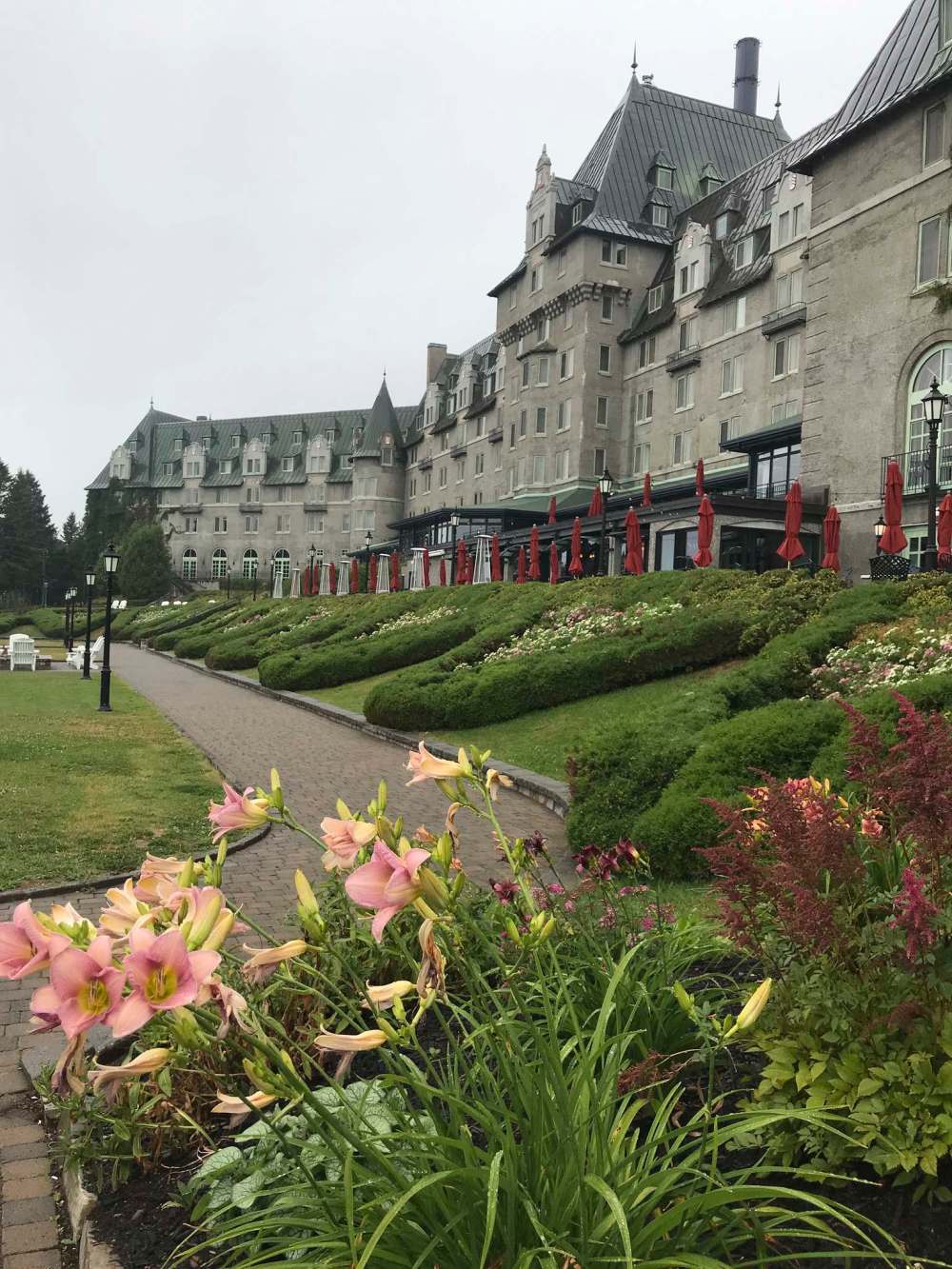
Unless you are fortunate to time your visit with a Charlevoix Museum fundraiser to peek into the private world of summer houses and gardens, you can still step back in time by visiting the historic Le Manoir Richelieu. This grand castle-like hotel, run by Fairmont Hotels and Resorts, is also located in the village of La Malbaie and exemplifies summer living in the region.
The first Le Manoir Richelieu, a large wooden structure clad in shingles, was built in 1899 on its clifftop setting overlooking the St. Lawrence. But after the original building burned down in September 1928, this 250-room grand hotel — which once hosted the king of Siam, Charlie Chaplin and Jean Harlow, to name a few of its distinguished guests — was quickly rebuilt in time for the 1929 summer season.
The hotel today has 405 rooms, four restaurants, a pool, spa, golf course and casino.
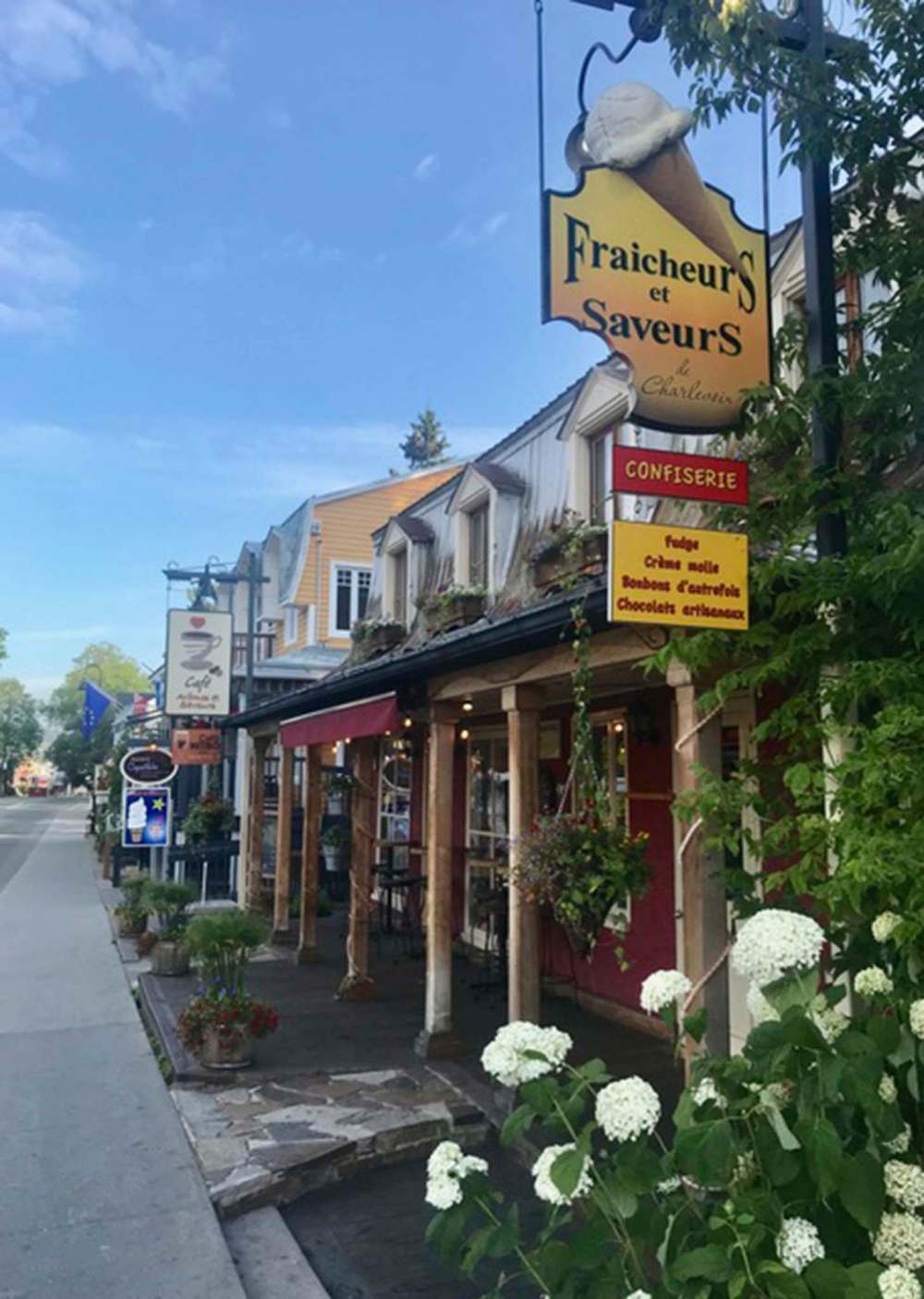
Another charming village in the Charlevoix region is nearby at Baie-Saint-Paul, first settled around 1650. Here, visitors will see typical French-style Quebec architecture, with steep roofs and symmetrical dormer windows reminiscent of 17th- and 18th-century houses in Normandy, France.

Many of these centuries-old homes have been converted to boutiques, art galleries and restaurants in a village appropriately nicknamed “the artist’s paradise,” since the town has a wealth of art galleries.
If you are planning to stay overnight, an ideal accommodation, set in the heart of downtown, is La Maison Otis, yet another heritage building that has been updated for maximum comfort.
And if you prefer modern, another good choice, within walking distance to downtown and directly outside the train station, is the Le Germain Charlevoix Hotel & Spa.
Although contemporary in design, the many outbuildings have been designed to replicate the farm that once stood in this valley, nestled between the Laurentian Mountains and the river.
The dramatic landscape in Charlevoix is breathtaking and one of the main reasons it’s a year-round destination for approximately one million visitors annually.
The region has two national parks — Grands-Jardins and Hautes-Gorges-de-la-Rivière-Malbaie — within its borders, as well as being a World Biosphere Reserve, with a 54-kilometre-wide crater that was formed by a meteorite about 350 million years ago.
Summer and fall are the best seasons to visit if you plan to drive Charlevoix’s Flavour Trail, as more than 40 farms, mills and breweries are open for tastings and tours. (My favourite was trying the many delicious artisanal cheeses this region enjoys.)
If you are travelling between June and October, be sure to step aboard the Train de Charlevoix, which travels 125 km between Quebec City and La Malbaie, revealing otherwise-inaccessible terrain along the St. Lawrence. You can also travel partway, as the train stops in seven towns and coastal villages.
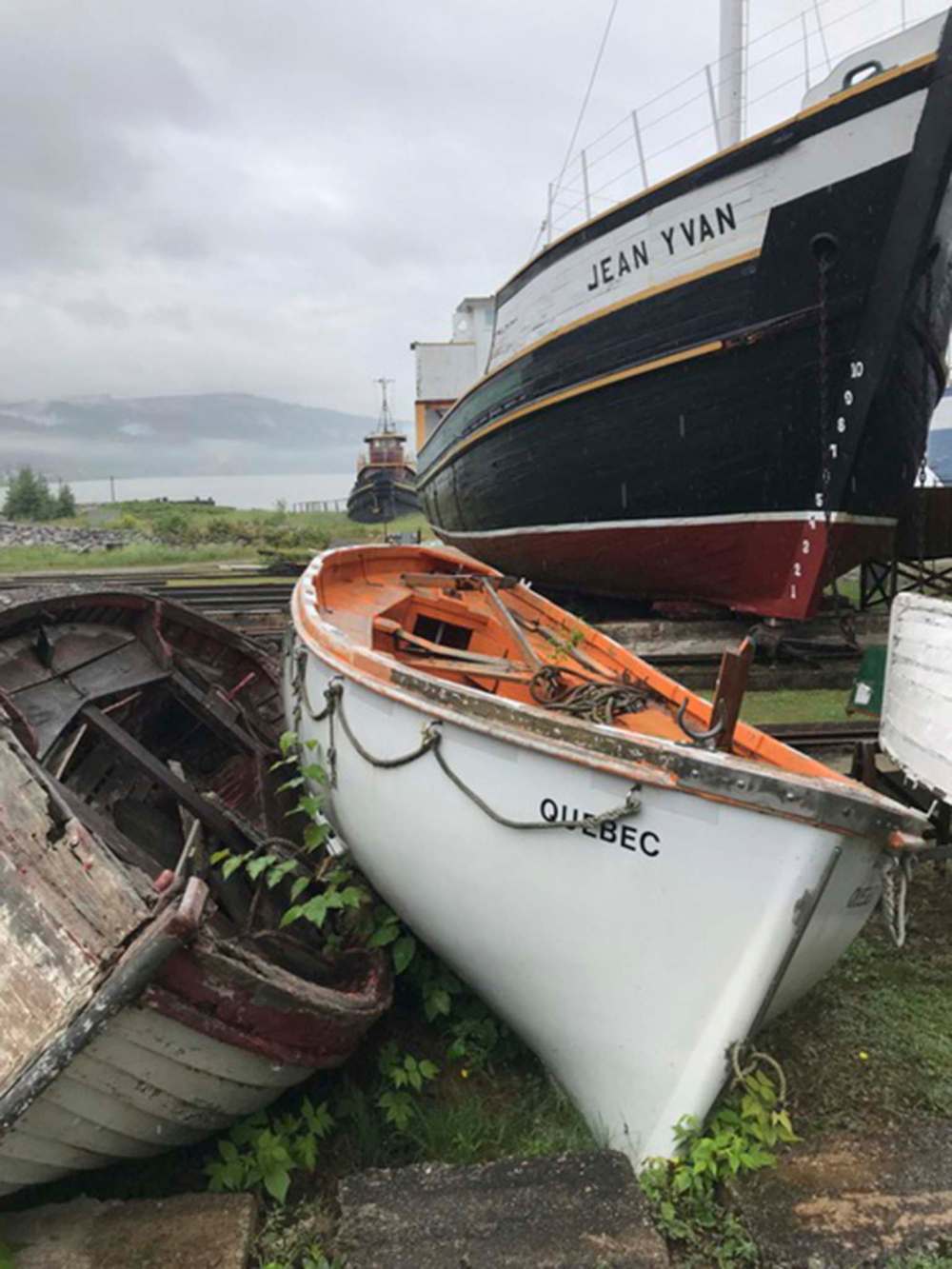
A stop you should check out to appreciate local customs is Charlevoix’s Maritime Museum, located on the grounds of a former shipyard. There, you can view the well-built, wooden schooners that once plied the river during early trading days.
If you are lucky, you might even see a whale from shore. Your best chance for whale watching is in the spring, since beluga, humpback and minke whales migrate from the Gulf of St. Lawrence. The Saint Lawrence estuary is known worldwide as one of the best spots to observe marine mammals.

Finally, for outdoor enthusiasts, Charlevoix is an ideal place to experience a Quebec winter as the region has many exceptional ski and snowboarding areas. There are also snowmobiling and dog-sledding tours available.
kpemberton@shaw.ca
History
Updated on Saturday, October 26, 2019 1:30 PM CDT: Corrects photo caption.