

Study: Lake Winnipeg has undergone extensive changes
Advertisement
Read this article for free:
or
Already have an account? Log in here »
To continue reading, please subscribe:
Monthly Digital Subscription
$1 per week for 24 weeks*
- Enjoy unlimited reading on winnipegfreepress.com
- Read the E-Edition, our digital replica newspaper
- Access News Break, our award-winning app
- Play interactive puzzles
*Billed as $4.00 plus GST every four weeks. After 24 weeks, price increases to the regular rate of $19.95 plus GST every four weeks. Offer available to new and qualified returning subscribers only. Cancel any time.
Monthly Digital Subscription
$4.99/week*
- Enjoy unlimited reading on winnipegfreepress.com
- Read the E-Edition, our digital replica newspaper
- Access News Break, our award-winning app
- Play interactive puzzles
*Billed as $19.95 plus GST every four weeks. Cancel any time.
To continue reading, please subscribe:
Add Free Press access to your Brandon Sun subscription for only an additional
$1 for the first 4 weeks*
*Your next subscription payment will increase by $1.00 and you will be charged $16.99 plus GST for four weeks. After four weeks, your payment will increase to $23.99 plus GST every four weeks.
Read unlimited articles for free today:
or
Already have an account? Log in here »
Hey there, time traveller!
This article was published 20/02/2021 (1899 days ago), so information in it may no longer be current.
A RECENT STUDY has raised more alarm bells about Lake Winnipeg.
The study was conducted by Freshwater Institute, Fisheries and Oceans Canada, Winnipeg and the Great Lakes Laboratory for Fisheries and Aquatic Sciences, Fisheries and Oceans Canada.
Since 2002, pelagic forage fish (baitfish) species and early life stages of large-bodied fish species in the pelagic zone in Lake Winnipeg have been monitored. To achieve the objective to study temporal and spatial variations in the offshore fish community in Lake Winnipeg, pelagic fish trawls were conducted during spring, summer, and fall from 2002 to 2019 using the M.V. Namao (operated by the Lake Winnipeg Research Consortium).
Here are some of the findings.
Lake Winnipeg has undergone extensive changes in environmental conditions and fish community structure during recent decades. The presence of cyanobacteria and invasive species as well as eutrophication, flow regulation, fishing pressure, and climate change all have potential impacts on the native fish community. Emerald shiner was the most dominant prey fish species, but has decreased in the catches since the early 2000s, while rainbow smelt have almost entirely disappeared from the catches in recent years.
Overall, scientists observed a decrease in four of the six most-caught pelagic species.
This research indicates that forage fish populations in the lake have dropped over 50 per cent since 2002.
There has also been considerable scientific interest to find out whether the freshwater drum of Lake Winnipeg have been consuming zebra mussels. In 2019 the biologists from the Freshwater Fish Institute and the University of Winnipeg examined the stomach contents of drum from different parts of the lake. The overall conclusion was that freshwater drum from Lake Winnipeg feed predominantly on insect larvae, not zebra mussels. This is not the case everywhere though. In Lake Erie, for example, zebra mussels are a big part of their diet.
One interesting fact that came out of the study was size of the fish and the age of the fish. The smallest 2019 fish (age two) was 187 mm and 76 g, and the largest (age 57) was 555 mm and 2800 g. It would be interesting to know how old a huge drum from Lake Manitoba would be? The all-time Manitoba record was caught in 2012 on the Whitemud River. It measured 914.40 millimetres, or 36 inches. That fish is almost double the size of the 57-year-old drum. Yikes!
Speaking of Lake Winnipeg, one question that I often get asked is: can you catch walleye at night on the big lake. The answer, yes you can. With the introduction of zebra mussels, anglers who fish the lake on a regular basis are amazed by the improved water quality. This is a direct result of the introduction of zebra mussels and their ability to filter algae.
That is a key component if you want to have success in low light. Fish can use their lateral line and sense of smell to find food in turbid water, but if you give clarity, they will change their feeding habits to maximize any advantage they might have.
For walleye, low light conditions give these aggressive predators an advantage over almost all fish species. The large cones and receptors in their eyes allow excellent low-light vision. With a reduction in forage over the last number of years as mentioned earlier in this column, walleye use this to their advantage.
With the extreme cold in the province over the last couple of weeks, the ice fishing effort has dropped off considerably. Anglers who managed to set up permanent shacks before the cold hit, have been able to fish in heated comfort. In fact, more and more are spending the money on large portable ones, like the Ice Castle and Yeti, just to name two of the largest manufactures. These units supply all the comforts of home, including a kitchen, bathroom and television.
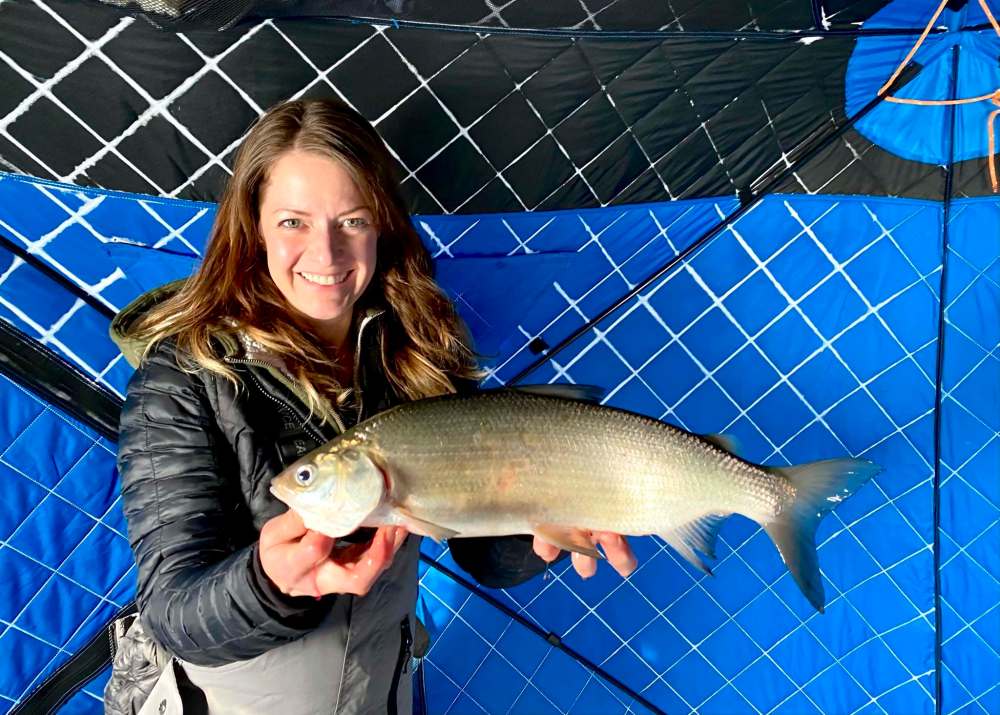
For those who have been able to get out, the cold-water species like lake whitefish, lake trout and cisco have been providing some good angling opportunities. Friend Robyn Grant and her partner Robert Karpiak spent last weekend at Big Whiteshell Lake. They were rewarded with several master-angler fish.
Clear Lake whitefish are still biting with a few big pike thrown in the mix. Crappie fishing has slowed in the Whiteshell, but a few fish are still being caught.
dlamont46@gmail.com