

Giving the Gobi a go
Prior to steering a Red River cart, Manitoba family trekked across the taiga and experienced Mongolia’s desert region
Advertisement
Read this article for free:
or
Already have an account? Log in here »
To continue reading, please subscribe:
Digital Subscription
One year of digital access for only $1.44 a week*
- Enjoy unlimited reading on winnipegfreepress.com
- Read the E-Edition, our digital replica newspaper
- Access News Break, our award-winning app
- Play interactive puzzles
*Billed as $5.77 plus GST every four weeks. After 52 weeks, price increases to the regular rate of $19.95 plus GST every four weeks. Offer available to new and qualified returning subscribers only. Cancel any time.
To continue reading, please subscribe:
Add Free Press access to your Brandon Sun subscription for only an additional
$1 for the first 4 weeks*
- Enjoy unlimited reading on winnipegfreepress.com
- Read the E-Edition, our digital replica newspaper
- Access News Break, our award-winning app
- Play interactive puzzles
*Your next Brandon Sun subscription payment will increase by $1.00 and you will be charged $17.95 plus GST for four weeks. After four weeks, your payment will increase to $24.95 plus GST every four weeks.
Read unlimited articles for free today:
or
Already have an account? Log in here »
Hey there, time traveller!
This article was published 16/11/2024 (701 days ago), so information in it may no longer be current.
In 2022 Terry Doerksen and his wife Patty took an ox and Red River cart from downtown Winnipeg to downtown St. Paul, Minn., along the Red River Trail. Last year, they dusted off their oxcart for a rumble down the Old Dawson Road. Readers of the Free Press followed along on these journeys. But it seems there are still a few unwritten stories begging to be told.
In a previous column, I poked the ribs of the CoW (City of Winnipeg) by mentioning its reputation for nasty potholes. I observed that the most frequent expletive heard from lurching cars in spring is “Holy cow!”
We find a bit of relief while dodging potholes by swearing at the city. Truth be told, Winnipeg has a pretty good excuse. As I understand it, temperature fluctuations wreak havoc on paved roads — especially the frost coming out of the ground in spring. Winnipeg has the second-greatest temperature fluctuation from the coldest of winter to the hottest of summer in the world. First place goes to the Gobi Desert in Mongolia where we lived for three years, starting in 1998. Similarly, Mongolia’s capital, Ulaan Baatar, is the world’s coldest large city, and Winnipeg is second.
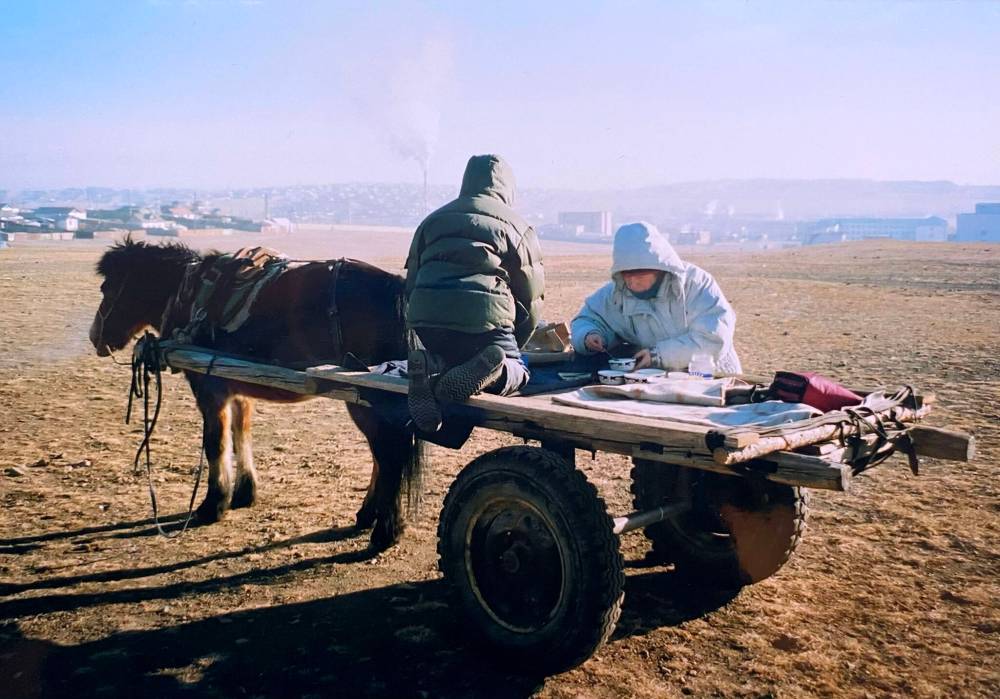
Terry Doerksen / Free Press
Having a cart picnic in the cool, arid Gobi Desert in Mongolia.
Holy cow, you call this a road?
Mongolians handle potholes differently. Instead of getting frustrated they simply veer off a torturous road and fly along over the nice smooth desert. Of course off-roading is a lot easier there because of another category in which Mongolia ranks first: least densely populated country on Earth. Again Canada comes in second.
With few people and no fences, potholes are easily avoided, but Mongolians might encounter another hazard. They also rank first in most livestock per capita, so there are lot of animals to watch out for, including yaks and other bovines. I’m sure you’ve guessed what a Mongolian might say if he happens to swerve into one: “Nuukhtei Ukher!” Yep, holy cow.
Before moving to the Gobi, we lived for four years in Arhangai. Arhangai is called the “Switzerland of Mongolia,” complete with mountain meadows and edelweiss.
It was there that I first became fascinated by oxcarts. Just like the Red River cart, the local version was made entirely out of wood — no metal. It was only after leaving Arhangai and on a later model — this one tricked out with pneumatic tires and pulled by a horse — that we took our first cart ride.
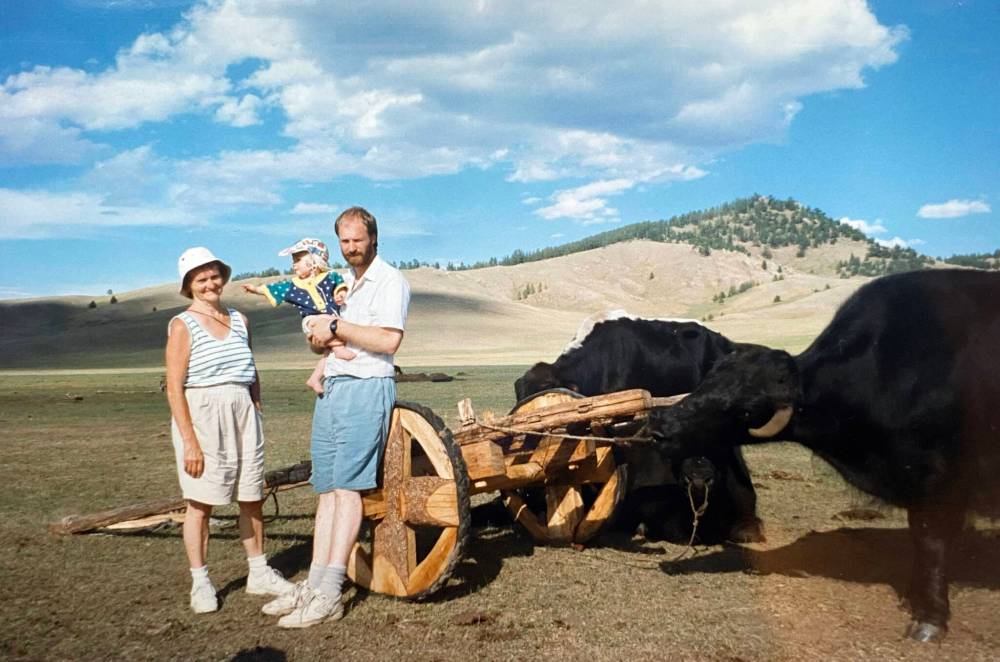
In Arhangai, Mongolia, as with the Red River cart, the traditional local version is made entirely out of wood, with no metal components.
Not owning a car, it was sometimes hard for our family to get out of town to see something special. But one Christmas I had an idea for a family surprise. I went to the market and negotiated with a parked cart operator for a slightly different delivery service. Instead of furniture, he would be hauling a family of crazy Canucks for a winter picnic out to ‘The Arch.’ This relic from the communist era stood alone on a hill in the middle of nowhere to commemorate some long-forgotten event. My guy promised to swing by our apartment at noon on Dec. 25.
Without giving anything away to the family, I had Patty and the three kids bundled into snowsuits with lunch packed when the “limo” pulled up. I’m sure our chauffeur never fully grasped what complexities of the Canadian mind might prompt such a venture, but he unquestioningly carted us to our rather odd destination. In the end he got a generous fare and some weird foreign food for a tip. And I got started on a trail that would end decades later with a couple of long-distance oxcart journeys.
Let’s learn Mongolian
● tereg: cart
● tereg: car (Once you learn that the English cart and car are descended from the same Old French word, you realize the word tereg doing double duty isn’t that weird.)

Terry Doerksen / Free Press
The cows of the Hangai in Mongolia.
● govi: desert (Once you learn that Gobi is the anglicized form of govi, you realize saying ‘Gobi Desert’ actually means ‘desert desert.’)
● aimag: province
● Dornogovi: East (or Left) Gobi. The desert aimag where we lived.
● Arhangai: North (or Behind) Hangai. The aimag we lived in before we moved to the Gobi. (Once you learn that east is to the left and north is behind the speaker, you realize Mongolians used to view the map with south at the top.)
● hangai: forested mountain region
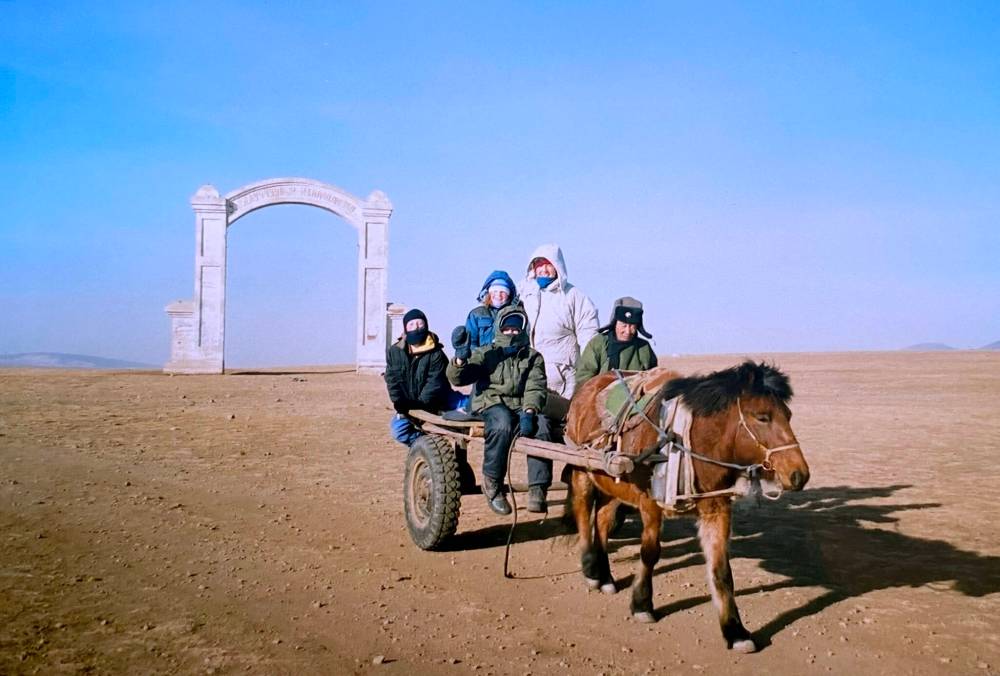
PHOTOS BY Terry Doerksen / Free Press
The Doerksen family embarks on a surprise Christmas Day cart trip to ‘The Arch’ in Arhangai, Mongolia.
● taiga: taiga (the often swampy coniferous forest regions of high northern latitudes).
Moving up south
They said “Dornogovi is the place you oughtta be,”
So we loaded up our truck and we moved to the Gobi. (Desert that is. Smooth trails. Skinny cows.)
— Adapted from The Beverly Hillbillies theme song
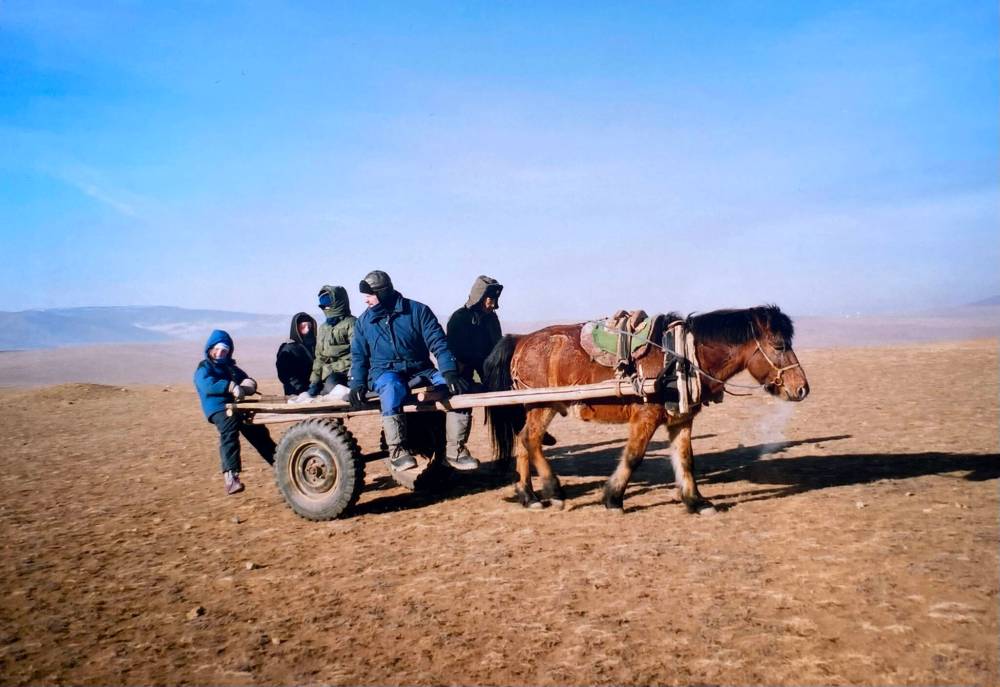
The Doerksens’ very first cart adventure in Arhangai, Mongolia.
When our friends from the leafy taiga of Arhangai learned we were being sent to the arid Gobi, they couldn’t silence their concerns. “We have a saying that it’s better to be a cow in the Hangai than a human in the Gobi,” said one friend. I responded with a little bravado: “I’d rather be a human in the Gobi than a cow in the Gobi.”
We had way too much stuff for an oxcart so we had to hire the Russian equivalent of a three-ton grain truck. Before we embarked I bought a new couch at the market. With that for a guarantee of a comfortable ride, I carefully arranged a cocoon at the front of the truck box, theoretically big enough for Patty and me, three kids and our friend Altantsetseg — Golden Flower — who came along to help with the little ones.
The only family members privileged enough to travel in the cab with the two drivers were our pet birds, Para and Keet. We had made it a good 10 kilometres out of town before we hit a massive bump on the dirt road. All six of us became airborne and then, as gravity regained control, we heard a loud crack beneath us. We’d be travelling the rest of the journey funnelled towards the centre of a busted couch. I’m sure our new seating conditions helped Patty finally sign the waiver to let me and the kids ride up top on the load.
A thunderous rainstorm on our first night saw all of us reunited in the cocoon which was relatively protected by a sheet of poly I had brought along for that eventuality. Six claustrophobic humans piled on top of one another trying to avoid breaks in our water-defence system was not a recipe for a great night’s sleep.
The next day’s trundle brought us to a checkpoint outside the capital, Ulaan Baatar, just before midnight. We were only two hours away from a hotel where we could spend the remainder of the night and get a warm bath. The guard at the checkpoint borrowed my imported rechargeable flashlight to survey this bizarrely loaded conveyance.
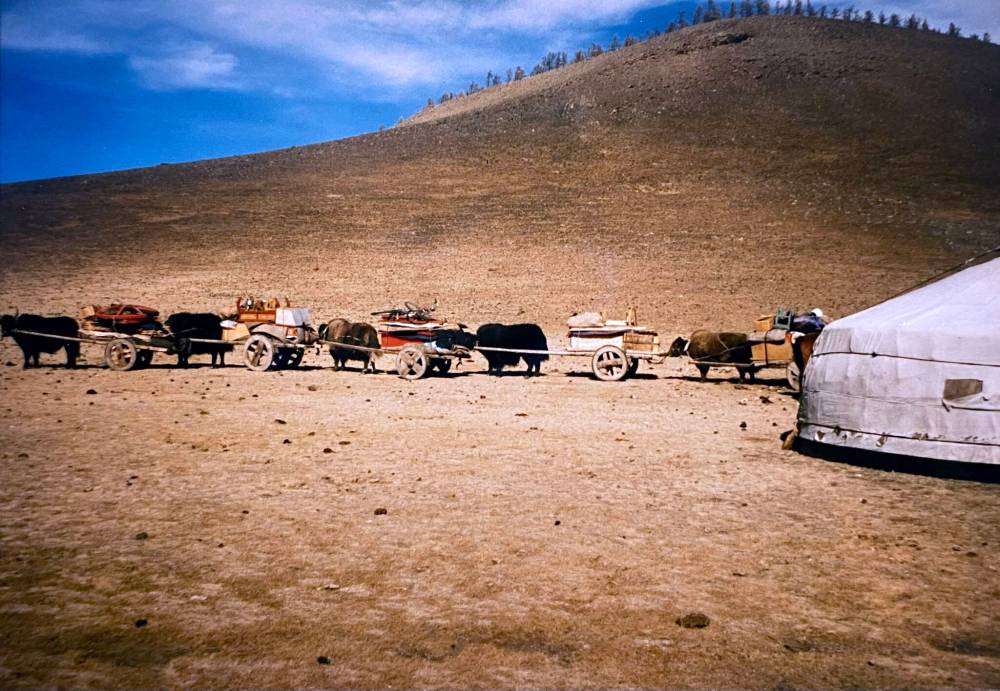
Terry Doerksen / Free Press
Bumper-to-bumper traffic, Mongolian-style.
When he spotted the pair of parakeets in the cab, the guard knew he was on to something. “Do your birds have passports to enter the city?” Apparently such documentation was absolutely necessary for us to keep travelling, but if I’d give him my flashlight he’d let it go, this time. I’m guessing sleep deprivation didn’t help my mood. In my broken Mongolian I gave my unedited opinion of extortion. Those watching from the darkness of the cocoon took the higher road, and at Golden Flower’s suggestion, prayed silently for favour from the guard. Suddenly and inexplicably the gate opened and we passed through — rechargeable flashlight, passport-less parakeets and all.
As we headed south towards the Gobi the following day, we started picking up speed — especially when we’d get off the road and onto a parallel track. I measured the time it took between kilometre markers and did the math. On one particularly smooth stretch we topped 35 km/h! My ox Zik with his Red River cart would have been a brown blur as we flew on by.
On our third and final night, we took a lesson from the cows of the Gobi and stretched out on a mattress of warm desert sand. This wasn’t Arhangai: no edelweiss, no taiga and no muddy ruts. But as stars sparkled down on me through the pristine desert air, I became sure I didn’t want to be anywhere else.
sonsofdoerk@gmail.com

Better call the CAA — camel-assistance association, that is.