

Literary landscape
A visit with Tom and Huck in Mark Twain's Missouri hometown
Advertisement
Read this article for free:
or
Already have an account? Log in here »
To continue reading, please subscribe:
Digital Subscription
One year of digital access for only $1.44 a week*
- Enjoy unlimited reading on winnipegfreepress.com
- Read the E-Edition, our digital replica newspaper
- Access News Break, our award-winning app
- Play interactive puzzles
*Billed as $5.77 plus GST every four weeks. After 52 weeks, price increases to the regular rate of $19.95 plus GST every four weeks. Offer available to new and qualified returning subscribers only. Cancel any time.
To continue reading, please subscribe:
Add Free Press access to your Brandon Sun subscription for only an additional
$1 for the first 4 weeks*
- Enjoy unlimited reading on winnipegfreepress.com
- Read the E-Edition, our digital replica newspaper
- Access News Break, our award-winning app
- Play interactive puzzles
*Your next Brandon Sun subscription payment will increase by $1.00 and you will be charged $17.95 plus GST for four weeks. After four weeks, your payment will increase to $24.95 plus GST every four weeks.
Read unlimited articles for free today:
or
Already have an account? Log in here »
Hey there, time traveller!
This article was published 06/02/2016 (3906 days ago), so information in it may no longer be current.
Samuel Clemens was born in the small community of Florida, Mo., and died 75 years later in Redding, Conn., but it was the 11 years of his youth in Hannibal, Mo., that flavoured much of Clemens’ best-known works. The characters, locations, and experiences of Huckleberry Finn, Tom Sawyer and Becky Thatcher were frequently drawn from events and acquaintances during the years Clemens lived in Hannibal.
Clemens, better known by his pen name Mark Twain, served as a riverboat captain, Confederate soldier (sort of), typesetter, newspaper reporter, gold miner and one of America’s best-known authors. He led an adventurous life, married the daughter of a wealthy businessman, successfully published the memoirs of Ulysses S. Grant, made quite a lot of money and authored books that have remained popular for more than a century.
Clemens also made poor investment choices, declared personal bankruptcy, suffered numerous family tragedies and died an unhappy man.

It’s difficult to gain an understanding of Samuel Clemens and his creations of Huck Finn and Tom Sawyer without taking a look at the community in which he grew to adulthood. Like most of us, Clemens’ childhood and coming of age influenced his thinking, actions, and accomplishments during the remainder of his life.
Birth of a river town
Hannibal is a river town where steamboats once plied this great ribbon of water that was named by the Ojibwe who lived further north in present-day Minnesota. This was a divided community during the U.S. Civil War with conflict between Confederate sympathizers and abolitionists. It is a town that evolved from relying mostly on trade and lumber to one that prospered, at least for a time, from the production of shoes and stoves. Life along and on the river would serve as an important influence on Clemens’ life and writings.
Native American tribes including the Missouri, Sac and Fox occupied this area of present-day Missouri for centuries prior to the 1673 appearance of Jesuit priest Father Marquette and French-Canadian explorer Louis Joliet. In the late 1700s, Spanish land grants were issued when salt was discovered in the vicinity. However, it was not until 1800, during a Spanish mapping expedition, that a small tributary of the great Mississippi was named Hannibal Creek after the famous Carthaginian general, considered by many as one of history’s greatest military commanders.
The community of Hannibal was founded in 1819 by Moses Bates who, along with a friend, constructed a log cabin at the current intersection of Main and Bird streets. Bates had arrived with the assignment of platting the town for a company that intended to sell lots. Several years later, Bates purchased a steamboat he utilized to make trips between Galena, Ill., and St. Louis, with stopovers at Hannibal along the way.
Fifteen years following Hannibal’s 1845 official charter as a city, the town had grown to more than 2,000 individuals and the first school was constructed.
The town’s early growth received an assist from travellers passing through in the mid-1800s on their way to the California gold fields, followed several years later by completion of the first railroad to cross the state. Street cars, telephone service, a public water system, additional public schools, and Missouri’s first tax-supported library all appeared in Hannibal before the turn of the century.
The area’s industries changed with the times. In the early years, employment was concentrated in businesses such as lumber milling, coopering, tanning, and candle making. These were replaced by lumbering and cement manufacturing. In the 1920s, the town laid claim to the largest shoe factory in the United States.
Life and times of Samuel Clemens
Samuel Clemens was born in 1835, in the small town of Florida, Mo., shortly after his parents moved there from Tennessee. Four years later, the family moved again, this time to the more prosperous and larger port town of Hannibal, where the Clemens built a house that today is known as Mark Twain’s Boyhood Home.
Samuel’s father died in 1847 of pneumonia following a short illness, forcing 12-year-old Samuel to find work that included employment as a printer’s apprentice, typesetter and writer with local newspapers. Clemens departed Hannibal at age 18, and found work as a printer in several cities including Cincinnati, New York, Philadelphia and St. Louis.
While growing up in Hannibal, Clemens developed a love for life on the river, especially, the steamboats that plied the Mississippi. He was taken on as a river pilot trainee and received his pilot’s licence in 1858. Unfortunately, after several years, his days as a pilot ended as a result of the Civil War and the Union’s desire to control all commercial traffic on the river.

Never one to avoid challenges, Samuel decided to accompany older brother Orion on a two-week stagecoach ride west, where he ended up in Virginia City, Nev. After failing to achieve his goal of getting rich in mining, Clemens went to work for the local newspaper, the Territorial Enterprise. This was where, in 1863, he first used the pen name “Mark Twain,” a term meaning “two fathoms,” the river depth that allowed safe passage for most riverboats.
Clemens subsequently moved to San Francisco, travelled to Hawaii and, in 1867, toured Europe and the Middle East. These adventures served as background for a number of his articles and books, including The Celebrated Jumping Frog of Calaveras County, Roughing It and The Innocents Abroad.
He returned to the United States in 1868, and two years later married the 24-year-old daughter of a wealthy businessman. This led to a move to Buffalo, N.Y., and the acquisition of part interest in the city’s newspaper, the Buffalo Express. The Clemens subsequently moved to Hartford, Conn., where they lived for nearly two decades and he authored some of his best-known works, including The Adventures of Tom Sawyer, The Prince and the Pauper, Adventures of Huckleberry Finn and A Connecticut Yankee in King Arthur’s Court.
Despite a successful writing career and, initially, a successful publishing career, Clemens made some poor investment decisions and filed for personal bankruptcy in 1894.
He experienced a number of personal tragedies, including the deaths of his son and three of his four daughters. He was also preceded in death by his wife. Clemens died of a heart attack in April of 1910, and is buried at Woodlawn Cemetery in Elmira, N.Y. The burial plot includes a monument two-fathoms (3.6-metres) tall.
Hannibal today
Hannibal today has a population of about 18,000, a figure that has changed little during the past 50 years. Its economy has evolved from candle making, slaughter houses and shoe manufacturing to light manufacturing and services that include becoming a regional medical centre. (We were impressed to learn the local General Mills plant once produced Underwood Deviled Ham, the iconic spread packaged in the small paper-wrapped tin.)
The town has long served as a transportation hub with water, rail and interstate connections. However, it is Hannibal as Samuel Clemens’ hometown that attracts most visitors to this historic river city.
Although Clemens has been deceased for more than a century, his spirit surely lives on in Hannibal, where the local telephone book lists 23 businesses named for the town’s most-famous citizen. These range from Mark Twain Auto & Tire Repair to Mark Twain Taxi. And don’t forget Becky’s Old Fashioned Ice Cream Parlor and Emporium, Clemens Field, and Mrs. Clemens Shop.
Samuel Clemens’ home was within shouting distance of the dock where steamboats unloaded freight and passengers, making it easy to understand why the young boy would yearn to become a steamboat captain.
His boyhood home and an adjoining gift shop are the beginning point of a self-guiding tour of all things Mark Twain. The house, with exhibits and information about related sites, is filled with period furniture as there is no record of the home’s furniture pieces when Clemens lived here.
Located beside Mark Twain’s Boyhood Home is the reconstructed Huckleberry Finn House on the site where Clemens’ unschooled, but good-hearted childhood friend, Tom Blankenship, lived. (Blankenship was the inspiration for the Huckleberry Finn character.)
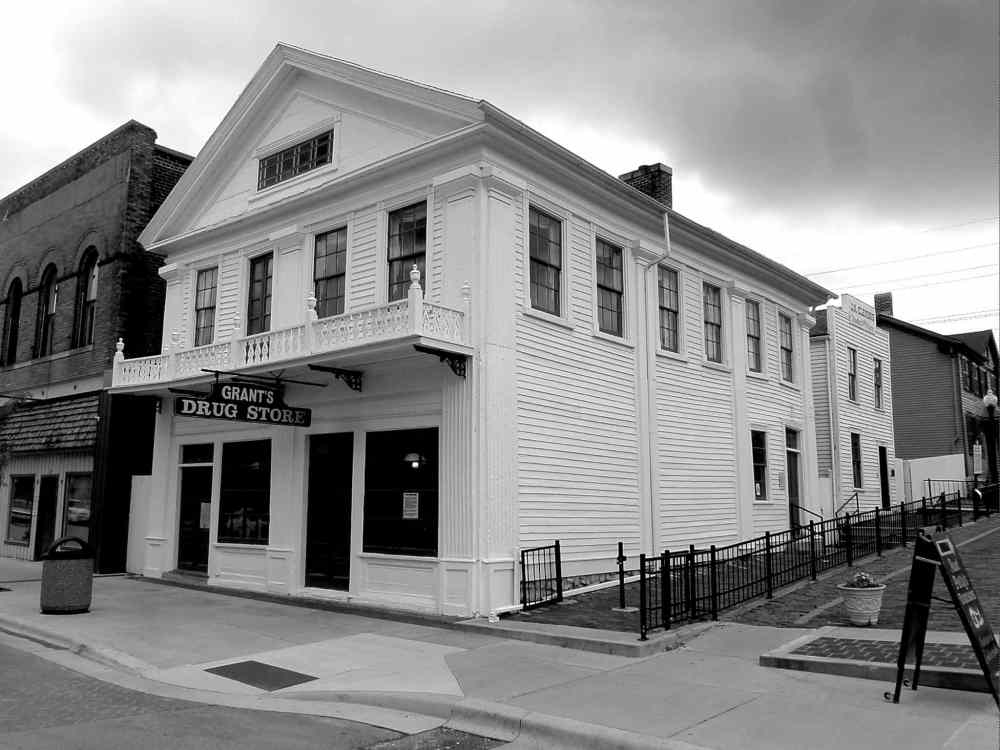
Other sites associated with Clemens’ writings include the Becky Thatcher House (where his boyhood sweetheart, Laura Hawkins, lived) and Grant’s Drug Store (where the Clemens family lived for a spell following the death of Samuel’s father). The J.M. Clemens Justice of the Peace office is next door.
A museum gallery two blocks south on Main Street houses Clemens family artifacts and a number of Norman Rockwell sketches and oil paintings commissioned by the publisher of two of Clemens’ most-famous books. A single ticket (US$11 adults, US$9 seniors, US$7 children) provides entrance for all these venues.
Other places of interest in or near Hannibal include the Mark Twain Cave explored by Tom Sawyer and Becky Thatcher in Clemens’ writings. The cave is just south of town and guided tours are offered.
Rockcliffe Mansion, a late 1800s mansion built by local lumber baron John Cruikshank, is open for guided tours from mid-March to mid-November. Hannibal Trolley Company offers sightseeing tours from mid-April through October.
The town is home to the Hannibal Cavemen, a Prospect League baseball team comprised of unpaid college players with collegiate eligibility remaining. The season runs from late May to mid-August and $5 gets you in the gate.
David and Kay Scott are authors of Complete Guide to the National Park Lodges (Globe Pequot). Visit them at www.valdosta.edu/dlscott/Scott