

SEC Commissioner says frustration with NCAA led to committee with Big Ten, but Division I can work
Advertisement
Read this article for free:
or
Already have an account? Log in here »
To continue reading, please subscribe:

Digital Subscription
One year of digital access for only $205*
- Enjoy unlimited reading on winnipegfreepress.com
- Read the E-Edition, our digital replica newspaper
- Access News Break, our award-winning app
- Play interactive puzzles
*First annual payment billed as $205.00 + GST for one year. This annual subscription will automatically renew at $233.00 + GST every 52 weeks (10% off the regular annual price of $259.35). Offer available to new and qualified returning subscribers only. Cancel any time.
To continue reading, please subscribe:
Add Free Press access to your Brandon Sun subscription for only an additional
$1 for the first 4 weeks*
- Enjoy unlimited reading on winnipegfreepress.com
- Read the E-Edition, our digital replica newspaper
- Access News Break, our award-winning app
- Play interactive puzzles
*Your next Brandon Sun subscription payment will increase by $1.00 and you will be charged $17.95 plus GST for four weeks. After four weeks, your payment will increase to $24.95 plus GST every four weeks.
Read unlimited articles for free today:
or
Already have an account? Log in here »
Hey there, time traveller!
This article was published 30/05/2024 (844 days ago), so information in it may no longer be current.
DESTIN, Fla. (AP) — Frustrating meetings for the College Football Playoff and at the NCAA convention earlier this year led Southeastern Conference Commissioner Greg Sankey to try to look for a way to seek solutions for issues facing college sports within smaller groups.
“So afterwards, traveling home, like, you know, we have some really big problems,” Sankey said Thursday as he wrapped up four days of SEC spring meetings. “And it didn’t seem to me that we were working to solve even some of the medium problems. And we weren’t even talking in some of those rooms about the really big problems.”
Sankey called Big Ten Commissioner Tony Petitti upon his return home, a call that led to the SEC and Big Ten forming a joint advisory committee between college sports’ two wealthiest and most powerful conferences.
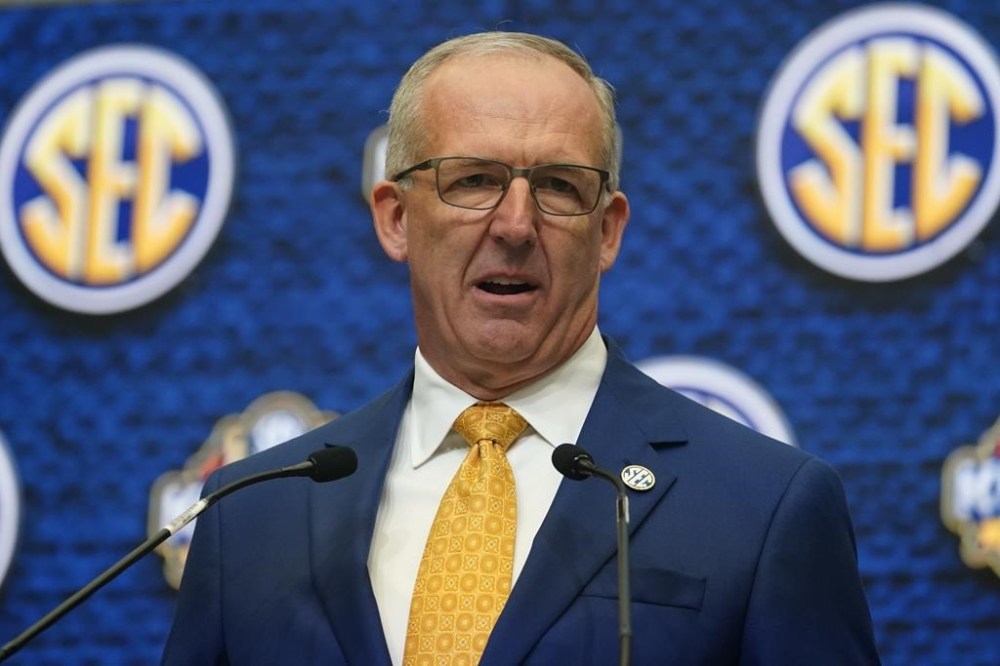
“I have thought for a long period of time that if the two conferences could agree that you could fulfill a leadership responsibility,” Sankey said.
During his last of four briefing with reporters, and less than a week after the NCAA and five power conferences agreed to a $2.8 billion antitrust settlement, Sankey said he still believes a large Division I can work as college sports heads toward sweeping changes.
But, he added: “This is not like the lightning strike moment, but the realization you’re not going to solve the big problems in big rooms filled with people, because the realities are so different across Division I.”
NCAA Division I is comprised of 352 schools, with a vast array of sizes, budgets and priorities. Most Power Five conferences schools, like those in the SEC, have athletic budgets well over $100 million annually.
Those power conferences, plus the NCAA, are the defendants in several class-action antitrust lawsuits. The NCAA and conferences agreed to a proposed settlement last week that not only pays out nearly $3 billion in damages to former and current athletes, but comes with an agreement that schools will soon be permitted to share tens of millions of dollars in revenue with athletes annually.
How the SEC will handle the settlement and build a new compensation system for its athletes was a major topic this week, though Sankey said these meetings were more about discussions than decisions.
The settlement still needs to be approved by a judge, with more detailed terms still being fleshed out.
Sankey said the lucrative NCAA men’s basketball tournament — which accounts for the vast majority of the association’s more than $1 billion in revenue — is what binds a diverse membership, but he re-iterated some modification of March Madness is likely necessary.
“We’ve allowed Division I to grow,” he said. “We have conferences solving their membership problem by inviting non-Division I members in, but we haven’t modified the bracket size. I think common sense says you have to dig into that. There are competitive issues, there are calendar issues, there are economic issues. But I do think that March can be kept together. That doesn’t mean it stays exactly the same.”
Sankey said the Big Ten-SEC advisory committee has no meetings on the calendar, but expects that to change soon.
“We’re going to have to make independent decisions on a number of key things,” he said. “We can’t solve every problem together, otherwise you reintroduce antitrust concerns.”
He added: “We also have to draw people in, so it’s not like two votes change the world. Certainly two conferences agreeing on things and in the right sort of way have influence.”
___
Follow Ralph D. Russo at https://twitter.com/ralphDrussoAP
___
AP college football: https://apnews.com/hub/college-football