

Judge says men convicted in Coutts blockade were ready for shootout with police
Advertisement
Read this article for free:
or
Already have an account? Log in here »
To continue reading, please subscribe:

Digital Subscription
One year of digital access for only $205*
- Enjoy unlimited reading on winnipegfreepress.com
- Read the E-Edition, our digital replica newspaper
- Access News Break, our award-winning app
- Play interactive puzzles
*First annual payment billed as $205.00 + GST for one year. This annual subscription will automatically renew at $233.00 + GST every 52 weeks (10% off the regular annual price of $259.35). Offer available to new and qualified returning subscribers only. Cancel any time.
To continue reading, please subscribe:
Add Free Press access to your Brandon Sun subscription for only an additional
$1 for the first 4 weeks*
- Enjoy unlimited reading on winnipegfreepress.com
- Read the E-Edition, our digital replica newspaper
- Access News Break, our award-winning app
- Play interactive puzzles
*Your next Brandon Sun subscription payment will increase by $1.00 and you will be charged $17.95 plus GST for four weeks. After four weeks, your payment will increase to $24.95 plus GST every four weeks.
Read unlimited articles for free today:
or
Already have an account? Log in here »
Hey there, time traveller!
This article was published 27/08/2024 (747 days ago), so information in it may no longer be current.
LETHBRIDGE, Alta. – An Alberta judge says evidence shows two men convicted for their roles at the 2022 border blockade near Coutts, Alta., were ready for a shootout with police.
Justice David Labrenz said Tuesday that while a jury found Anthony Olienick and Chris Carbert not guilty of conspiring to murder police at the blockade, it did find the pair guilty of mischief and possessing a weapon for a dangerous purpose.
Olienick was also found guilty of possessing a pipe bomb.
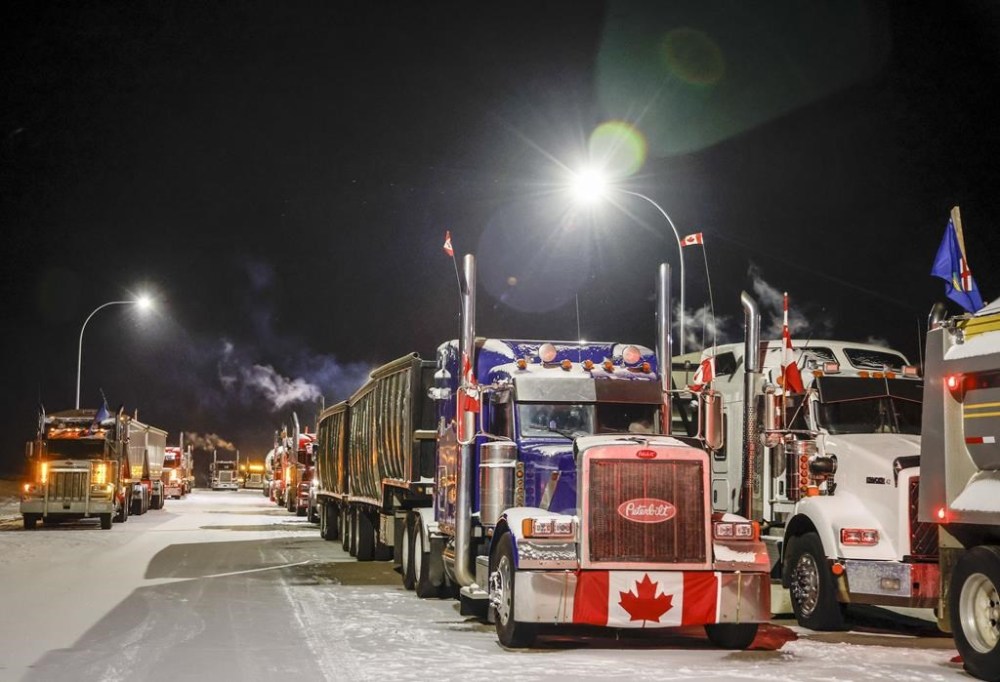
The judge told court he accepts the verdicts as proof the jury believed both men brought weapons, ammunition and body armour to the two-week standoff not just to show off or hunt animals but for a more sinister purpose.
“It was to support the blockade and to engage in a war with police if it came to that eventuality,” Labrenz said.
“The abundance of live ammunition, the medical kit, the ballistic vests are not supportive of showing off firearms or hunting coyotes.
“They are supportive of a war with police.”
The men were arrested in February 2022 at the blockade, which tied up traffic at the Canada-U.S. border crossing to protest COVID-19 rules and vaccine mandates.
The jury reached its verdicts Aug. 2, following a two-month trial. Given the reasons for jury verdicts are secret, the judge must determine the facts he believes underlie the decisions.
The sentencing hearing is to continue Thursday.
On Monday, Crown and defence lawyers made arguments about how the judge should interpret the verdicts.
Labrenz’s decision echoed the Crown’s submission that the weapons convictions indicate jurors believed the men were prepared to battle with police.
The men offered more benign explanations at trial.
Carbert told court he brought his new rifles to hunt coyotes and to show off.
He also downplayed text messages to his mother talking about an upcoming war that he might not survive.
Labrenz said those statements are not plausible, adding that Carbert lied on the stand in pre-trial hearings.
“Mr. Carbert demonstrated then, as now, that he is prepared to lie under oath when it suits him to do so,” Labrenz said.
“I conclude that Mr. Carbert, like Mr. Olienick, was prepared to engage in a firefight with police.
“This was an exceedingly dangerous situation.”
The judge said he also accepted as true Olienick’s comments to female undercover Mounties, in which he said he viewed the blockade as a war, that weapons were needed for credibility and that he would like to slit Mountie throats.
Olienick’s lawyer, Marilyn Burns, suggested the evidence was tainted because the undercover officers flirted with Olienick to elicit information.
Burns pointed to heart emojis on some texts between Olienick and an officer.
Labrenz said heart emojis are often used to agree with something someone has written.
“I find no basis to conclude that the operators used romance or any other such distasteful connectivity to induce conversations. (I am also) not clear how it would induce anybody to say what they said,” the judge said.
“I simply find that suggestion to be offensive.”
This report by The Canadian Press was first published Aug. 27, 2024.