

Recent B.C. earthquakes linked to fracking as regulator tightens oversight
Advertisement
Read this article for free:
or
Already have an account? Log in here »
To continue reading, please subscribe:

Digital Subscription
One year of digital access for only $205*
- Enjoy unlimited reading on winnipegfreepress.com
- Read the E-Edition, our digital replica newspaper
- Access News Break, our award-winning app
- Play interactive puzzles
*First annual payment billed as $205.00 + GST for one year. This annual subscription will automatically renew at $233.00 + GST every 52 weeks (10% off the regular annual price of $259.35). Offer available to new and qualified returning subscribers only. Cancel any time.
To continue reading, please subscribe:
Add Free Press access to your Brandon Sun subscription for only an additional
$1 for the first 4 weeks*
- Enjoy unlimited reading on winnipegfreepress.com
- Read the E-Edition, our digital replica newspaper
- Access News Break, our award-winning app
- Play interactive puzzles
*Your next Brandon Sun subscription payment will increase by $1.00 and you will be charged $17.95 plus GST for four weeks. After four weeks, your payment will increase to $24.95 plus GST every four weeks.
Read unlimited articles for free today:
or
Already have an account? Log in here »
Hey there, time traveller!
This article was published 14/02/2025 (570 days ago), so information in it may no longer be current.
The British Columbia Energy Regulator has toughened its oversight of what it calls “induced” seismic activity after a series of earthquakes linked to hydraulic fracturing, or fracking, in the northeastern corner of the province.
John Cassidy, a seismologist with Natural Resources Canada, said the regulator had confirmed that four quakes recorded between last Saturday and Wednesday were related to the gas industry practice.
The quakes ranged in magnitude from 3.1 to 4.7, with the most powerful felt in Fort St. John, B.C., about 105 kilometres southeast of the epicentre.
Cassidy said earthquakes triggered by fracking in B.C. typically result from the injection of material into shallow wells to open up fractures and release gas for extraction, and almost all of the induced quakes are “tiny.”
“There have been no recorded earthquakes large enough to cause damage in the area,” he said.
Still, B.C.’s energy regulator issued an update on Thursday saying it was “strengthening” its oversight of induced seismicity in the region by “enhancing” an existing order and adding a new one for another nearby area.
The orders both require operators in the two areas to immediately halt operations if they trigger a seismic event of a certain magnitude.
In the existing Kiskatinaw seismic monitoring and mitigation area, a shutdown would be triggered by a quake of magnitude 3 or higher within five kilometres of fracking operations.
The threshold is magnitude 4 in the nearby Wonowon-Pink Mountain area, where a new order has been established.
Over the last year, Cassidy said there have been five quakes in the range of magnitude 4 within 100 kilometres of the most recent series, as well as 29 quakes of a magnitude of 3 to 3.9 and 74 with a magnitude of 2 to 2.9.
Magnitude 3 is typically when an earthquake may start to be felt, he added, depending on proximity to the epicentre.
“It would be shaking, you would feel (it) and it would be frightening,” he said in an interview. “But in terms of structural damage, typically (magnitude) 5 or larger, and if you’re very close.
The orders from the energy regulator require real-time seismicity monitoring and the submission of pre-assessments with each notice of operation.
In an emailed statement on Friday, the regulator said the latest “enhancements” were initiated last year and released on Thursday.
It said regulations were enhanced with the removal of any option for a permit holder to request an exception and the removal of discretionary terms, such as “may.”
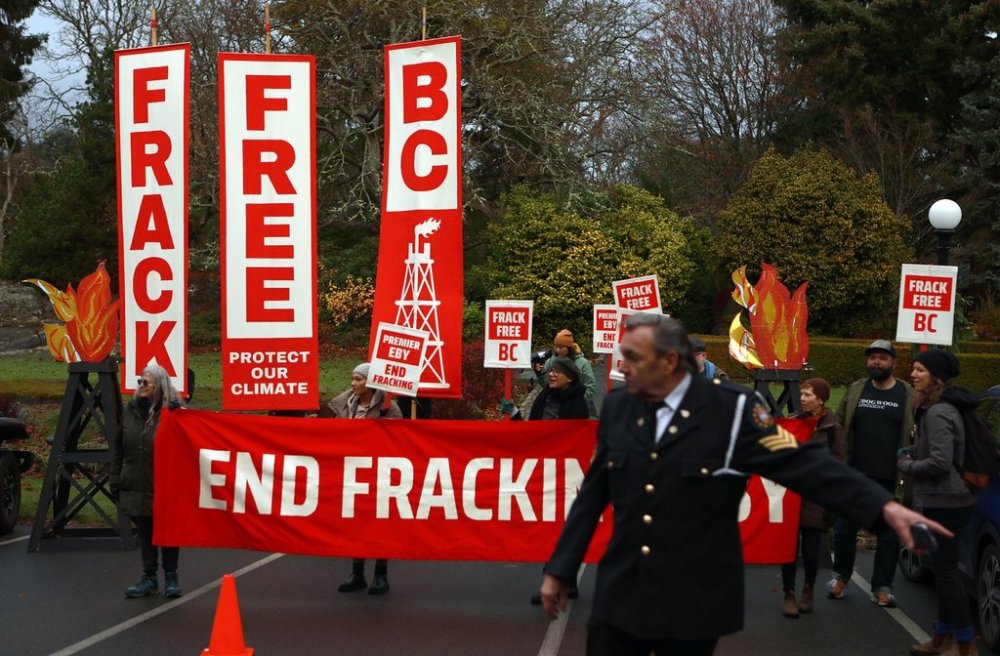
Typically, more than 15 companies conduct fracturing operations across the broader Peace region, with five of those operating in the Kiskatinaw area and six within the newly created North Montney monitoring area and order, it said.
The regulator also maintains a system of 35 seismometers in the region.
Cassidy said there is ongoing research seeking to better understand industry-induced earthquakes.
“It seems to depend quite a bit on the geology, on the natural faults in the area and existing fluids in the ground. So, there are a lot of factors,” he said.
People living on southern Vancouver Island, meanwhile, reported feeling a 3.8 magnitude earthquake that struck off the coast at around 10 p.m. Thursday.
It was lightly felt in Victoria, Sidney and across southern Vancouver Island, with Earthquakes Canada saying more than 300 people reported feeling it.
There was no reported damage from any of the recent quakes in B.C.
This report by The Canadian Press was first published Feb. 14, 2025.