

Environment Canada lifts coastal flooding bulletin for southern B.C.
Advertisement
Read this article for free:
or
Already have an account? Log in here »
To continue reading, please subscribe:
Monthly Digital Subscription
$1 per week for 24 weeks*
- Enjoy unlimited reading on winnipegfreepress.com
- Read the E-Edition, our digital replica newspaper
- Access News Break, our award-winning app
- Play interactive puzzles
*Billed as $4.00 plus GST every four weeks. After 24 weeks, price increases to the regular rate of $19.95 plus GST every four weeks. Offer available to new and qualified returning subscribers only. Cancel any time.
Monthly Digital Subscription
$4.99/week*
- Enjoy unlimited reading on winnipegfreepress.com
- Read the E-Edition, our digital replica newspaper
- Access News Break, our award-winning app
- Play interactive puzzles
*Billed as $19.95 plus GST every four weeks. Cancel any time.
To continue reading, please subscribe:
Add Free Press access to your Brandon Sun subscription for only an additional
$1 for the first 4 weeks*
*Your next subscription payment will increase by $1.00 and you will be charged $16.99 plus GST for four weeks. After four weeks, your payment will increase to $23.99 plus GST every four weeks.
Read unlimited articles for free today:
or
Already have an account? Log in here »
Environment Canada has lifted a special weather statement for possible flooding from stormy weather and high tides along parts of British Columbia’s south coast.
The bulletin had spanned most of the Vancouver Island coastline along with the Sunshine Coast and Greater Victoria and Metro Vancouver areas, saying some flooding was likely as high tides combined with a low pressure system.
Strong winds and waves had been projected to push water levels above the highest astronomical tides this weekend, with the highest risk expected Sunday.
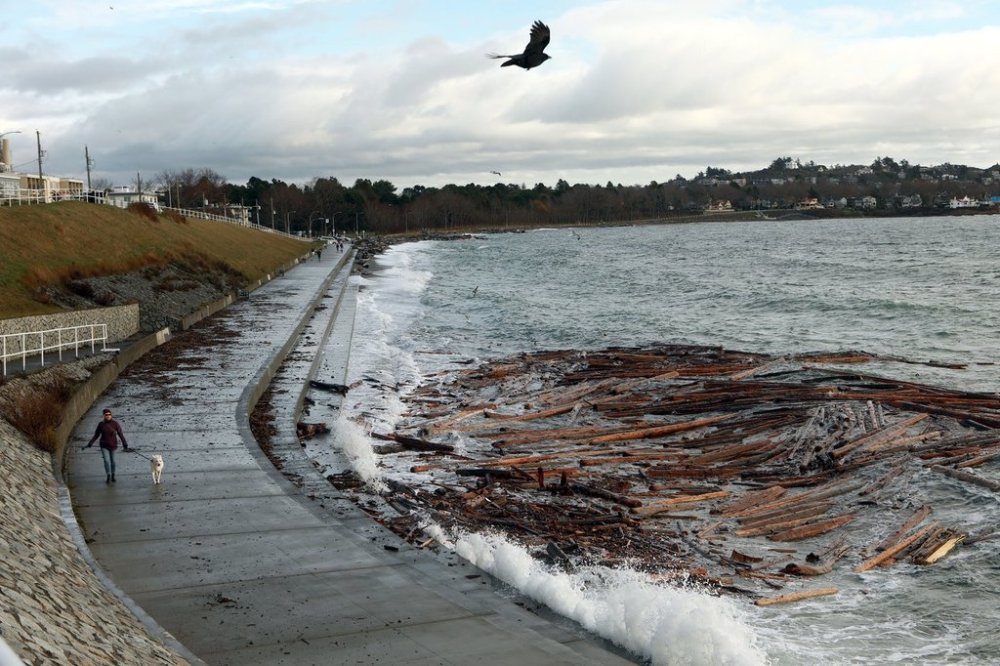
Environment Canada’s figures from a tidal station in Vancouver shows the water level peaking Sunday at nearly 5.4 metres at about 7:30 a.m., while the station’s highest recorded water level was 5.75 metres on Dec. 27, 2022.
Only a yellow-level snowfall warning for a stretch of Highway 3 in the Boundary and Kootenay regions of southern B.C. remains, with a forecast of 15 to 20 centimetres along the route between Paulson Summit and Kootenay Pass.
Avalanche Canada has meanwhile downgraded the risk level for Metro Vancouver’s North Shore Mountains and the Gibsons area, though it says the risk of sliding snow is still considerable from the coast to Pemberton.
The risk is also considerable, or level three out of five on the avalanche-danger rating scale, on mountains on Vancouver Island, southeastern B.C., and along the boundary with Alberta from the Cranbrook area to north of Prince George.
The risk is moderate in the Kitimat, Terrace and Smithers areas and mountains along the southern portion of the province’s border with Alaska.
This report by The Canadian Press was first published Jan. 4, 2026.