

There’s so much snow in N.L., police have asked people to stop putting it in the road
Advertisement
Read this article for free:
or
Already have an account? Log in here »
To continue reading, please subscribe:

Digital Subscription
One year of digital access for only $205*
- Enjoy unlimited reading on winnipegfreepress.com
- Read the E-Edition, our digital replica newspaper
- Access News Break, our award-winning app
- Play interactive puzzles
*First annual payment billed as $205.00 + GST for one year. This annual subscription will automatically renew at $233.00 + GST every 52 weeks (10% off the regular annual price of $259.35). Offer available to new and qualified returning subscribers only. Cancel any time.
To continue reading, please subscribe:
Add Free Press access to your Brandon Sun subscription for only an additional
$1 for the first 4 weeks*
- Enjoy unlimited reading on winnipegfreepress.com
- Read the E-Edition, our digital replica newspaper
- Access News Break, our award-winning app
- Play interactive puzzles
*Your next Brandon Sun subscription payment will increase by $1.00 and you will be charged $17.95 plus GST for four weeks. After four weeks, your payment will increase to $24.95 plus GST every four weeks.
Read unlimited articles for free today:
or
Already have an account? Log in here »
Hey there, time traveller!
This article was published 19/02/2026 (231 days ago), so information in it may no longer be current.
ST. JOHN’S – Another winter storm has left shovellers in eastern Newfoundland looking for somewhere to put all the snow, but police have warned them to keep it off the roads.
Environment Canada said the snow began in some areas on Tuesday evening, spreading toward the island’s northeast coast and continuing until late Wednesday night.
Some parts of St. John’s, the provincial capital, have been buried under 56 centimetres of snow.
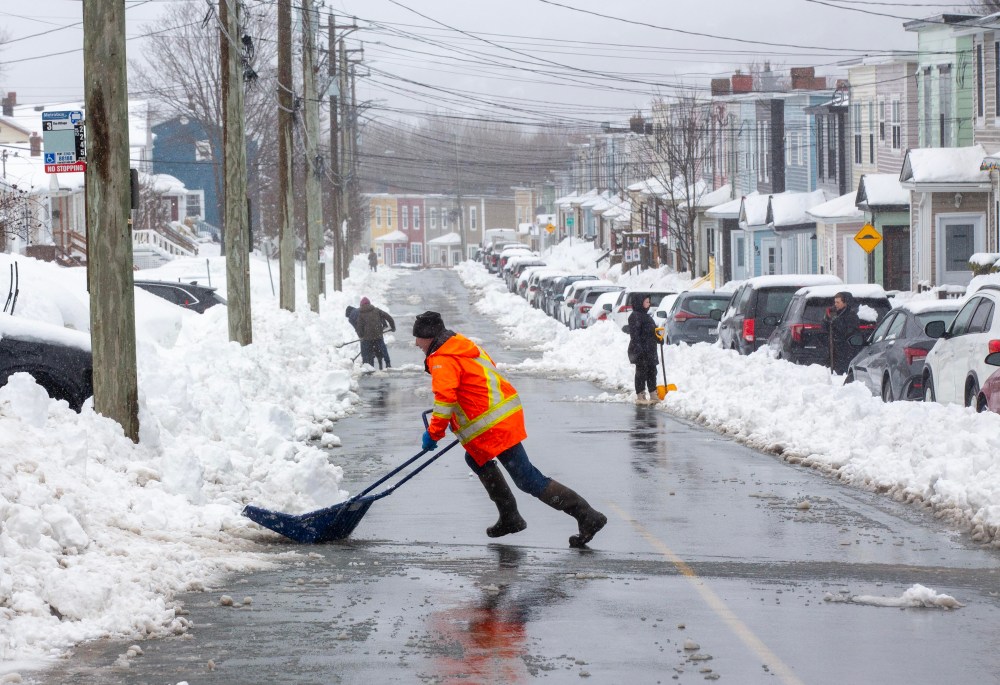
The nearby communities of Mount Pearl and Paradise saw 65 cm and 74 cm, respectively.
RCMP issued a warning on social media saying residents could face fines for shovelling snow from driveways onto roads.
Environment Canada says nearly 330 cm of snow has fallen in St. John’s since Nov. 1, while totals in Gander, in central Newfoundland, have hit 434 cm.
This report by The Canadian Press was first published Feb. 19, 2026.