

Halifax shipyard workers lay backbone for first of Canada’s 15 River-class destroyers
Advertisement
Read this article for free:
or
Already have an account? Log in here »
To continue reading, please subscribe:

Digital Subscription
One year of digital access for only $205*
- Enjoy unlimited reading on winnipegfreepress.com
- Read the E-Edition, our digital replica newspaper
- Access News Break, our award-winning app
- Play interactive puzzles
*First annual payment billed as $205.00 + GST for one year. This annual subscription will automatically renew at $233.00 + GST every 52 weeks (10% off the regular annual price of $259.35). Offer available to new and qualified returning subscribers only. Cancel any time.
To continue reading, please subscribe:
Add Free Press access to your Brandon Sun subscription for only an additional
$1 for the first 4 weeks*
- Enjoy unlimited reading on winnipegfreepress.com
- Read the E-Edition, our digital replica newspaper
- Access News Break, our award-winning app
- Play interactive puzzles
*Your next Brandon Sun subscription payment will increase by $1.00 and you will be charged $17.95 plus GST for four weeks. After four weeks, your payment will increase to $24.95 plus GST every four weeks.
Read unlimited articles for free today:
or
Already have an account? Log in here »
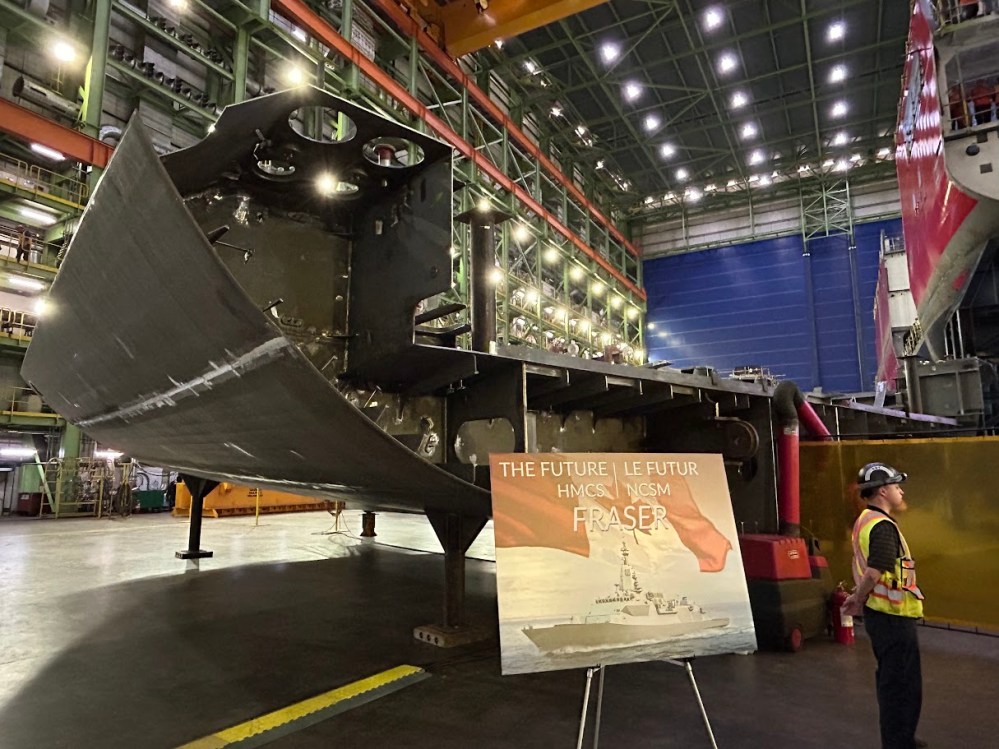
HALIFAX – Irving Shipbuilding officially began construction on the first of Canada’s 15 new River-class destroyers in Halifax on Friday, marking an important step in the Royal Canadian Navy’s efforts to replace its aging fleet of frigates.
Hundreds of workers were on hand for the ceremonial laying of the keel — the foundational structure for the future HMCS Fraser. The centuries-old tradition dates back to the ancient Romans and included placing a silver coin in the ship’s hull for good luck.
Vice-admiral Angus Topshee, commander of the Royal Canadian Navy, said the new destroyers will be a generational improvement. They will have advanced radar, be able to fire missiles to the edge of space and defend against enemy submarines.
“We’ve already retired the four destroyers that this is part of the replacement for,” Topshee told reporters Friday.
“The 12 Halifax-class frigates are doing great work but they were designed to last 30 years and it’s been more than that. So the faster we can get warships back out on the waters, the modern ships Canada needs, the better off we’re going to be.”
The Navy still relies on frigates but the effort needed to keep them running is only growing as they operate past their intended life expectancy.
Last year the federal government signed a deal that will see Irving paid $8 billion for the first six years of destroyer construction, covering only part of the tab for the first three ships that are expected to cost $22.2 billion in total. The Department of National Defence has said all 15 are expected to cost about $60-billion, but in 2022 the Parliamentary Budget Officer suggested it could be as much as $80 billion.
The navy expects HMCS Fraser will be delivered in the early 2030s, but Topshee said Friday that Irving has a great shipyard that’s improving every day, and they’re working to see if the ship can be completed earlier.
The federal government expects nine vessels by 2040, coming in small batch orders of several at a time. The full order of 15 destroyers is projected for completion by 2050.
Jim Irving, CEO of Irving Shipbuilding, said there are 3,000 employees at the shipyard and another 500 contractors on the project.
“It shows what is possible here in Canada, built at home, and with our own tradespeople, and our own management and infrastructure,” Irving told reporters.
“So it’s an exciting day, and it’s good for Canada. This is what Canada needs to be doing, we want to diversify the economy a little bit.”
Irving Shipbuilding was first selected as one of two principal shipyards for Canada’s National Shipbuilding Strategy in 2011, along with Seaspan’s Vancouver Shipyards in North Vancouver. In the last year Irving delivered the sixth and final Arctic and Offshore Patrol Ship to the navy. It’s also building two more of those ships for the Canadian Coast Guard.
This report by The Canadian Press was first published June 12, 2026.
Note to readers:This is a corrected story. A previous version incorrectly reported that Seaspan Marine in Vancouver had been selected in 2011 for Canada’s National Shipbuilding Strategy. In fact, it was Seaspan’s Vancouver Shipyards in North Vancouver that had been selected.