

Why the Black Ferns are indebted to women’s rugby world champion England
Advertisement
Read this article for free:
or
Already have an account? Log in here »
To continue reading, please subscribe:

Digital Subscription
One year of digital access for only $205*
- Enjoy unlimited reading on winnipegfreepress.com
- Read the E-Edition, our digital replica newspaper
- Access News Break, our award-winning app
- Play interactive puzzles
*First annual payment billed as $205.00 + GST for one year. This annual subscription will automatically renew at $233.00 + GST every 52 weeks (10% off the regular annual price of $259.35). Offer available to new and qualified returning subscribers only. Cancel any time.
To continue reading, please subscribe:
Add Free Press access to your Brandon Sun subscription for only an additional
$1 for the first 4 weeks*
- Enjoy unlimited reading on winnipegfreepress.com
- Read the E-Edition, our digital replica newspaper
- Access News Break, our award-winning app
- Play interactive puzzles
*Your next Brandon Sun subscription payment will increase by $1.00 and you will be charged $17.95 plus GST for four weeks. After four weeks, your payment will increase to $24.95 plus GST every four weeks.
Read unlimited articles for free today:
or
Already have an account? Log in here »
LONDON (AP) — After an absence of nearly two years, the biggest rivalry in women’s rugby returns when England hosts New Zealand in front of more than 55,000 at Twickenham on Saturday.
Such a break would have concerned both teams not so long ago, for different reasons.
The English, the serial queens of Europe, wanted to keep tabs on how they rated against the serial world champion.
New Zealand’s excuse was far more desperate: It needed games, exposure, vindication.
If not for England, New Zealand would not have played any rugby in 1997, 2001, 2005, 2009, 2011, 2012, 2013.
In that period, the Black Ferns still won the Women’s World Cup in 1998, 2002, 2006 and 2010 but became a victim of their own success.
New Zealand Rugby chronically underfunded the women’s game, and sexism and apathy were allowed to persist because there was no public pressure to change its attitude while the Black Ferns kept winning World Cups.
England, winner of the 1994 World Cup that New Zealand was banned from attending because the tournament wasn’t officially sanctioned, made first contact with New Zealand in 1997 with only players who could afford the 2,000 pounds to travel.
England returned in 2001, again a year out from the World Cup, and won the second test in Auckland 22-17 for its first win over the Black Ferns, who suffered their first loss in 10 years.
There was another visit in 2005, and New Zealand finally went to England in 2009 for two of the only six matches it played between the 2006 and 2010 World Cups.
Having lost three consecutive World Cup finals to New Zealand, England strategized more matches with the Black Ferns before hosting the 2014 World Cup. The English Rugby Football Union largely bankrolled tours by New Zealand in 2011 and 2012 and a reciprocal visit in 2013.
When New Zealand suffered consecutive defeats for the first time during the 2011 tour and failed to beat England in six straight matches, the alarm bells in New Zealand were not heard outside of women’s rugby circles.
They finally were at the 2014 World Cup, where the Black Ferns lost to Ireland for the first time, failed to reach the semifinals, and England won the title. From that point on, the Black Ferns began to be taken more seriously by NZR. They regained the world crown in 2017 and 2022.
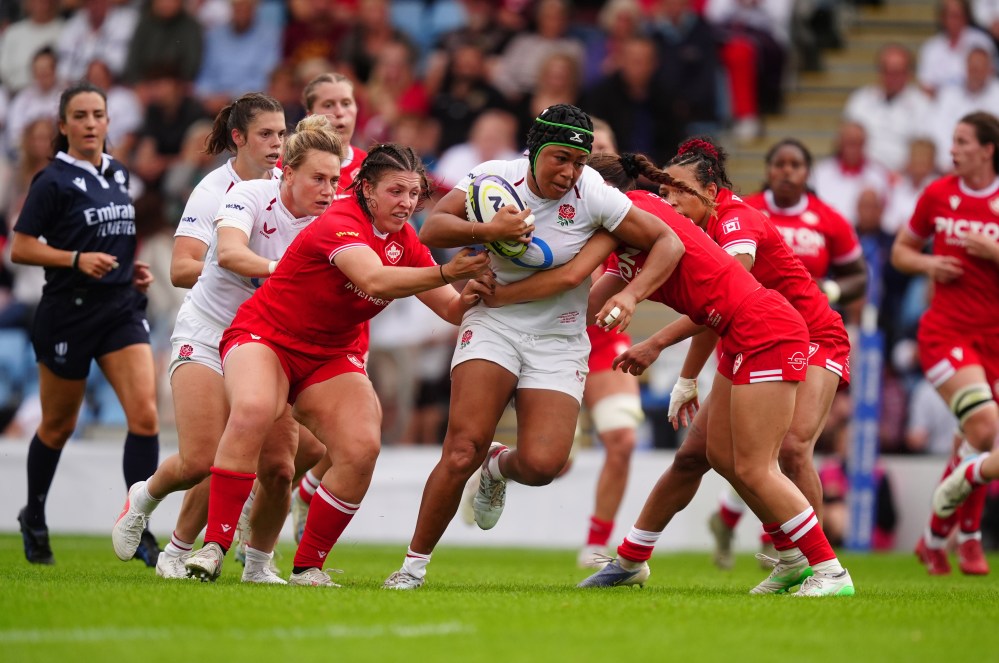
Saturday’s game will be the first between them since the Red Roses won the World Cup they hosted a year ago and replaced New Zealand as world champions. They were on track to meet in that 2025 final but New Zealand was humbled by Canada in the semifinals.
Canada went on to lose the final but rebounded last weekend by stopping England’s unprecedented 39-match winning streak in a gripping 26-26 draw in Exeter.
New Zealand is unbeaten this year at 7-0 under new coach Whitney Hansen.
___
See AP’s full rugby coverage here