Dalai Lama travels to remote Ladakh region bordering China

Advertisement

Advertise with us

SRINAGAR, India (AP) — The exiled Tibetan Buddhist spiritual leader the Dalai Lama on Friday arrived in India's remote Ladakh region bordering China where he received a rousing reception.

Read this article for free:


or

Already have an account? Log in here »

To continue reading, please subscribe:

Subscribe and receive a limited-edition Free Press branded hat or tote.

Digital Subscription

One year of digital access for only $205*

  • Enjoy unlimited reading on winnipegfreepress.com
  • Read the E-Edition, our digital replica newspaper
  • Access News Break, our award-winning app
  • Play interactive puzzles

*First annual payment billed as $205.00 + GST for one year. This annual subscription will automatically renew at $233.00 + GST every 52 weeks (10% off the regular annual price of $259.35). Offer available to new and qualified returning subscribers only. Cancel any time.

To continue reading, please subscribe:

Add Free Press access to your Brandon Sun subscription for only an additional

$1 for the first 4 weeks*

  • Enjoy unlimited reading on winnipegfreepress.com
  • Read the E-Edition, our digital replica newspaper
  • Access News Break, our award-winning app
  • Play interactive puzzles
Start now

*Your next Brandon Sun subscription payment will increase by $1.00 and you will be charged $17.95 plus GST for four weeks. After four weeks, your payment will increase to $24.95 plus GST every four weeks.

Hey there, time traveller!
This article was published 15/07/2022 (1524 days ago), so information in it may no longer be current.

SRINAGAR, India (AP) — The exiled Tibetan Buddhist spiritual leader the Dalai Lama on Friday arrived in India’s remote Ladakh region bordering China where he received a rousing reception.

Thousands of people lined both sides of the road outside the airport in the cold desert region’s Leh town to welcome the Dalai Lama, who is touring outside his base in the northern Indian city of Dharmsala for the first time since the outbreak of the coronavirus pandemic in 2020. He will stay in Ladakh for about 45 days.

The Dalai Lama has made Dharmsala his headquarters since fleeing from Tibet after a failed uprising against Chinese rule in 1959. India considers Tibet to be part of China, though it hosts Tibetan exiles.
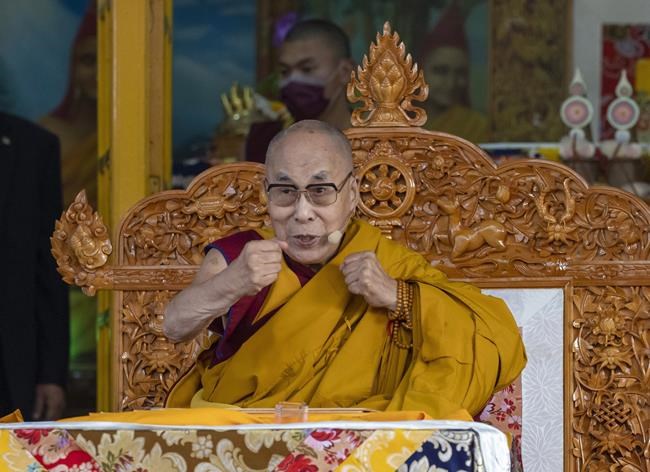
FILE- Tibetan spiritual leader the Dalai Lama gestures to indicate that he is in good health during a religious talk at the Tsuglakhang temple in Dharmsala, India, Friday, March 18, 2022. The Dalai Lama on Friday, July 15, 2022, arrived in the remote Ladakh region bordering China where he received a rousing reception. He will stay in Ladakh for about 45 days. (AP Photo/Ashwini Bhatia, File)

Officials said at least 20,000 people gathered all along the road to the Dalai Lama’s summer palace, some 10 kilometers (6 miles) from the airport. The ride took the spiritual leader about 90 minutes, since the entire stretch was filled with people jostling and some dancing in traditional attire.

They welcomed the spiritual leader by waving religious flags and Tibetan flags and showering the road with flower petals. At least 7,000 Tibetans live in Ladakh.

“Happy. Once more (I have) come (to) Ladakh,” the Dalai Lama said in tangled English as he entered his palace. “These people showing from heart this.”

The visit is also his first since India split the high-altitude region from disputed Kashmir and took direct control of it in 2019 while revoking the entire territory’s semiautonomous status. A year after that change, Indian and Chinese troops came close to war in Ladakh and ever since they have been locked in a military standoff along their disputed border.

China criticized India’s Prime Minister Narendra Modi for greeting the Dalai Lama on his 87th birthday earlier this month, saying New Delhi should stop using Tibet-related issues to interfere in China’s “internal affairs.”

India’s Foreign Ministry hit back and said: “It has been a consistent policy of our government to treat him as a guest in India and as a respected religious leader who enjoys a large following in India.”

Before his last visit in 2018, the Dalai Lama would frequently travel to Ladakh and deliver religious sermons in the region, which is famous for its Buddhist monks in mountaintop monasteries, sparsely populated and stunning landscapes and elusive snow leopards prowling rugged terrain.
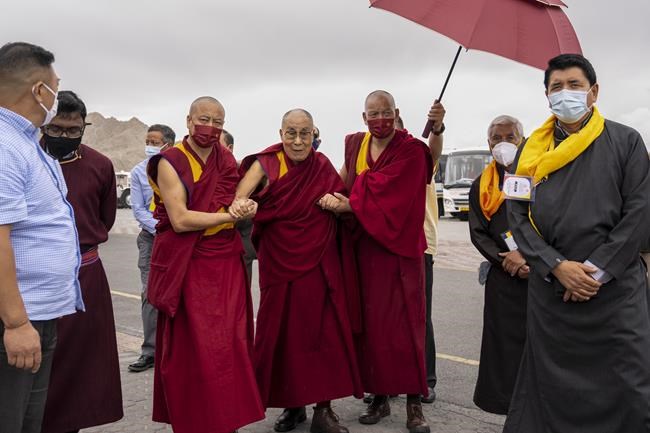
Tibetan spiritual leader the Dalai Lama arrives at the airport in Leh, Ladakh, India, Friday, July 15, 2022. The visit is also his first since India split the high-altitude region from disputed Kashmir and took direct control of it in 2019 while revoking the entire territory's semiautonomous status. A year after that change, Indian and Chinese troops came close to war in Ladakh and ever since they have been locked in a military standoff along their disputed border. (AP Photo/Tenzin Choejor)

China doesn’t recognize the Tibetan government-in-exile and hasn’t held any dialogue with the representatives of the Dalai Lama since 2010.

China says Tibet has historically been part of its territory since the mid-13th century, and the Communist Party has governed the Himalayan region since 1951. But many Tibetans say they were effectively independent for most of their history, and that the Chinese government wants to exploit their resource-rich region while crushing their cultural identity.

The Dalai Lama denies being a separatist and says he only advocates substantial autonomy and protection of Tibet’s native Buddhist culture.

Report Error Submit a Tip

The Free Press acknowledges the financial support it receives from members of the city’s faith community, which makes our coverage of religion possible.
More Stories

Manitoba mineral production set to triple, premier says

Carol Sanders 5 minute read Preview

Manitoba mineral production set to triple, premier says

Carol Sanders 5 minute read Updated: Yesterday at 5:19 PM CDT

Premier Wab Kinew said Tuesday Manitoba plans to triple mineral production in the next five years “to unlock a new era of wealth creation and growth.”

“We’re going to make sure that opportunity is spread throughout the province,” he told a news conference at the Canada investment summit in Toronto.

The province is working with industry and Indigenous governments to send a message to investors that “we’re going to do mining right in Manitoba,” the premier said.

For too long, Manitoba has lagged behind neighbouring provinces, Kinew said.

Read
Updated: Yesterday at 5:19 PM CDT

Food literacy curriculum on the menu

Maggie Macintosh 5 minute read Preview

Food literacy curriculum on the menu

Maggie Macintosh 5 minute read 2:01 AM CDT

Manitoba has a new recipe for health class and “food literacy” is a key ingredient.

The in-class portion of phys-ed has historically involved lessons about puberty, the risks of consuming drugs and dissecting Canada’s food guide.

A new pilot program asks teachers to expand their nutrition units and include in-depth discussions about how everything from diet culture to food insecurity affects eating habits.

“This is really moving beyond a conception of food as only fuel, where you just boil down food to its calories, its vitamins,” said Sarah Elvins, a food historian at the University of Manitoba who researches popular culture and marketing.

Read
2:01 AM CDT

You can’t hold a government accountable for what it won’t let you see.

Wind and batteries the best bet

James Wilt 5 minute read Preview

Wind and batteries the best bet

James Wilt 5 minute read 2:01 AM CDT

For years, Manitoba Hydro has claimed that we can’t rely on wind turbines during multi-day or even multi-week cold snaps.

Read
2:01 AM CDT

Seven years sought for serial harasser

Dean Pritchard 5 minute read Preview

Seven years sought for serial harasser

Dean Pritchard 5 minute read Yesterday at 2:01 AM CDT

Alexander Beaton finished serving a two-year jail sentence for criminally harassing six women and didn’t last two days in the community before he was back at it, sending unwanted obscene messages and videos to a dozen women.

Now prosecutors are seeking a seven-year prison sentence for the 30-year-old Winnipeg man, whose latest string of victims includes a police officer who investigated his earlier crimes.

“He essentially continued (offending) unabated,” Crown attorney Brett Rach told provincial court Judge Malcolm McDonald at a sentencing hearing Friday. “It caused more than a nuisance to these victims — it caused them to fear for their safety.”

Beaton pleaded guilty to 14 charges of criminal harassment, sending indecent communications and breaching court orders for a campaign of harassment waged between 2015 and 2025.

Read
Yesterday at 2:01 AM CDT

BRANDON — A 29-year-old man has been sentenced to 18 years in prison for sexually abusing and impregnating a 14-year-old girl in 2024.

“Sexual abuse of a child is inherently a grave violation of the child’s bodily integrity, dignity, and security, and in this case, the consequences were compounded by the victim’s pregnancy and the need to undergo a termination,” Brandon provincial court Judge Patrick Sullivan said on Tuesday.

The accused had pleaded guilty to two counts of sexual interference and two counts of breaching a court order banning him from contacting anyone under 18.

A publication ban prohibits the publication of information that could identify the 14-year-old, who is from a western Manitoba First Nation, and two other minors with whom he communicated.