3 scientists win Nobel physics prize for black hole research
Advertisement
Read this article for free:
or
Already have an account? Log in here »
To continue reading, please subscribe:
Monthly Digital Subscription
$1 per week for 24 weeks*
- Enjoy unlimited reading on winnipegfreepress.com
- Read the E-Edition, our digital replica newspaper
- Access News Break, our award-winning app
- Play interactive puzzles
*Billed as $4.00 plus GST every four weeks. After 24 weeks, price increases to the regular rate of $19.95 plus GST every four weeks. Offer available to new and qualified returning subscribers only. Cancel any time.
Monthly Digital Subscription
$4.99/week*
- Enjoy unlimited reading on winnipegfreepress.com
- Read the E-Edition, our digital replica newspaper
- Access News Break, our award-winning app
- Play interactive puzzles
*Billed as $19.95 plus GST every four weeks. Cancel any time.
To continue reading, please subscribe:
Add Free Press access to your Brandon Sun subscription for only an additional
$1 for the first 4 weeks*
*Your next subscription payment will increase by $1.00 and you will be charged $16.99 plus GST for four weeks. After four weeks, your payment will increase to $23.99 plus GST every four weeks.
Read unlimited articles for free today:
or
Already have an account? Log in here »
Hey there, time traveller!
This article was published 06/10/2020 (2025 days ago), so information in it may no longer be current.
STOCKHOLM – Three scientists won the Nobel Prize in physics Tuesday for establishing the all-too-weird reality of black holes — the straight-out-of-science-fiction cosmic monsters that suck up light and time and will eventually swallow us, too.
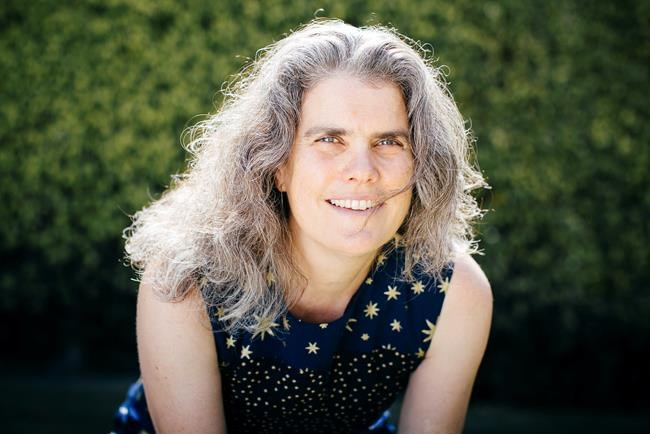
Roger Penrose of Britain, Reinhard Genzel of Germany and Andrea Ghez of the United States explained to the world these dead ends of the cosmos that are still not completely understood but are deeply connected, somehow, to the creation of galaxies.
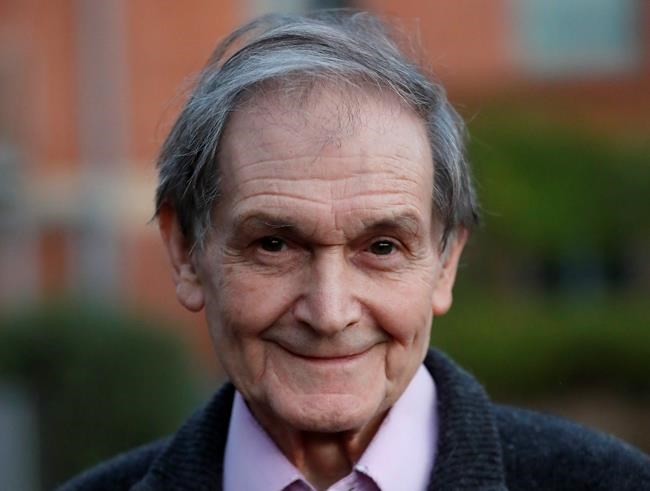
Penrose, an 89-year-old at the University of Oxford, received half of the prize for proving with mathematics in 1964 that Einstein’s general theory of relativity predicted the formation of black holes, even though Einstein himself didn’t think they existed.
Genzel, who is at both the Max Planck Institute in Germany and the University of California, Berkeley, and Ghez, of the University of California, Los Angeles, received the other half of the prize for discovering in the 1990s a supermassive black hole at the centre of our galaxy.
Black holes fascinate people because “the idea of some monster out there sucking everything up is a pretty weird thing,” Penrose said an interview with The Associated Press. He said our galaxy and the galaxies near us “will ultimately get swallowed by one utterly huge black hole. This is the fate … but not for an awful long time, so it’s not something to worry too much about.”
Black holes are at the centre of every galaxy, and smaller ones dot the universe. Just their existence is mind-bending. They are so massive that nothing, not even light, can escape their gravitational pull. They warp and twist light in a way that seems unreal and cause time to slow and stop.
“Black holes, because they are so hard to understand, is what makes them so appealing,’’ Ghez, 55, said after becoming the fourth woman ever to win a Nobel in physics. “I really think of science as a big, giant puzzle.”
While the three scientists showed the existence of black holes, it wasn’t until last year that people could see one for themselves when another science team captured the first and only optical image of one. It looks like a flaming doughnut from hell but is in a galaxy 53 million light-years from Earth.

Penrose, a mathematical physicist who got the call from the Nobel Committee while in the shower, was surprised at his winning because his work is more theoretical than observational, and that’s not usually what wins physics Nobels.
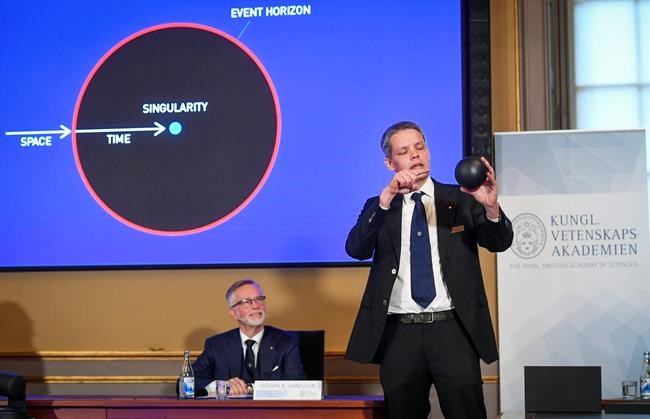
What fascinated Penrose more than the black hole was what was at the other end of it, something called the “singularity.” It’s something science still can’t figure out.
“Singularity, that’s a place where the densities and curvatures go to infinity. You expect the physics go crazy,” he said from his home. “If you fall into a black hole, then you pretty well inevitably get squashed into this singularity at the end. And that’s the end.”
Penrose said he was walking to work with a colleague 56 years ago, thinking about “what it would be like to be in this situation where all this material is collapsing around you.” He realized he had “some strange feeling of elation,” and that was when things started coming together in his mind.
Martin Rees, the British astronomer royal, noted that Penrose triggered a “renaissance” in the study of relativity in the 1960s, and that, together with a young Stephen Hawking, he helped firm up evidence for the Big Bang and black holes.

“Penrose and Hawking are the two individuals who have done more than anyone else since Einstein to deepen our knowledge of gravity,” Rees said. “Sadly, this award was too much delayed to allow Hawking to share the credit.”
Hawking died in 2018, and Nobel Prizes are awarded only to the living.
New York University astrophysicist Glennys Farrar said: “There is no doubt that if this prize were awarded when Hawking was still alive, he would share it. He did overall more significant work on this subject than almost anyone.”
Genzel, 68, and Ghez won because “they showed that black holes are not just theory — they’re real, they’re here, and there’s a monster-size black hole in the centre of our galaxy, the Milky Way,” said Brian Greene, a theoretical physicist and mathematician at Columbia University.
In the 1990s, Genzel and Ghez, leading separate groups of astronomers, trained their sights on the dust-covered centre of our Milky Way galaxy, a region called Sagittarius A(asterisk), where something strange was going on. It was “an extremely heavy, invisible object that pulls on the jumble of stars, causing them to rush around at dizzying speeds,” according to the Nobel Committee.
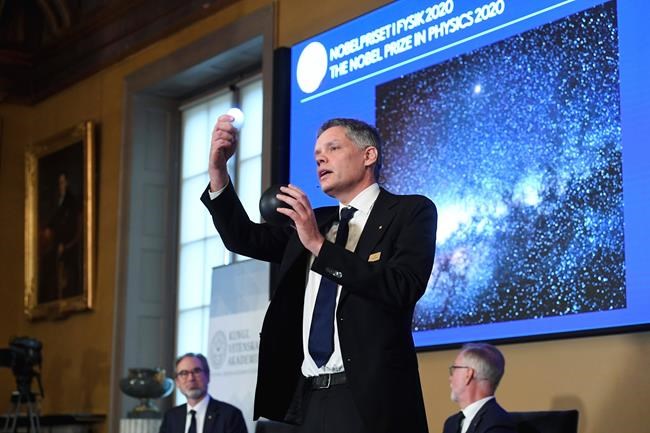
It was a black hole. Not just an ordinary black hole, but a supermassive one, 4 million times the mass of our sun.
The first image Ghez got was in 1995, using the Keck Telescope in Hawaii that had just gone online. A year later, another image seemed to indicate that the stars near the centre of the Milky Way were circling something. A third image led Ghez and Genzel to think they were really on to something.
A fierce competition developed between Ghez and Genzel, whose team was using an array of telescopes at the European Southern Observatory in Chile.
“Their rivalry elevated them to greater scientific heights,” said Harvard astronomer Avi Loeb.
Unlike with other achievements honoured with Nobels, there is no practical application for these discoveries.

“Is there a practical application to Beethoven’s Ninth Symphony?” Columbia’s Greene asked. “But its existence, this type of spectacular knowledge, is part of what gives life meaning.”
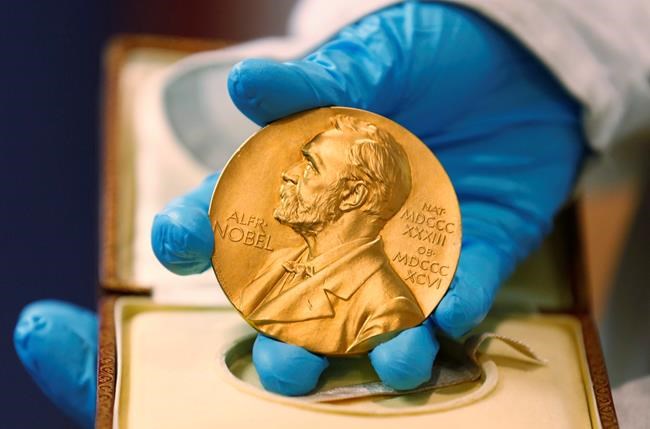
The Nobel comes with a gold medal and 10 million kronor (more than $1.1 million), courtesy of a bequest left 124 years ago by the prize’s creator, Alfred Nobel, the inventor of dynamite.
On Monday, the Nobel in medicine was awarded to Americans Harvey J. Alter and Charles M. Rice and British-born scientist Michael Houghton for discovering the liver-ravaging hepatitis C virus. The prizes for chemistry, literature, peace and economics will be announced in the coming days.
___
Borenstein reported from Kensington, Maryland, Jordans from Berlin. AP Science Writer Christina Larson in Washington contributed to this report.
___
Read more stories about Nobel Prizes past and present by The Associated Press at https://www.apnews.com/NobelPrizes