WEATHER ALERT

UN: Wildfires getting worse globally, governments unprepared

Advertisement

Advertise with us

BILLINGS, Mont. (AP) — A warming planet and changes to land use patterns mean more wildfires will scorch large parts of the globe in coming decades, causing spikes in unhealthy smoke pollution and other problems that governments are ill prepared to confront, according to a U.N. report released Wednesday.

Read this article for free:

or

Already have an account? Log in here »

To continue reading, please subscribe:

Subscribe and receive a limited-edition Free Press branded hat or tote.

Digital Subscription

One year of digital access for only $205*

  • Enjoy unlimited reading on winnipegfreepress.com
  • Read the E-Edition, our digital replica newspaper
  • Access News Break, our award-winning app
  • Play interactive puzzles

*First annual payment billed as $205.00 + GST for one year. This annual subscription will automatically renew at $233.00 + GST every 52 weeks (10% off the regular annual price of $259.35). Offer available to new and qualified returning subscribers only. Cancel any time.

To continue reading, please subscribe:

Add Free Press access to your Brandon Sun subscription for only an additional

$1 for the first 4 weeks*

  • Enjoy unlimited reading on winnipegfreepress.com
  • Read the E-Edition, our digital replica newspaper
  • Access News Break, our award-winning app
  • Play interactive puzzles
Start now

*Your next Brandon Sun subscription payment will increase by $1.00 and you will be charged $17.95 plus GST for four weeks. After four weeks, your payment will increase to $24.95 plus GST every four weeks.

Hey there, time traveller!
This article was published 23/02/2022 (1597 days ago), so information in it may no longer be current.

BILLINGS, Mont. (AP) — A warming planet and changes to land use patterns mean more wildfires will scorch large parts of the globe in coming decades, causing spikes in unhealthy smoke pollution and other problems that governments are ill prepared to confront, according to a U.N. report released Wednesday.

The Western U.S., northern Siberia, central India, and eastern Australia already are seeing more blazes, and the likelihood of catastrophic wildfires globally could increase by a third by 2050 and more than 50% by the turn of the century, according to the report from the United Nations Environment Program.

Areas once considered safe from major fires won’t be immune, including the Arctic, which the report said was “very likely to experience a significant increase in burning.”
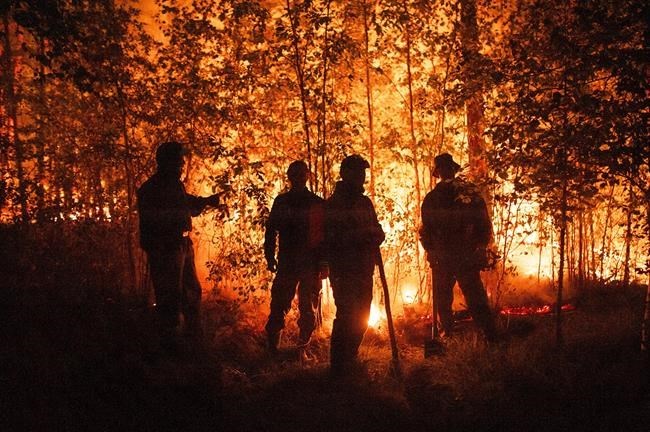
FILE -Firefighters work at the scene of forest fire near Kyuyorelyakh village at Gorny Ulus area, west of Yakutsk, in Russia Thursday, Aug. 5, 2021. A warming planet and land use changes mean more wildfires will scorch large parts of the globe in coming decades. That's according to a UN report released Wednesday, Feb. 23, 2022 that says many governments are ill-prepared to address the problem. (AP Photo/Ivan Nikiforov, File)

Tropical forests in Indonesia and the southern Amazon of South America also are likely to see increased wildfires, the report concluded.

“Uncontrollable and devastating wildfires are becoming an expected part of the seasonal calendars in many parts of the world,” said Andrew Sullivan, with the Commonwealth Scientific and Industrial Research Organisation in Australia, one of the report’s authors.

The report describes a worsening cycle: Climate change brings more drought and higher temperatures that make it easy for fires to start and spread, and in turn those blazes release more climate-changing carbon into the atmosphere as they burn through forests and peatland.

Some areas including parts of Africa are seeing decreasing wildfires, in part because more land is being devoted to agriculture, said report co-author Glynis Humphrey from the University of Cape Town.

But U.N. researchers said many nations continue to spend too much time and money fighting fires and not enough trying to prevent them. Land use changes can make the fires worse, such as logging that leaves behind debris that can easily burn and forests that are intentionally ignited to clear land for farming, the report said.

Poor communities are often hit hardest by fires, which can degrade water quality, destroy crops and reduce land available to grow food.

“It impacts people’s jobs and the economic situation that people are in,” Humphrey said. “It’s integral that fire be in the same category of disaster management as floods and droughts. It’s absolutely essential.”

In the United States, officials recently unveiled a $50 billion effort to reduce fire risks over the next decade by more aggressively thinning forests around “hot spots” where nature and neighborhoods collide. Only some of that work has funding so far — about $3 billion over five years under the recently passed federal infrastructure bill, according to officials in President Joe Biden’s administration.

Critics of the administration’s plan say it continues to put too much emphasis on fighting some fires that can be useful to clear out underbrush when the flames remain relatively small and don’t threaten houses.

The U.N. researchers also called for more awareness of the dangers from wildfire smoke inhalation, which can affect tens of millions of people annuall y as plumes from major wildfires drift thousands of miles across international borders.

Report Error Submit a Tip

More Stories

Mosquito-free summers nice while they lasted

Editorial, July 8 4 minute read Preview

Mosquito-free summers nice while they lasted

Editorial, July 8 4 minute read Yesterday at 7:11 AM CDT

It was nice while it lasted, wasn’t it? And it certainly seemed to last a long, lovely time. But with this spring and early summer’s unusually heavy rainfall and significant standing-water accumulation, our blissful vacation from mosquito swarming and swatting is most definitely over.

Read
Yesterday at 7:11 AM CDT

Songwriter reckons with past, present on new album

Ben Waldman 7 minute read Preview

Songwriter reckons with past, present on new album

Ben Waldman 7 minute read Yesterday at 2:00 AM CDT

Grab a kitchen scale and you’ll quickly see that Jacob Brodovsky’s newest LP is exactly the same weight as his last one, but Tell the Kids We Tried is still the heaviest music released by the singer-songwriter.

Read
Yesterday at 2:00 AM CDT

Auto body shops swamped following record-setting weather-related claims

Tyler Searle 6 minute read Preview

Auto body shops swamped following record-setting weather-related claims

Tyler Searle 6 minute read Yesterday at 6:24 PM CDT

Manitoba’s auto body industry has kicked into high gear after rain and hail battered parts of the province in early June, smashing windshields, submerging vehicles and shattering the 30-year-old record for the most auto insurance claims tied to a single weather event, new data shows.

Manitoba Public Insurance logged more than 30,000 insurance claims connected to the massive storm system that settled over Winnipeg and surrounding areas on June 9 — exceeding the record set during a 1996 hailstorm that generated 24,000 claims, data provided to the Free Press shows.

“Truthfully, it has never been this busy,” said Trevor Sprechert, general manager of Dr. Dent Winnipeg.

“I’ve seen windshields being broken, sunroofs, pretty substantial dents on hoods and roofs. There is a plethora of different types of damage.”

Read
Yesterday at 6:24 PM CDT

Paramedic petition fails to change folk fest first aid procedures

Eva Wasney 3 minute read Preview

Paramedic petition fails to change folk fest first aid procedures

Eva Wasney 3 minute read Updated: Yesterday at 9:45 PM CDT

Paramedics will not be stationed at Winnipeg Folk Festival this year despite a petition calling on the summer festival to enhance its on-site medical services.

Read
Updated: Yesterday at 9:45 PM CDT

Kathleen Edwards basking in musical liberation

Rob Williams 7 minute read Preview

Kathleen Edwards basking in musical liberation

Rob Williams 7 minute read 2:00 AM CDT

Kathleen Edwards is experiencing total freedom.

Years removed from taking a break from the music industry, the songwriter, who turns 48 on Saturday, has come to a certain peace about who she is as a person and a musician.

On her latest full-length, Billionaire, released last year, she wrote almost enough music for a double album, but time constraints limited her to a tight 10 tracks. Local music fans will get to hear some of those songs when Edwards returns to the Winnipeg Folk Festival Sunday.

“I think it’s an age thing. I think I’ve gotten less caught in, ‘What if this isn’t good, or is it?’ And now I’m like, ‘Oh, nothing is a waste of time on the creative front. Everything has a purpose.’

Read
2:00 AM CDT

Today’s horoscope

Georgia Nicols 4 minute read Preview

Today’s horoscope

Georgia Nicols 4 minute read 2:00 AM CDT

MOON ALERT: There are no restrictions to shopping or important decisions. The moon is in Taurus.

ARIES (March 21-April 19)

Your desire to relate to others, especially at work, will be stronger in the next four weeks, which is why you might choose to make peace with certain co-workers or customers. This will be easier to do. In fact, it’s an excellent time to extend an olive branch to someone.

TAURUS (April 20-May 20)

Read
2:00 AM CDT