

Official warns of failure-prone rail part
Nearly led to repeat of deadly 1947 Dugald disaster

Advertisement
Read this article for free:
or
Already have an account? Log in here »
To continue reading, please subscribe:
Monthly Digital Subscription
$0 for the first 4 weeks*
- Enjoy unlimited reading on winnipegfreepress.com
- Read the E-Edition, our digital replica newspaper
- Access News Break, our award-winning app
- Play interactive puzzles
*No charge for 4 weeks then price increases to the regular rate of $19.00 plus GST every four weeks. Offer available to new and qualified returning subscribers only. Cancel any time.
Monthly Digital Subscription
$4.75/week*
- Enjoy unlimited reading on winnipegfreepress.com
- Read the E-Edition, our digital replica newspaper
- Access News Break, our award-winning app
- Play interactive puzzles
*Billed as $19 plus GST every four weeks. Cancel any time.
To continue reading, please subscribe:
Add Free Press access to your Brandon Sun subscription for only an additional
$1 for the first 4 weeks*
*Your next subscription payment will increase by $1.00 and you will be charged $16.99 plus GST for four weeks. After four weeks, your payment will increase to $23.99 plus GST every four weeks.
Read unlimited articles for free today:
or
Already have an account? Log in here »
Hey there, time traveller!
This article was published 26/08/2010 (5595 days ago), so information in it may no longer be current.
It was almost a deadly case of history repeating itself.
Sixty-two years after two CN Rail trains collided in Dugald, killing 31 passengers and crew, a faulty part on a tank car filled with flammable chemicals could have led to another tragedy there.
Fortunately, the tank car stayed on the track on Jan. 14, 2009, and rolled to a stop after the faulty part caused it to disengage from the other rail cars.
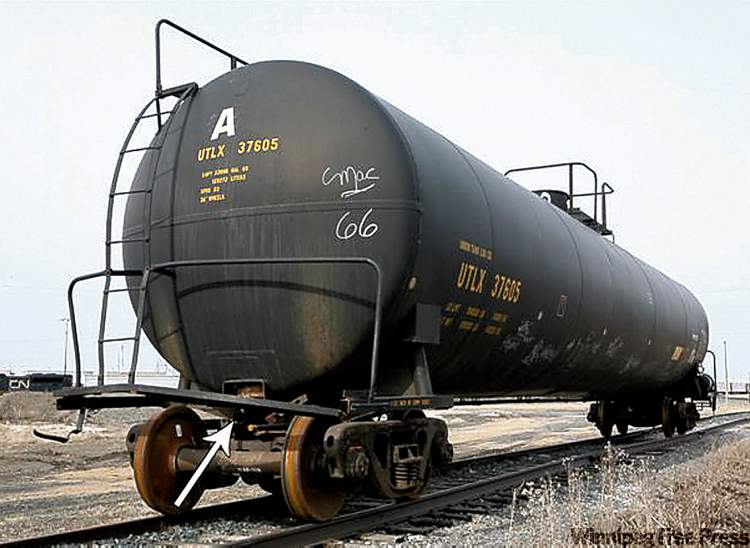
There were no injuries or damages.
But, much like the earlier collision that led to new safety measures in trains across North America, the latest incident could also help increase safety because the Transportation Safety Board of Canada has now identified 41,000 other tanker cars that have the same part prone to failure.
And the TSB says 35,000 of them carry dangerous chemicals.
Rob Johnston, the TSB’s acting rail/pipeline director of investigations, said the broken part — called a stub sill — is on 13 per cent of the tank-car population, but accounts for 34 per cent of the cracked parts and 100 per cent of the broken ones in Canada. The part is used to attach tank cars to each other.
"These numbers are alarming and must not be ignored," Johnston said on Wednesday.
"It’s very fortunate (there was no accident). It is one of the times we can be positive. Usually we show up with a big hole in the ground."
But the TSB stopped short of recommending that all of the tank cars be pulled off the rails.
"We’ve identified the problem — it’s up to the regulators to come up with a fix," Johnston said.
Later, in an email to the Free Press, a Transport Canada official said the department is reviewing the TSB’s recommendations. The official said the department has 90 days to respond.
But the official said Transport Canada has already implemented several measures to increase safety including working with Union Tank Car, the manufacturer of the tank car, beginning a targeted inspection program for the tank cars, accelerating the re-welding program for the cars and doing an engineering analysis to see if the stub sill can still work with today’s loads and environment.
According to the TSB’s 34-page report, the tank car filled with 23,360 kilograms of liquid propylene, was the 41st car in a 72-car train bound from Winnipeg to Toronto on Jan. 14, 2009.
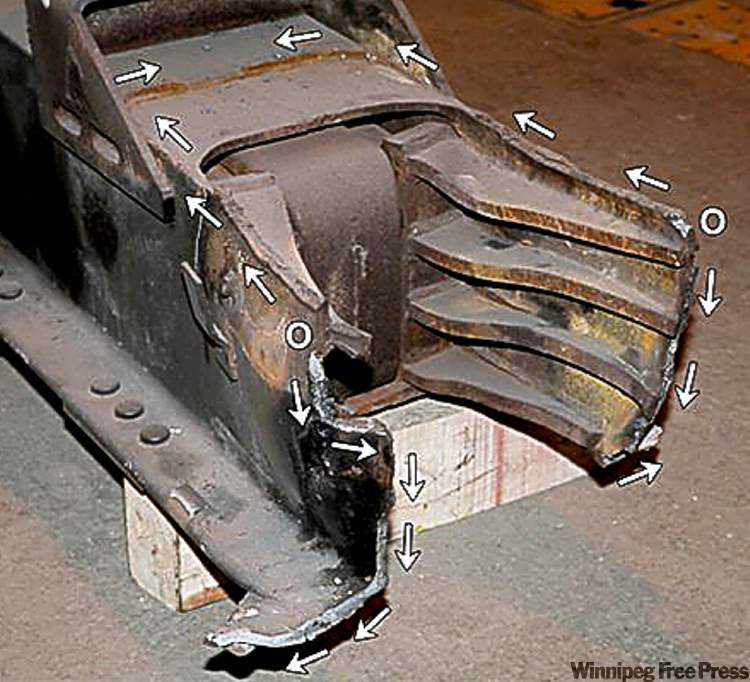
The train had just accelerated to 6.4 kilometres per hour at about 3:30 a.m., when the stub sill broke and the car separated from the other cars, causing the train’s emergency brake to go on.
While no dangerous chemical leaked out, the chemical inside the car later had to be burned off for three days because the parts inside the tank were also damaged.
But when the TSB investigated the incident, they found not only was the stub sill responsible for the incident, they also determined it was hard to find out how many times it had happened before because there is no central place where the information is collected.

As well, because the tank cars with these parts were manufactured before 1995, many of them are scrapped when there is a part failure with no record being made of the stub sill breaking.
John Ferguson, one of the TSB’s senior regional investigators for rail/pipeline, said it’s hard for inspectors to catch the problem.
"When you look at the car, you would see nothing defective," Ferguson said.
kevin.rollason@freepress.mb.ca
Kevin Rollason is a general assignment reporter at the Free Press. He graduated from Western University with a Masters of Journalism in 1985 and worked at the Winnipeg Sun until 1988, when he joined the Free Press. He has served as the Free Press’s city hall and law courts reporter and has won several awards, including a National Newspaper Award. Read more about Kevin.
Every piece of reporting Kevin produces is reviewed by an editing team before it is posted online or published in print — part of the Free Press‘s tradition, since 1872, of producing reliable independent journalism. Read more about Free Press’s history and mandate, and learn how our newsroom operates.
Our newsroom depends on a growing audience of readers to power our journalism. If you are not a paid reader, please consider becoming a subscriber.
Our newsroom depends on its audience of readers to power our journalism. Thank you for your support.
Kevin Rollason is a general assignment reporter at the Free Press. He graduated from Western University with a Masters of Journalism in 1985 and worked at the Winnipeg Sun until 1988, when he joined the Free Press. He has served as the Free Press’s city hall and law courts reporter and has won several awards, including a National Newspaper Award. Read more about Kevin.
Every piece of reporting Kevin produces is reviewed by an editing team before it is posted online or published in print — part of the Free Press‘s tradition, since 1872, of producing reliable independent journalism. Read more about Free Press’s history and mandate, and learn how our newsroom operates.
Our newsroom depends on a growing audience of readers to power our journalism. If you are not a paid reader, please consider becoming a subscriber.
Our newsroom depends on its audience of readers to power our journalism. Thank you for your support.
Advertisement Advertise With Us
Advertisement Advertise With Us