

Speed cameras’ safety value doesn’t add up
MPI reports more collisions, police data show decrease
Advertisement
Read this article for free:
or
Already have an account? Log in here »
To continue reading, please subscribe:
Digital Subscription
One year of digital access for only $1.44 a week*
- Enjoy unlimited reading on winnipegfreepress.com
- Read the E-Edition, our digital replica newspaper
- Access News Break, our award-winning app
- Play interactive puzzles
*Billed as $5.77 plus GST every four weeks. After 52 weeks, price increases to the regular rate of $19.95 plus GST every four weeks. Offer available to new and qualified returning subscribers only. Cancel any time.
To continue reading, please subscribe:
Add Free Press access to your Brandon Sun subscription for only an additional
$1 for the first 4 weeks*
- Enjoy unlimited reading on winnipegfreepress.com
- Read the E-Edition, our digital replica newspaper
- Access News Break, our award-winning app
- Play interactive puzzles
*Your next Brandon Sun subscription payment will increase by $1.00 and you will be charged $17.95 plus GST for four weeks. After four weeks, your payment will increase to $24.95 plus GST every four weeks.
Read unlimited articles for free today:
or
Already have an account? Log in here »
Hey there, time traveller!
This article was published 24/09/2010 (5870 days ago), so information in it may no longer be current.
A long-awaited independent report on the safety value of Winnipeg’s speed cameras is still weeks away from being submitted, a city police spokesman said Thursday.
The Winnipeg Police Service hired the Traffic Injury Research Foundation (TIRF) more than a year ago to review whether the intersection cameras and mobile photo radar units influenced driver habits not only at camera locations, but everywhere.
Staff-Sgt. Mark Hodgson said the TIRF study will look at whether or not the cameras have got people to slow down. TIRF is still collecting data on the cameras and collisions. Once that’s done it will take six to eight weeks to submit its report.
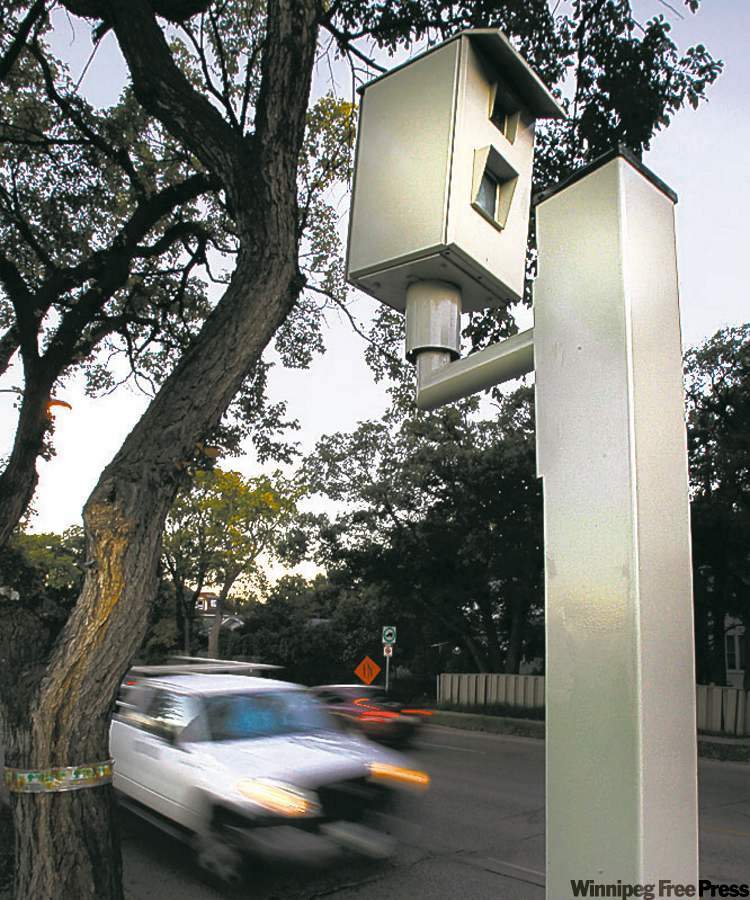
“We’re not going to ask them to hurry up and do a report,” Hodgson said, in response to a report that said the average number of crashes at the city’s 12 original red-light camera intersections jumped 18 per cent since the devices were installed in 2003. The crash data was supplied by Manitoba Public Insurance.
MPI and police compile intersection collision data differently. MPI’s numbers are based on claims and police numbers are based on collision reports to police.
Police collision numbers from 2009 show there has been an overall decrease of 31 per cent in the number of collisions at the original 12 camera locations.
Mayor Sam Katz said data from police also show right-angle collisions are down 64.9 per cent at the original 12 camera locations. He added as a result injuries from right-angle crashes are down 77.8 per cent. Katz said rear-end collisions are up 1.6 per cent, but that rear-end injuries are down 11.8 per cent.
“If you look at the statistics from the Winnipeg Police Service, it’s having a positive impact,” Katz said of photo enforcement.
Revenue from the Photo Enforcement Program was $11,171,776 in 2009, according to the Photo Enforcement Safety Program’s 2009 annual report. The cost of running the program was $5,231,105 for a surplus of $4,940,672 that goes to the police service to fund other policing activities.
Mayoral challenger Judy Wasylycia-Leis said the information she’s reviewed also suggests red-light cameras do play an important role in reducing fatalities at high-traffic intersections.
She said the city must continue to monitor the cameras to ensure public safety — not revenue — remains the goal of the program. She also said she would like to see the city add one second to amber lights on a pilot-project basis, at a small number of intersections that would be selected by traffic engineers.
When police first brought in the cameras under former Mayor Glen Murray they said the long-term goal was to make city streets safer by reducing speeding.

Police also say in the 2009 annual report that there has been a decline in the number of speeding violations of vehicles monitored by the mobile photo radar units. Of the 12,387,062 vehicles that drove past the cameras in 2009, only .536 per cent (66,383) of those vehicles were in violation. That number represents a reduction from 2008 and is the lowest since photo enforcement’s inception. In 2008, 12,269,23 vehicles were monitored by mobile photo radar with 118,692 getting speeding tickets.
Earlier this year, TIRF released its findings from a public opinion poll on what Winnipeggers think of the cameras.
It said almost 80 per cent of Winnipeggers believe photo enforcement makes the public more aware about speeding while 81 per cent support its continuation.
The survey also said support for photo radar remains high at about 74 per cent even among those who’ve been caught speeding by the cameras. Seventy-one per cent also said they believed the program improves road safety in Winnipeg.
The poll also found that the actual percentage of respondents reporting concern about overall road safety was only 54 per cent, indicating that it’s considered a mid-level priority to the public.
A history of car crashes
A 10-year history of collision statistics in Winnipeg reported to police. Excludes collisions in parking lots and back lanes. It compares the number of crashes to the number of registered vehicles in Winnipeg. The last number is the total number of pedestrian deaths and people killed in car crashes. The red-light cameras were installed in 2003.
1999 — 14,242 (389,451) 21 people killed
2000 — 15,185 (394,673) 17 people killed
2001 — 14,620 (402,613) 20 people killed
2002 — 15,315 (428,851) 20 people killed
2003 — 16,392 (429,651) 21 people killed
2004 — 5,859 (440,728) 20 people killed
2005 — 14,752 (447,422) 15 people killed
2006 — 13,927 (466,626) 19 people killed
2007 — 13,819 (465,708) 25 people killed
2008 — 2,645 (476,984) 14 people killed
— Source: City of Winnipeg
Related Articles
Longer amber logical
Advertisement Advertise With Us
Advertisement Advertise With Us