

Young, deaf athletes get a sporting chance
Get access to free interpretation

Advertisement
Read this article for free:
or
Already have an account? Log in here »
To continue reading, please subscribe:

Digital Subscription
One year of digital access for only $205*
- Enjoy unlimited reading on winnipegfreepress.com
- Read the E-Edition, our digital replica newspaper
- Access News Break, our award-winning app
- Play interactive puzzles
*First annual payment billed as $205.00 + GST for one year. This annual subscription will automatically renew at $233.00 + GST every 52 weeks (10% off the regular annual price of $259.35). Offer available to new and qualified returning subscribers only. Cancel any time.
To continue reading, please subscribe:
Add Free Press access to your Brandon Sun subscription for only an additional
$1 for the first 4 weeks*
- Enjoy unlimited reading on winnipegfreepress.com
- Read the E-Edition, our digital replica newspaper
- Access News Break, our award-winning app
- Play interactive puzzles
*Your next Brandon Sun subscription payment will increase by $1.00 and you will be charged $17.95 plus GST for four weeks. After four weeks, your payment will increase to $24.95 plus GST every four weeks.
Read unlimited articles for free today:
or
Already have an account? Log in here »
Hey there, time traveller!
This article was published 01/10/2013 (4710 days ago), so information in it may no longer be current.
Rick Zimmer knows what it’s like to be playing sports when you can’t hear the coach.
When he was younger, Zimmer, who is deaf, could shoot a puck and skate during a hockey game, but, without a sign language interpreter, he missed out on advice from his coach to take his game to the next level.
Now, thanks to a mediated settlement facilitated by the Manitoba Human Rights Commission, Zimmer’s 16-year-old son, Cody, and other young deaf athletes will have access to American Sign Language (ASL) interpretation services during games.
The province’s Sport Secretariat, through its agency Sport Manitoba, has agreed to pay up to $40,000 per year to help deaf children communicate with coaches and game officials during sport activities.
The agreement comes after the parents of five children who are deaf complained it was systemic discrimination not to provide sign language service at games. The agreement also comes before the commission investigated so there was no determination if the issue was discrimination.
“Cody will be thrilled,” Zimmer said on Monday of his son who was one of the five. Cody, currently studying at the Maryland School for the Deaf where he is on the school’s football team, played for the provincial soccer team two years ago when he was 14.
“I’m sure there will now be other deaf athletes who come out. It means the struggling and looking for teams to play on is over.
“People who are deaf will be able to be on any team.”
Zimmer said he knows what it’s like to not have an interpreter because once he didn’t tell Cody an interpreter wouldn’t be at one of his soccer games.
“He said he felt like a fool,” the dad said. “He said ‘I don’t want to go out there and look stupid.’ He said he didn’t want to go again when he didn’t have an interpreter.”
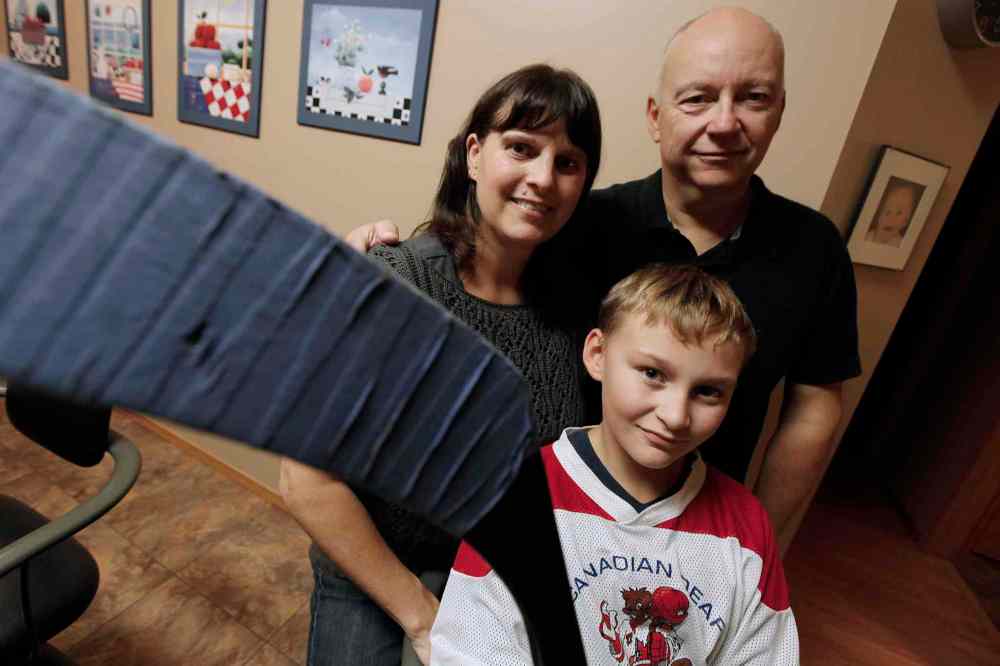
Cheryl and Brian Broszeit were two of the driving forces behind the ASL agreement. They knew first-hand what interpretation services were worth, both to their 10-year-old son, Tylo, who plays hockey and golf, and to their bank account.
“It has been a four or five-year fight. We think it’s wonderful. Tylo will have the opportunity to learn all the technical aspects of sport so he’ll be able to progress just the same way a non-deaf child would,” Cheryl Broszeit said.
The Broszeits estimated they spent between $3,000 and $6,000 per year for the last five or six years on interpretation services for Tylo.
He started playing hockey at age four but he had no interpreter at that point. He had to rely on a demonstration first and once he had seen how the other players would do a drill, he would go. His parents, both of whom are also deaf, were doing the same thing in the stands and relaying messages to him.
Some of Tylo’s teammates over the last few years — he’s playing for the Fort Garry Black A3 team this year — have learned some basic sign language so they can communicate a little.
“They’ve been able to develop a relationship and get to know each other,” she said.
Tylo’s sporting goal, however, is to become a professional golfer.
“Without the interpretation services, it would limit his opportunities for sure and his dreams would never be fulfilled. Now it’s allowing him to dream just like any other child,” she said.
In an emailed statement from the Manitoba Deaf Sport Association, which has 23 deaf athletes registered, president Cliff Beaulieu and the rest of his board of directors said they were pleased to learn about the agreement.
“This goes to show that our language barriers have been recognized after years of frustrations of recruiting interpreters in Deaf sports,” they said.
“This will now give youth athletes (a) sense of pride and sense of self-esteem participating in their sports knowing they will no longer be ‘left out on the sidelines’ and be able to ‘fit’ in with others among their hearing teammates.”
The association hopes not only will more deaf athletes take advantage of sports, but it may end up seeing more local athletes reach the Canadian Deaf Championships and the international Deaflympics.
Yvonne Peters, vice-chairwoman of the Manitoba Human Rights Commission, said “it’s a good news story.
“This is for all the children who are deaf and require sign language interpretation. This does seem to be a leading-edge settlement for these children. If the deaf kids are going to participate and benefit the way the others do for skills development and coaching they need to understand.
“We’re pretty happy and pretty pleased.”
Jeff Hnatiuk, president and CEO of Sport Manitoba, said it already supports organizations like the Manitoba Deaf Sport Association, but this is the first time it has funded a service to help athletes with disabilities participate in mainstream sports leagues and activities.
“This is new to us and we’ll be looking to the experts in the field,” Hnatiuk said.
“We’re not aware of other programs this specific… we see it as a very positive program that we’re able to implement.”
Hnatiuk said the $40,000 will come out of its existing budget that is funded by the province, but he said Sport Manitoba will not have to cut other sport funding to find the cash.

Bonnie Heath, executive director of E-Quality Communication Centre of Excellence (ECCOE), which offers sign language interpretation, said “there is a need out there.
“Sign language interpretation is not just for the deaf people, we are the interpreters for the coaches too… they’re the ones who don’t know sign language.”
Heath said the $40,000 will go a long way toward paying for the service youth athletes need.
kevin.rollason@freepress.mb.ca
Some have called increased funding to sign language interpretation for deaf children who play sports a “luxury we can’t afford.” Yet others say playing sports helps these children take part fully in the community. How should the system deal with the so-called “invisible” disabilities? Join the conversation in the comments below.
Kevin Rollason
Reporter
Kevin Rollason was a general assignment reporter at the Free Press.
Our newsroom depends on a growing audience of readers to power our journalism. If you are not a paid reader, please consider becoming a subscriber.
Our newsroom depends on its audience of readers to power our journalism. Thank you for your support.
WHEN COMMUNICATING WITH DEAF PEOPLE:
- Make sure you have the attention of the deaf person before communicating.
- Use facial expression and natural mouth movement.
- If possible, include the deaf person in the conversation when a hearing person joins. No one likes to be left out.
- Help the deaf person to feel comfortable during social gatherings. Introduce them to your hearing friends.
Kevin Rollason
Reporter
Kevin Rollason was a general assignment reporter at the Free Press.
Our newsroom depends on a growing audience of readers to power our journalism. If you are not a paid reader, please consider becoming a subscriber.
Our newsroom depends on its audience of readers to power our journalism. Thank you for your support.
Advertisement Advertise With Us
Advertisement Advertise With Us
History
Updated on Tuesday, October 1, 2013 6:22 AM CDT: Replaces photo, adds question for discussion