

Put Transport Canada in charge of rail crossings
Advertisement
Read this article for free:
or
Already have an account? Log in here »
To continue reading, please subscribe:
Monthly Digital Subscription
$0 for the first 4 weeks*
- Enjoy unlimited reading on winnipegfreepress.com
- Read the E-Edition, our digital replica newspaper
- Access News Break, our award-winning app
- Play interactive puzzles
*No charge for 4 weeks then price increases to the regular rate of $19.95 plus GST every four weeks. Offer available to new and qualified returning subscribers only. Cancel any time.
Monthly Digital Subscription
$4.99/week*
- Enjoy unlimited reading on winnipegfreepress.com
- Read the E-Edition, our digital replica newspaper
- Access News Break, our award-winning app
- Play interactive puzzles
*Billed as $19.95 plus GST every four weeks. Cancel any time.
To continue reading, please subscribe:
Add Free Press access to your Brandon Sun subscription for only an additional
$1 for the first 4 weeks*
*Your next subscription payment will increase by $1.00 and you will be charged $16.99 plus GST for four weeks. After four weeks, your payment will increase to $23.99 plus GST every four weeks.
Read unlimited articles for free today:
or
Already have an account? Log in here »
Hey there, time traveller!
This article was published 29/04/2015 (3902 days ago), so information in it may no longer be current.
“See Tracks, Think” is the key message of this year’s Rail Safety Week, a national week of activities devoted to educating the public about dangers associated with railway crossings.
People should think “train”, “danger” or “death” when they see tracks. Most importantly, they should think about the impact that a lack of awareness around railway property can have on them, their family, the community and railway employees.
The Transportation Safety Board lists railway crossing safety as an issue that poses a great risk to Canada’s transportation system, and one that needs addressing immediately. Roadway-railway crossing accidents account for nearly 20 per cent of all rail accidents in Canada, and sadly, 30 per cent of these accidents result in death or serious injury. Last year, 21 souls were lost to railway crossing accidents in Canada.
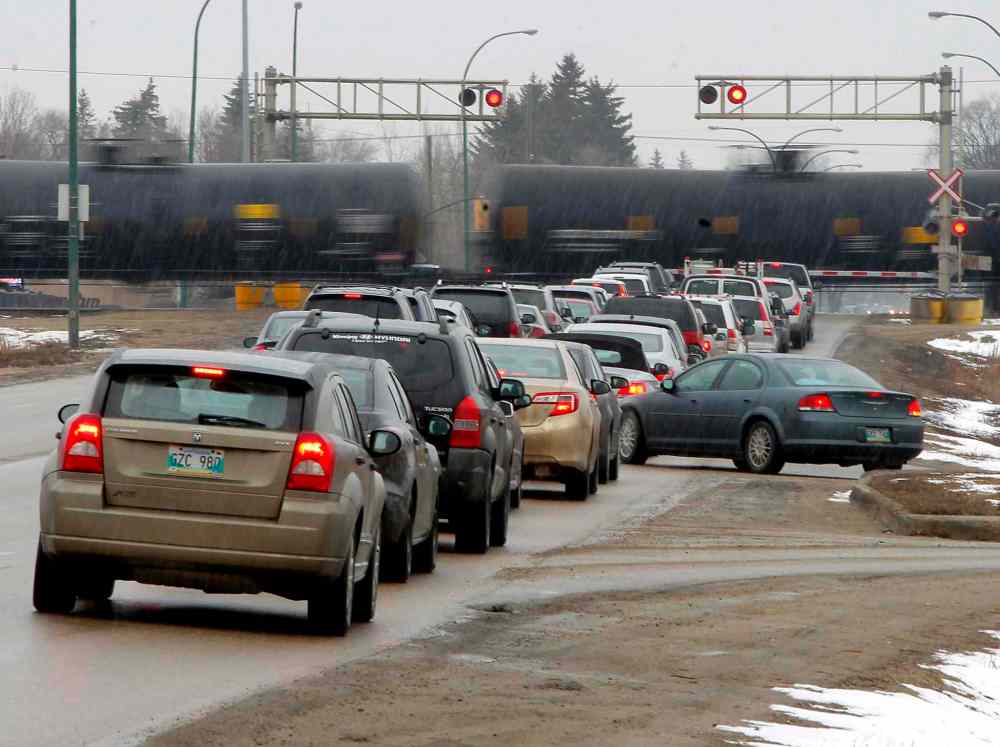
Over the last 10 years, crossing safety in Canada has generally improved. Accidents have decreased thanks to railway company investments, new regulations, and joint industry-government efforts such as Operation Lifesaver, which works to educate the public about trespassing on railway property and the hazards associated with crossings.
But recently, the number of crossing incidents has not decreased. In 2014, there were 180 crossing accidents in Canada, a total similar to the previous year, and to the five-year average. This total is not surprising, due to record levels of road and rail traffic. But the trend is concerning, and will not improve unless activity at crossings declines.
The opening of new crossings has contributed to the issue. When the Canada Transportation Act was passed in 1996, it gave the Canadian Transportation Agency the authority to order a railway company to build a suitable private crossing if it “considers it necessary for the owner’s enjoyment of the land.”
At the time, no one foresaw an increase in new crossings, nor did they consider the severe impact of these crossings on public safety and railway capacity. But communities have since grown in proximity to railway lines, traffic has increased at Canada’s tens of thousands of existing crossings, and additional crossings have been built to relieve traffic congestion in many municipalities.
As Canadians increasingly rely on rail, the best way to improve public safety and railway capacity is to reduce the number of crossings.
Unfortunately, the existing regulatory approach for opening and closing rail crossings in Canada is standing in the way of this goal. Under the existing regime, Transport Canada has the authority to close grade crossings, while the Canadian Transportation Agency has the authority to open new crossings, without the need to assess public safety.
This dichotomy in authority is jeopardizing public safety, and has led to some counterproductive outcomes. In one case, for example, the agency ordered CP to open a crossing just after Transport Canada had ordered it permanently closed for safety reasons.
New crossings should only be approved as a last resort and if no alternatives exist. In the event of a new crossing opening, an existing one should be closed so that there is no net increase to the number of crossings.
While public safety should be the main motivation for closing crossings, there is also an economic argument to be made. The economy depends on Canada’s railways to move 75 million people and more than $280 billion worth of goods each year. Crossings have the effect of slowing rail traffic for people and goods. Crossing accidents negatively affect people, railway employees, communities, the environment and business. Railways need to maintain fluidity on their mainline tracks in order to deliver high levels of service to their customers. These stretches of track are like highways; when an accident occurs, the whole network gets clogged, resulting in negative economic outcomes, impacting other customers and the public.
Transport Canada should maintain its authority to close all unsafe crossings. The department regulates the overall safety of crossings in Canada, understands the associated dangers of railway crossings, and has developed regulations and grade crossing closure and upgrade programs to deal with this issue.
In addition, sole authority to open new crossings should be given to Transport Canada so that public safety is always considered in the approval process for new railway crossings.

The Canada Transportation Act review that’s currently underway should consider how to reduce the number of rail crossings in Canada, and how to apply appropriate protections to those that remain.
Organizations like Operation Lifesaver and events like Rail Safety Week help to raise awareness about this issue, but these efforts get curtailed if crossings continue to open without due consideration of public safety. Operation Lifesaver’s network – made up of railway companies, labour groups, law enforcement and community volunteers – hosts more than 500 rail safety presentations and activities across Canada each year. Since 2003, the year that Rail Safety Week was launched, crossing accidents in Canada have been reduced by 28 per cent.
This outreach has resulted in progress. If these efforts continue, and the regulatory regime evolves, together we can improve crossing safety in Canada.
Michael Bourque is president and CEO of the Railway Association of Canada.