

Long, winding road downhill
Beatles milestone a reminder that pop music no longer is transformational
Advertisement
Read this article for free:
or
Already have an account? Log in here »
To continue reading, please subscribe:

Digital Subscription
One year of digital access for only $205*
- Enjoy unlimited reading on winnipegfreepress.com
- Read the E-Edition, our digital replica newspaper
- Access News Break, our award-winning app
- Play interactive puzzles
*First annual payment billed as $205.00 + GST for one year. This annual subscription will automatically renew at $233.00 + GST every 52 weeks (10% off the regular annual price of $259.35). Offer available to new and qualified returning subscribers only. Cancel any time.
To continue reading, please subscribe:
Add Free Press access to your Brandon Sun subscription for only an additional
$1 for the first 4 weeks*
- Enjoy unlimited reading on winnipegfreepress.com
- Read the E-Edition, our digital replica newspaper
- Access News Break, our award-winning app
- Play interactive puzzles
*Your next Brandon Sun subscription payment will increase by $1.00 and you will be charged $17.95 plus GST for four weeks. After four weeks, your payment will increase to $24.95 plus GST every four weeks.
Read unlimited articles for free today:
or
Already have an account? Log in here »
Hey there, time traveller!
This article was published 05/02/2014 (4598 days ago), so information in it may no longer be current.
It’s an odd thing. Sometimes, when I speak before high school or college students, someone in the audience, knowing I began my professional life as a pop music critic, will ask what I think of music today. I always demur that I don’t listen to a lot of it, but that most of what I do hear kind of, well… bores me. While there are exceptions — i.e., Adele — much of it feels corporate, cold, plastic, image-driven, less reflective of talent than tech, more programmed than played.
Of course, the old folks are not supposed to get the young folks’ music. That’s the whole point of the young folks’ music.
But here’s the odd part: After I’ve said all this, as I’m bracing to take my lumps for being antique and out of touch, the young people — many of them, anyway — tell me I’m right. They agree with me. That’s not supposed to happen and it says something that it does.
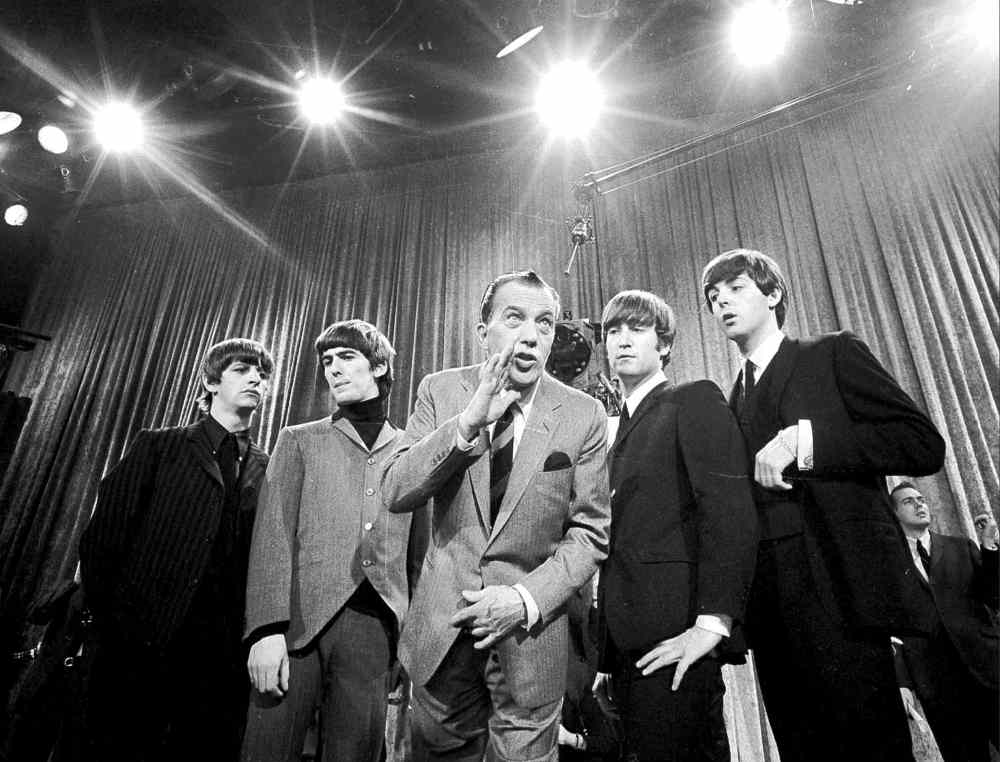
What it says is worth pondering as we commemorate a milestone in popular music and culture. On Friday, it will be 50 years since the Beatles landed in New York City. They would appear on The Ed Sullivan Show — in 1964 Sullivan was what passed for music television — over three successive Sundays, twice from New York, once from the Deauville Hotel in Miami Beach. They also squeezed in a concert in Washington.
There is a great photo that captures the pandemonium of that era: It shows a hapless New York City cop carrying some girl who just passed out, limbs splayed, knocked senseless by proximity to the “lads from Liverpool.” John Lennon, Paul McCartney, George Harrison and Ringo Starr brought their bright harmonies, jangling guitars, long-for-1964 hair and cheeky irreverence to America, and American girls responded in shrieks while suddenly ignored American boys practised looking indifferent, as if they were cinder blocks who could stand, unmoved and unchanged, by the wave now washing over them.
But they were not cinder blocks, they were sandcastles. We all were. The Beatles rode the forefront of a wave that would reshape everything — music fashion, culture, politics — and neither America nor the world would ever be the same.
It is hard to imagine that Justin Bieber or Chris Brown, extraordinarily popular as they are, give anyone that finger-stuck-in-a-wall-socket shock of something new, that lunar landing sense of discovery, that fizzy realization that you have found something made for you, about you, definitive of you and your times — not them and theirs. Has that happened since hip hop hit middle age? Hasn’t the culture become repetitive and pro forma, contenting itself with staged provocations (Madonna kissing Britney, Kanye mugging Taylor) that pretend to portend Something New Happening, but really do not? Like they’re all just trying too hard?
It’s too bad. That moment of Something New Happening is the birthright of every generation. To hear young people agree with some aging boomer about their music is to feel they have been cheated. Apparently, some of them know it. They’re the ones telling me I’m right and listening to Beatles songs on their phones. When I was that age, I’d have put my ears out rather than listen to Nat King Cole.
Because popular music is about breaking away from the staid normalcy of what came before. But maybe in an era where Mom has tattoos and Dad has a boyfriend, there’s nothing left to break away from. That’s pop culture’s victory and burden, the unseen thing Justin Bieber and Rihanna struggle against.

They ply their trade in a day when change has a tour jacket and a corporate sponsor. But as that girl passed out in a policeman’s arms could tell you: It’s just not the same. Fifty years ago, change stepped off a jet at JFK and sent the country into an uproar. We have gained much — but lost a few things, too — on the long and winding road since then.
Leonard Pitts Jr., winner of the 2004 Pulitzer Prize for commentary, is a columnist for the Miami Herald.
— McClatchy Tribune Services