

Parallels of 1914 and 2014
Advertisement
Read this article for free:
or
Already have an account? Log in here »
To continue reading, please subscribe:
Monthly Digital Subscription
$0 for the first 4 weeks*
- Enjoy unlimited reading on winnipegfreepress.com
- Read the E-Edition, our digital replica newspaper
- Access News Break, our award-winning app
- Play interactive puzzles
*No charge for 4 weeks then price increases to the regular rate of $19.00 plus GST every four weeks. Offer available to new and qualified returning subscribers only. Cancel any time.
Monthly Digital Subscription
$4.75/week*
- Enjoy unlimited reading on winnipegfreepress.com
- Read the E-Edition, our digital replica newspaper
- Access News Break, our award-winning app
- Play interactive puzzles
*Billed as $19 plus GST every four weeks. Cancel any time.
To continue reading, please subscribe:
Add Free Press access to your Brandon Sun subscription for only an additional
$1 for the first 4 weeks*
*Your next subscription payment will increase by $1.00 and you will be charged $16.99 plus GST for four weeks. After four weeks, your payment will increase to $23.99 plus GST every four weeks.
Read unlimited articles for free today:
or
Already have an account? Log in here »
Hey there, time traveller!
This article was published 10/03/2014 (4311 days ago), so information in it may no longer be current.
The Russian occupation of Crimea has, naturally enough, led to a historical comparison with Adolf Hitler’s occupation and annexation of Sudetenland, Czechoslovakia in 1938.
Prime Minister Stephen Harper, Foreign Affairs Minister John Baird, as well as former U.S. secretary of state (and possible 2016 presidential candidate) Hillary Clinton, and others, have pointed out that Russian President Vladimir Putin’s recent actions bear a striking similarity to Hitler’s invasion of the northwest Czechoslovakia region.
Just like Hitler who used the pretext of protecting Sudentland’s ethnic Germans, Putin has declared he is only protecting Crimea’s large ethnic Russian population from what he regards as an illegal Ukrainian government.
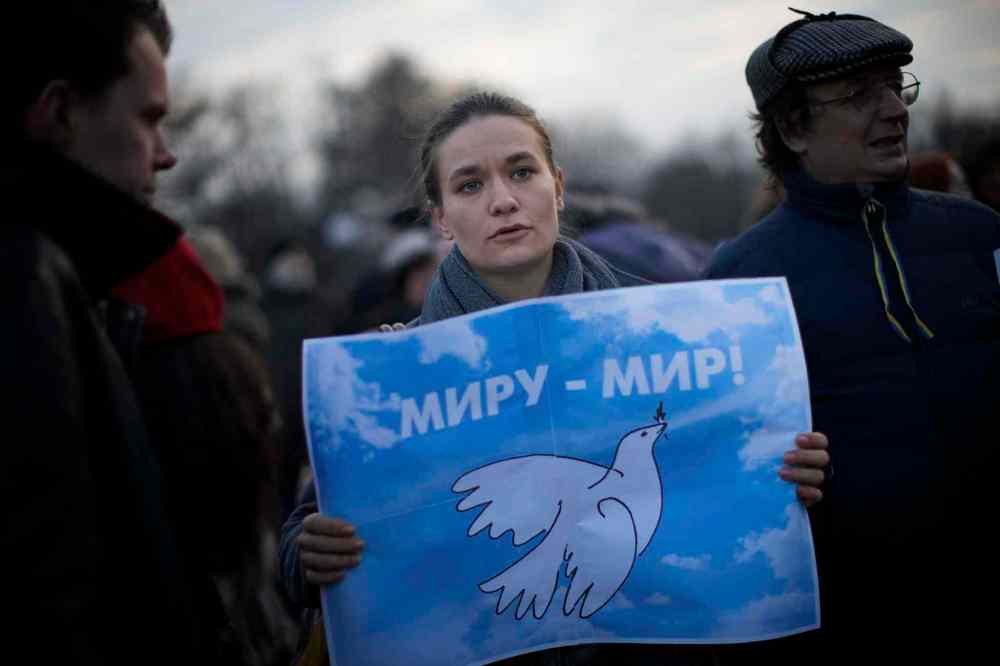
Crimea, the focus of a brief war between Russia, on one side, and Britain and France on the other in the early 1850s, is home to about two million people, 58 per cent of them Russian. During the First and Second World Wars the area went back and forth between Germany and the Soviet Union before Soviet leader Nikita Khrushchev made it part of the Soviet Socialist Republic of the Ukraine in 1954. Putin’s other excuse for his military movement is to ensure nothing happens to the key Russian naval base in Sevastopol, on the Black Sea.
One key difference between Hitler and Putin is for Hitler the annexation of the Sudetenland was part of a much larger Nazi policy of Lebensraum, the intention of giving the German people more territory or “living space.” Wanting to avoid war at all costs, the West then led by British prime minister Neville Chamberlain and French prime minister âdouard Daladier appeased Hitler, let him keep the Sudetenland and sold out Czechoslovakia. Hitler, we now know, had no intention of honouring the agreement and was already plotting a move to take Poland and other areas of Europe.
Whatever Putin’s flaws — Hillary Clinton described him as “tough guy with a thin skin”– he probably will wait out the West and eventually annex Crimea, but rest assured a third world war is not part of his future plans.
In many ways, the current crisis is more reminiscent of the tension in Europe 100 years ago, in the months leading up to the beginning of the First World War, again with one big exception. In 1914 (and to a certain extent 1938-39) war, though a last resort, was still perceived as a way for countries to settle differences. Diplomacy was preferred, yet decisive military action had its benefits.
“We do not want a war,” said Ivan Goremykin, the elderly Russian prime minister in 1914, “but do not fear it.” A century later with machine guns and tanks replaced by nuclear weapons, Putin, U.S. President Barack Obama, and every other leader negotiating an acceptable settlement in Crimea and Ukraine understand much better war is not an option. However, the mindset that led to the First World War still lingers.
The “spark” of that terrible conflict was the assassination of Archduke Franz Ferdinand of Austria-Hungary on June 28, 1914 in Sarajevo. It was an act of terror perpetrated by Gavrilo Princip and a group of young Serbian extremists of the Black Hand Secret Society.
Ardent nationalists, Princip and his comrades believed the province of Bosnia bordering northwest Serbia and which had been annexed by Austria-Hungary in 1908, with a population of three million Serbs, should be part of greater Serbia. And they were determined to make this happen, one way or the other. Within six weeks after the assassination, the five major European powers, Britain, France and Russia — the Triple Entente — and Germany and Austria-Hungary (part of the Triple Alliance with Italy that opted to stay out of the conflict and then supported the Triple Entente) were at war. Four years later, military casualties on both sides exceeded 8.5 million, of which 67,000 were Canadians; there were millions more civilian deaths and about 21 million wounded.
The causes of the war were more complex. Apart from a few brief skirmishes — the Franco-Prussian War of 1870-71, for example — Europe had been at peace since Napoleon’s defeat at Waterloo in 1815. Yet during the next 100 years a number of political, economic and social factors contributed to the tension Europe found itself in during the spring of 1914, many of which echo to the present time.
At the top of the list were nationalism and the idea, given more credence in the Treaty of Versailles in 1918 by U.S. president Woodrow Wilson’s concept of “self-determination,” each “nation,” however defined, had an innate right to govern itself and control its own territory. Yet because European borders, then and now, have never followed ethnic or national settlements, bitter land disputes were inevitable. That was the case over Austria-Hungary’s attempts to maintain a vast empire incorporating numerous different national groups and it is at the heart of Putin’s desire to protect ethnic Russians in Crimea. Other examples of nationalism creating unresolved tension from Quebec to the Middle East still abound.
Added to this in 1914 were the arms race, empire-building and an alliance system based on militarism in which war as the ultimate policy was influenced by social Darwinism and the doctrine national interest was based on “survival of the fittest or the most adaptable.” In the natural order of things, the strong would survive on the battlefield while the weak would perish.

The monarchs and political leaders of 1914 equally had a strong sense of honour. It was part of the reason Germany gave Austria-Hungary a so-called “blank cheque” in dealing with Serbia, an action which triggered Austria-Hungary’s ultimatum to Serbia, led to Russia’s decision to back its ally Serbia and then declarations of war among the other main participants. What the leaders (and they were all men) failed to completely grasp was how technology — better and more accurate machine guns — were to fundamentally alter war and lead to the catastrophe that followed.
One of the strongest voices of reason in the summer of 1914 was the 55-year-old genial and wise French socialist Jean Jaurés. As historian Margaret MacMillan relates in her new book, The War That Ended Peace, Jaurés did everything he could to stop the outbreak of war and it cost him his life. On July 31, 1914, as he dined at a café in Paris he was assassinated by Raoul Villain, “a passionate and fanatical nationalist,” who according to MacMillan, had decided that Jaurés “was a traitor because of his internationalism and pacifism.”
Right now, the world could use another Jean Jaurés to remind Vladimir Putin and his officials just how precarious a policy they are pursuing. Nevertheless, unlike 1914, diplomacy, bolstered by tough sanctions, and sound judgment are bound to prevail.
Now & Then is a column in which historian Allan Levine puts the events of today in a historical context.