

A complicated kindness
In race relations, Canada's truth can be as uncomfortable as America's

Advertisement
Read this article for free:
or
Already have an account? Log in here »
To continue reading, please subscribe:

Digital Subscription
One year of digital access for only $205*
- Enjoy unlimited reading on winnipegfreepress.com
- Read the E-Edition, our digital replica newspaper
- Access News Break, our award-winning app
- Play interactive puzzles
*First annual payment billed as $205.00 + GST for one year. This annual subscription will automatically renew at $233.00 + GST every 52 weeks (10% off the regular annual price of $259.35). Offer available to new and qualified returning subscribers only. Cancel any time.
To continue reading, please subscribe:
Add Free Press access to your Brandon Sun subscription for only an additional
$1 for the first 4 weeks*
- Enjoy unlimited reading on winnipegfreepress.com
- Read the E-Edition, our digital replica newspaper
- Access News Break, our award-winning app
- Play interactive puzzles
*Your next Brandon Sun subscription payment will increase by $1.00 and you will be charged $17.95 plus GST for four weeks. After four weeks, your payment will increase to $24.95 plus GST every four weeks.
Read unlimited articles for free today:
or
Already have an account? Log in here »
Hey there, time traveller!
This article was published 29/07/2016 (3662 days ago), so information in it may no longer be current.
On the first night of the Democratic National Convention, Michelle Obama reached back to grasp the hands of her ancestors.
It was those past generations, she told the audience in Philadelphia, who “felt the lash of bondage” and “the sting of segregation,” but pressed forward anyway. They “kept on striving and hoping and doing what needed to be done,” she said, “so that today I wake up every morning in a house that was built by slaves.”
Of all the aspirational rhetoric dumped over the two American party conventions, this fact may be the most indisputably true and unalterably optimistic. In a handful of words, Obama perfectly traced the arc of history’s lurching progress: it has brought a nation to the point of recognizing that the fuel of her ancestral flame, never extinguished, was always righteous.
Unfortunately, the response to that raw and real moment was muted, in some quarters. The most infamous came courtesy of Fox News pundit Bill O’Reilly, whose response — his branded “Tip of the Day” — was to note that Obama was “essentially correct” that the White House was built by slaves, although “there were others as well.”
What was most striking was that his 90-second soliloquy included a jarring assertion, one of unclear provenance and even murkier relevance. The slaves whose bodies and labour were sold to build a stone paean to American power, he stated, were “well fed and had decent lodgings, provided by the government.”
That sort of slavery apologism is not new or rare in the United States. The same fixation with the benevolence of slavemasters has sprouted up in historical plantation tours; until 2014, a fifth-grade history textbook in Massachusetts proclaimed that some “slaves were treated well” and some “planters took pride in being fair and kind to their slaves.”
The function of this apologia is simple: to render more comfortable what can only ever be a shameful truth. It is akin to a fading but tenacious streak in Canada, which pushes some to proclaim that the residential school project that devastated indigenous families had its benefits, that some schools weren’t “as bad,” that it was a “free education.”
What is really being said: the story about who we are, the one we want to believe, cannot square with how the nations we live in were actually erected. This apologia isn’t the only tactic of avoiding uncomfortable truths; sometimes, when confronted with facts or events that give lie to the story, there is merely an awkward silence.
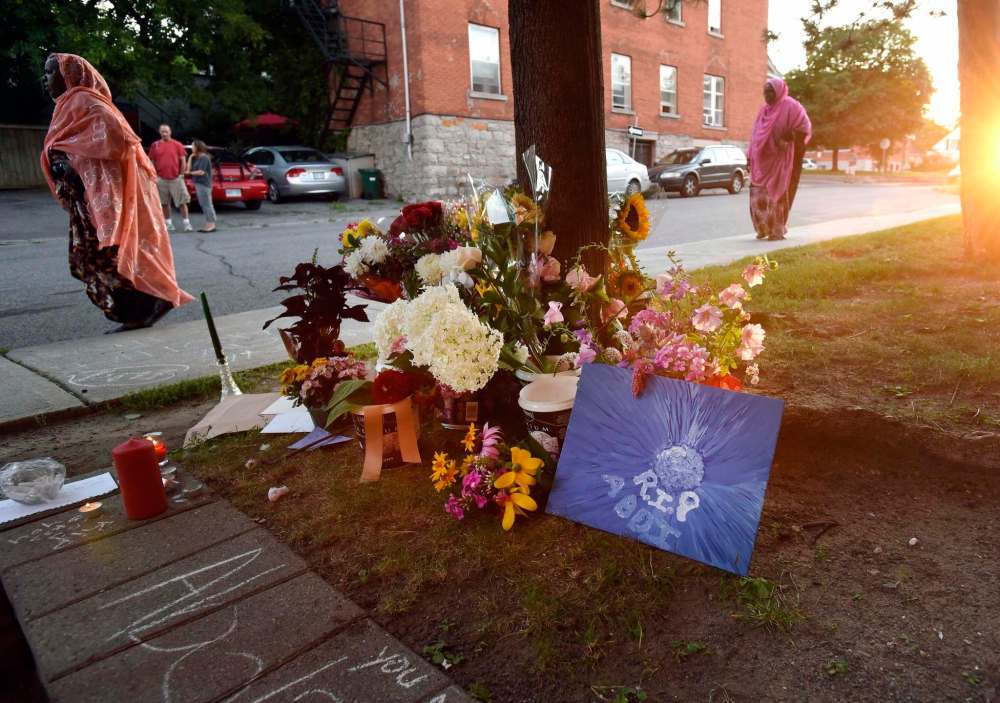
Such as there was in Ottawa this week. Abdirahman Abdi, a 37-year-old Somali-Canadian man living with mental illness, died after he was beaten while being arrested by Ottawa police on Sunday. The city’s Special Investigations Unit is investigating and, as of Wednesday, some details were still sketchy, including the absence of a confirmed cause of death.
Still, the facts that are on record are concerning. One witness came forward to describe his shock at the confrontation, calling the arresting officers’ actions “extremely violent” and “extremely excessive.” Abdi, the witness said, was not compliant, but the force he saw “escalated way too quickly for the type of resistance… It went from zero to 100 very, very, very fast.”
Yet news of this was slow to light on the burner of national conversation. Some folks I respect in Toronto, including writer and community activist Andray Domise and journalist Desmond Cole, were instrumental in drawing attention to the gap: in the two days after Abdi’s death, the story had not led on several national outlets, which just weeks earlier had given top play to similar cases in the United States.
Being part of the media, my first instinct is to find my own apologia, to explain why this was the case. One reason, perhaps, is mass coverage of police violence in the United States owes much to monumental efforts of organization and consciousness-raising; my sense is Canada may be earlier in this process of raising a spotlight on racial justice.

Yet there is something else I cannot escape, and it is always this: there is a story we want to believe about Canada, one in which the problems and brutalities of our neighbour were not and are not replicated here. We are more “polite,” we like to tell ourselves, and more peaceful; we are more “tolerant,” more “inclusive,” more systemically just.
It is comforting to believe that, and in the era of Donald Trump it is relatively easy to make the distinction. If Canadians were widely turned off by fearmongering about niqabs in the last federal election, it’s highly doubtful we would have better tolerated pledges of mass deportations, blanket entry bans on Muslims and a literal wall.
That’s civility, though. It’s how we allow the story to be told, not necessarily the whole story itself. Not tolerating public proclamations of open bigotry does not mean it does not exist. It just makes it easier to look away from the questions we should be asking. So let’s start with: why was a deadly level of violence delivered against an unarmed man in Ottawa?
The answers may take us to a different story about Canada, one that isn’t as pretty to look at and even more uncomfortable to wear. But stories that are not routinely scrutinized for truth and scoured for relevance are merely fables. If we want to ensure a nation that lives up to its own self-image, it will take more than a fairy tale.
melissa.martin@freepress.mb.ca
Melissa Martin
Reporter-at-large
Melissa Martin reports and opines for the Winnipeg Free Press.
Every piece of reporting Melissa produces is reviewed by an editing team before it is posted online or published in print — part of the Free Press‘s tradition, since 1872, of producing reliable independent journalism. Read more about Free Press’s history and mandate, and learn how our newsroom operates.
Our newsroom depends on a growing audience of readers to power our journalism. If you are not a paid reader, please consider becoming a subscriber.
Our newsroom depends on its audience of readers to power our journalism. Thank you for your support.
Melissa Martin
Reporter-at-large
Melissa Martin reports and opines for the Winnipeg Free Press.
Every piece of reporting Melissa produces is reviewed by an editing team before it is posted online or published in print — part of the Free Press‘s tradition, since 1872, of producing reliable independent journalism. Read more about Free Press’s history and mandate, and learn how our newsroom operates.
Our newsroom depends on a growing audience of readers to power our journalism. If you are not a paid reader, please consider becoming a subscriber.
Our newsroom depends on its audience of readers to power our journalism. Thank you for your support.
Advertisement Advertise With Us
Advertisement Advertise With Us