

THE PUCK$ STOP HERE
Only now are the guys who guard the twine and win playoffs starting to get what they deserve

Advertisement
Read this article for free:
or
Already have an account? Log in here »
To continue reading, please subscribe:

Digital Subscription
One year of digital access for only $205*
- Enjoy unlimited reading on winnipegfreepress.com
- Read the E-Edition, our digital replica newspaper
- Access News Break, our award-winning app
- Play interactive puzzles
*First annual payment billed as $205.00 + GST for one year. This annual subscription will automatically renew at $233.00 + GST every 52 weeks (10% off the regular annual price of $259.35). Offer available to new and qualified returning subscribers only. Cancel any time.
To continue reading, please subscribe:
Add Free Press access to your Brandon Sun subscription for only an additional
$1 for the first 4 weeks*
- Enjoy unlimited reading on winnipegfreepress.com
- Read the E-Edition, our digital replica newspaper
- Access News Break, our award-winning app
- Play interactive puzzles
*Your next Brandon Sun subscription payment will increase by $1.00 and you will be charged $17.95 plus GST for four weeks. After four weeks, your payment will increase to $24.95 plus GST every four weeks.
Read unlimited articles for free today:
or
Already have an account? Log in here »
Hey there, time traveller!
This article was published 23/04/2009 (6296 days ago), so information in it may no longer be current.
Maybe it’s the salary cap, perhaps it’s sanity, but look around the NHL playoffs these days and it seems the smart kids are finally putting their money where their goal-mouth is.
Indeed, it’s was always a curiosity that outside of a few proven veterans, the paycheques of NHL netminders seemed to lag noticeably behind those of the flashy, point-producing superstars. Then the playoffs would start and almost every last pundit would heavily weight their predictions based on — ta-da — which team had the best goaltender.
Still happens, arguably even more so in an NHL landscape where parity and a cap on salaries has levelled the playing arena considerably.
For example, back in 2003-04, Curtis Joseph was the NHL’s highest-paid netminder at $8 million. But Cujo was 18th overall on the pay list, behind names like Forsberg, Jagr, Bure, Federov and Tkachuk, who all earned $10 million-plus.
In fact, a list of the top 20 wage-earners between 1989-90 and 2007-08 reveals just two goaltenders — Patrick Roy at 17th and Dominik Hasek at No. 20. That same list includes 14 forwards and four defencemen.
Compare those stats to professional football where, in almost every instance, who is the highest-paid player on the team? The quarterback, of course. And it figures. The quarterback touches the ball every play on offence. Every mistake he makes can be crucial, every big play a key to victory.
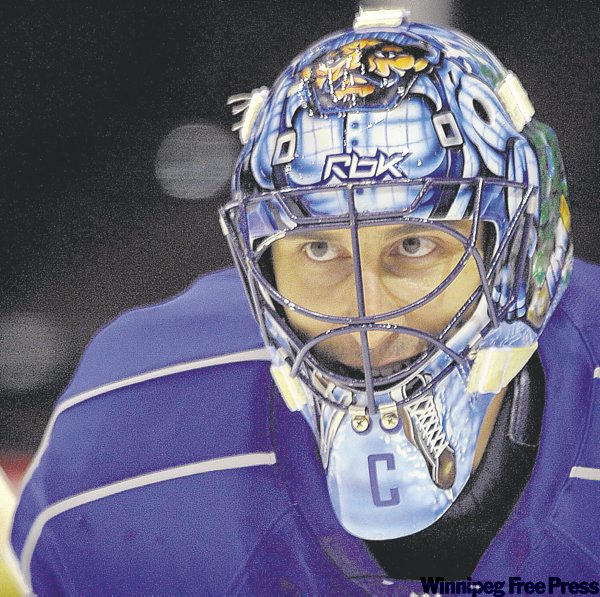
Question: How does this differ from a netminder who plays every minute of every game he plays? Look around and do the math? Did the Vancouver Canucks sweep the pesky St. Louis Blues because they were so dominant at every position? Try again. They swept because of Roberto Luongo, who made 126 saves and posted a spectacular .962 save percentage.
You might protest that the Blues lost because they were a brutal 4.2 per cent on the power play. Question: Who’s the most effective penalty-killer? Right, the goaltender.
Yet for some reason, even in Vancouver, the Canucks paid a 38-year-old Swede with a wonky body $10 million this season (prorated), which means Mats Sundin will earn as much money as Luongo this season, only for fewer games. Huh?
OK, so we’ll give that one to the Canucks, who otherwise have a salary structure reflective of the goaltender’s worth — it pays the Sedin twins combined as much as Luongo’s $7 million this year.
Maybe the Ottawa Senators should take notice. Like the Canucks over the last decade, the Sens have never wanted for firepower up front. Before Luongo’s arrival, the Canucks sank all their money into Todd Bertuzzi, Markus Naslund and Brendan Morrison. Meanwhile, in Ottawa they’ve been paying the bulk of their player budget to Dany Heatley, Daniel Alfredsson and Jason Spezza.
In both cases, the Senators of today and the Canucks of the past put their money into offence and scrimped in net. Back in 2004-05, for example, Vancouver front-loaded almost $20 million in salary on Bertuzzi, Naslund and defencemen Ed Jovanovski and Mattias Olund. Goaltender Dan Cloutier, ever considered the Canucks’ weak link, earned $2.5 million — and the Canucks got exactly what they paid for.
This season, the Senators anted up more than $32 million for Spezza, Heatley, Alfredsson, Mike Fisher and Mike Comrie. The Sens invested $4.7 million in the inconsistent Martin Gerber ($3.7 million) and journeyman Alex Auld ($1 million). By the end of a lost season, the Senators were starting prospect Brian Elliott ($758,000).
Sure, the playoffs have only just begun. But it’s not an accident that suddenly the Canucks are, for once, considered a Stanley Cup contender. Because, for once, they have a well-rounded team with one of the world’s best goaltenders.
But it’s not just Luongo. And it’s not just the NHL, either. The Moose didn’t fall behind the Toronto Marlies 2-1 in their opening AHL series because they were grossly outplayed or outcoached. The Marlies were getting better goaltending from Justin Pogge than Manitoba was getting from Cory Schneider. But Schneider was solid in Game 4, the Moose got to Pogge and, boom, the series is tied.
Sure, it’s not exactly that simple; nothing is. But it should be noted the NHL salary structures are finally starting to reflect the playoff realities of the men in the masks. The best goaltenders, on the whole, are now in the top three on the salary charts, with the likes of Martin Brodeur ($5.2 million), Miikka Kiprusoff ($8.5 million), Marty Turco ($5.7 million) and Henrik Lundqvist ($7.75 million) at least in the financial ballpark of the game’s top stars.
But here’s one last thing to consider: In Pittsburgh, Evgeni Malkin ($9.98 million) and Sidney Crosby ($9 million) get paid almost $20 million combined. Penguins starting netminder Marc-Andre Fleury, the last line of defence on a team loaded with offensive talent, makes $3.5 million.
Guess who’s going to be the fall guy if the Pens don’t win the Cup?
Guess who’s going to be the reason if the Canucks do?
randy.turner@freepress.mb.ca
What they make, how they’re doing
Here’s a look at starting goaltenders in this season’s NHL playoffs, with salary, 2008-09 season save percentage, and GAA in playoffs (prior to Wednesday night):
Miikka Kiprusoff (Flames): $8.5 million/.919, 2.68
Henrik Lundqvist (Rangers): $7.75 million/.936, 2.33
Roberto Luongo (Canucks): $7 million/.962, 1.15
Nikolai Khabibulin (Blackhawks): $6.75 million/.906, 2.68
Evgeni Nabokov (Sharks): $5.375 million/.890, 2.70
Martin Brodeur (Devils): $5.2 million/.929, 2.19
Jose Theodore (Capitals): $4.5 million/.810, 4.02
Marc-Andre Fleury (Penguins): $3.5 million/.937, 2.09
Martin Biron (Flyers): $3.5 million/.912, 2.81
Chris Mason (Blues): $3 million/.916, 2.34
Cam Ward (Hurricanes): $2.5 million/.920, 2.67
Chris Osgood (Red Wings): $1.416 million/.974, 0.67

Jonas Hiller (Ducks): $1.3 million/.947, 2.01
Tim Thomas (Bruins): $1.1 million/.940, 1.67
Simeon Varlamov (Capitals): $850,000/.982, 0.50
Carey Price (Canadiens): $850,000/.882, 4.15
Steve Mason (Blue Jackets): $850,000/.888, 3.67
Randy Turner
Reporter
Randy Turner spent much of his journalistic career on the road. A lot of roads. Dirt roads, snow-packed roads, U.S. interstates and foreign highways. In other words, he got a lot of kilometres on the odometer, if you know what we mean.
Our newsroom depends on a growing audience of readers to power our journalism. If you are not a paid reader, please consider becoming a subscriber.
Our newsroom depends on its audience of readers to power our journalism. Thank you for your support.
Randy Turner
Reporter
Randy Turner spent much of his journalistic career on the road. A lot of roads. Dirt roads, snow-packed roads, U.S. interstates and foreign highways. In other words, he got a lot of kilometres on the odometer, if you know what we mean.
Our newsroom depends on a growing audience of readers to power our journalism. If you are not a paid reader, please consider becoming a subscriber.
Our newsroom depends on its audience of readers to power our journalism. Thank you for your support.
Advertisement Advertise With Us
Advertisement Advertise With Us