

Disaster cripples nation’s transportation, communications systems
dk
Advertisement
Read this article for free:
or
Already have an account? Log in here »
To continue reading, please subscribe:

Digital Subscription
One year of digital access for only $205*
- Enjoy unlimited reading on winnipegfreepress.com
- Read the E-Edition, our digital replica newspaper
- Access News Break, our award-winning app
- Play interactive puzzles
*First annual payment billed as $205.00 + GST for one year. This annual subscription will automatically renew at $233.00 + GST every 52 weeks (10% off the regular annual price of $259.35). Offer available to new and qualified returning subscribers only. Cancel any time.
To continue reading, please subscribe:
Add Free Press access to your Brandon Sun subscription for only an additional
$1 for the first 4 weeks*
- Enjoy unlimited reading on winnipegfreepress.com
- Read the E-Edition, our digital replica newspaper
- Access News Break, our award-winning app
- Play interactive puzzles
*Your next Brandon Sun subscription payment will increase by $1.00 and you will be charged $17.95 plus GST for four weeks. After four weeks, your payment will increase to $24.95 plus GST every four weeks.
Read unlimited articles for free today:
or
Already have an account? Log in here »
Hey there, time traveller!
This article was published 12/03/2011 (5677 days ago), so information in it may no longer be current.
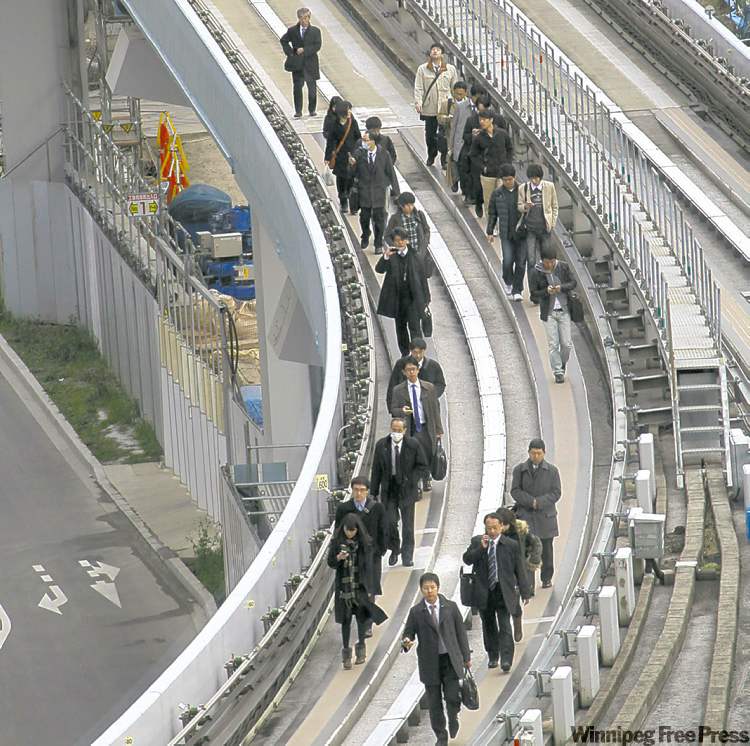
TOKYO — Japan’s huge earthquake brought super-modern Tokyo to a standstill as it paralyzed trains that normally run like clockwork, crippled mobile phones, stranded hordes of commuters and trapped scores of people in elevators.
The magnitude-8.9 quake that struck off the coast Friday afternoon and triggered a deadly tsunami in the northeast also violently shook buildings in the capital, where halted trains choked an evening commuter flow of more than 10 million people.
“This is the kind of earthquake that hits once every 100 years,” said restaurant worker Akira Tanaka, 54.
He gave up waiting for trains to resume and decided — for his first time ever — to set off on foot for his home 20 kilometres north of the capital. “I’ve been walking an hour and 10 minutes, still have about three hours to go,” he said.
Tokyo prides itself on being an orderly, technologically savvy, even futuristic city. Residents usually can rely on a huge, criss-crossing network of train and subway lines. But authorities were forced to scan the entire web for quake damage and cancel nearly all trains for the rest of the day.
Tomoko Suzuki and her elderly mother were unable to get to their 29th-floor condominium because of a stalled elevator. They unsuccessfully tried to hail a taxi to a relative’s house and couldn’t immediately find a hotel room in their neighbourhood.
“We are so cold,” Suzuki said Friday evening on a crowded corner. “We really don’t know what to do.”
Although there were no power outages in central Tokyo, some elevators may have been damaged in the quake while others were intentionally shut down as a precaution. Elsewhere, widespread electricity outages left millions of homes and buildings without power.
In all, 163 people were reported trapped in elevators throughout the country, the Transportation Ministry said, with 75 of them still stuck Saturday morning. It wasn’t clear how many of those were in Tokyo.
Tens of thousands of people milled at the capital’s train stations, roamed its streets or hunkered down at 24-hour cafés, hotels and government offices offered as emergency accommodations.
Mobile phone lines were crammed, preventing nearly all calls and text messages. Calls to northeastern Japan, where a seven–metre tsunami washed ashore after the quake, generally failed to go through, with a recording saying the area’s lines were busy.
Unable to rely on their mobile phones, people formed lines at Tokyo’s normally vacant public phone booths dotting the city.
Japan’s top telecommunications company, the Nippon Telegraph and Telephone Corp., set up an emergency phone line and a special Internet site for people to leave messages for family and friends.
Up to 90 per cent of calls were being restricted to prevent telecom equipment from being overloaded, NTT spokeswoman Mai Kariya said. The company was checking on damage to towers and cables.
Osamu Akiya, 46, was working in the office of a Tokyo trading company when the quake sent bookshelves and computers crashing to the floor and opened cracks in the walls.
“I’ve been through many earthquakes, but I’ve never felt anything like this,” he said.
A handful of subway lines resumed service after a six-hour outage, and officials said they would run all night, past their usual hours.
When Tokyo trains suffer rare problems, they usually are running again within an hour. So, many people initially waited at stations. But when the railway company announced a suspension of nearly all service for the day, crowds poured into the streets.
— The Associated Press


Advertisement Advertise With Us
Advertisement Advertise With Us