

Full-moon fever a dud theory
Transylvanian hypothesis holds little weight
Advertisement
Read this article for free:
or
Already have an account? Log in here »
To continue reading, please subscribe:
Digital Subscription
One year of digital access for only $1.44 a week*
- Enjoy unlimited reading on winnipegfreepress.com
- Read the E-Edition, our digital replica newspaper
- Access News Break, our award-winning app
- Play interactive puzzles
*Billed as $5.77 plus GST every four weeks. After 52 weeks, price increases to the regular rate of $19.95 plus GST every four weeks. Offer available to new and qualified returning subscribers only. Cancel any time.
To continue reading, please subscribe:
Add Free Press access to your Brandon Sun subscription for only an additional
$1 for the first 4 weeks*
- Enjoy unlimited reading on winnipegfreepress.com
- Read the E-Edition, our digital replica newspaper
- Access News Break, our award-winning app
- Play interactive puzzles
*Your next Brandon Sun subscription payment will increase by $1.00 and you will be charged $17.95 plus GST for four weeks. After four weeks, your payment will increase to $24.95 plus GST every four weeks.
Read unlimited articles for free today:
or
Already have an account? Log in here »
Hey there, time traveller!
This article was published 20/03/2011 (5558 days ago), so information in it may no longer be current.
If it is true what they say about a full moon provoking deviant behaviour in human beings, then evidence of an outbreak of lunacy should be clearly discernible on Canadian streets Saturday night.
We should expect to see an upward spike in the number of 911 emergency calls.
Saturday night’s full moon, which was slated to rise at 7:38 p.m. ET is going to be special — and not just because it will be the last full moon of the winter, coming on the eve of Sunday’s first official day of spring. No, Saturday night’s moon is going to be a supermoon, also known as a perigee moon.
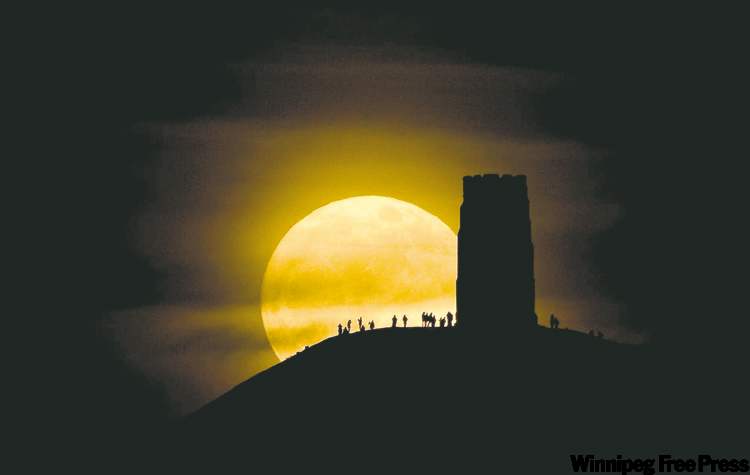
A supermoon is bigger and brighter than an ordinary full moon. The reason: the moon’s orbit around the Earth is elliptical, not round. And so when the elliptical path passes closest to Earth — as will be the case Saturday night — a full moon becomes 14 per cent wider and 30 per cent brighter than an average full moon. Not since 1992 has the moon passed as close to Earth as it will tonight.
The proposition that full moons can spark deviant behaviour in human beings is known in scholarly research as the Transylvanian hypothesis.
We owe the noun lunacy, and the adjective lunatic, to this proposition, and more literally to Luna, the old Roman moon goddess.
The Transylvanian hypothesis is as old as humankind itself. However, serious study has concluded that the hypothesis is not supported by scientific evidence.
A famous study that had found murders on the rise in and around Miami, Florida during full moons was subsequently revealed to be flawed. A British Medical Journal study that found dog bites on the rise during full moons in Britain found fewer dog bites than average during full moons in Australia.
In New York City, two major studies involving 500,000 births over two different time periods found a minor one per cent rise in births during full-moon periods — hardly significant.
In the mother of all studies, researchers at the University of Saskatchewan looked at 37 different studies involving full moons and human behaviour and found insufficient evidence to support the notion of a lunar effect.
And yet many people still believe in one.
Why? Selective memory, say psychologists. Nurses who might correctly recall full-moon nights when their maternity wards were overwhelmed tend not to recall quite as sharply those other full-moon nights when the number of births was unremarkable or lower than average.
Glenn Wilson, a psychiatrist at King’s College in London, England, has pointed out something significant about full moons: They were much more noticeable to the average person before the age of electricity than they are today.
Remarkably bright nights in the 1700s and 1800s would have brought a lot of people out into the streets and created exceptionally high incidences of social interaction between strangers.

— Postmedia News
Supermoon facts
14 per cent wider
30 per cent brighter
Closest to Earth since 1992