

Tabloid Readers’ Perverse Shocker!
CRIME, SEX AND SENSATION: Irresistible for last 100 years
Advertisement
Read this article for free:
or
Already have an account? Log in here »
To continue reading, please subscribe:
Digital Subscription
One year of digital access for only $75*
- Enjoy unlimited reading on winnipegfreepress.com
- Read the E-Edition, our digital replica newspaper
- Access News Break, our award-winning app
- Play interactive puzzles
*Billed as $5.77 plus GST every four weeks. After 52 weeks, price increases to the regular rate of $19.95 plus GST every four weeks. Offer available to new and qualified returning subscribers only. Cancel any time.
Monthly Digital Subscription
$4.99/week*
- Enjoy unlimited reading on winnipegfreepress.com
- Read the E-Edition, our digital replica newspaper
- Access News Break, our award-winning app
- Play interactive puzzles
*Billed as $19.95 plus GST every four weeks. Cancel any time.
To continue reading, please subscribe:
Add Free Press access to your Brandon Sun subscription for only an additional
$1 for the first 4 weeks*
- Enjoy unlimited reading on winnipegfreepress.com
- Read the E-Edition, our digital replica newspaper
- Access News Break, our award-winning app
- Play interactive puzzles
*Your next Brandon Sun subscription payment will increase by $1.00 and you will be charged $17.95 plus GST for four weeks. After four weeks, your payment will increase to $24.95 plus GST every four weeks.
Read unlimited articles for free today:
or
Already have an account? Log in here »
Hey there, time traveller!
This article was published 23/07/2011 (5419 days ago), so information in it may no longer be current.
There is something fitting, as well as pathetic, that media magnate Rupert Murdoch, the current king of sensational news, has become the prime focus of this summer’s most sensational news story.
Yet in a display of collective hypocrisy, the British public, which devoured every titillating article the tabloid News of the World published, is now castigating Murdoch and his journalists for their underhanded and illegal phone hacking and bribery tactics while reading about each new sordid development all the same.
As maddening as this seems, it has been a feature of the tabloid newspaper business for more than a century, ever since the compact format was created in London in the late 1890s by such press barons as Alfred Harmsworth (later Lord Northcliffe), the publisher of the Daily Mail and Daily Mirror.
Harmsworth figured out that by catering to the reading public’s basest tastes, he could sell a lot of papers; in 1909, the halfpenny Daily Mirror had a daily circulation of one million.
In trying to match or beat him, his competitors outdid themselves with sensationalism, stunts, lotteries, contests and chronicles of crime and sex.
Most of it was distorted half-truths gathered through pay-offs and enhanced with faked photographs and other technological wonders of the era, no different than the objectionable methods employed by some News of the World staff. Today’s technology might be more sophisticated, yet the no-holds-barred objective has remained constant.
American newspaper entrepreneurs, who knew a good investment when they saw it, imported the British tabloid model into the United States just after the First World War. Cousins Joseph Medill Patterson and Robert McCormick, the publishers of the Chicago Tribune, were first with the Daily News, which they launched in New York City. This was quickly followed in 1924 when William Randolph Hearst established the Mirror.
Long before Rupert Murdoch ruled the media world, there was Hearst. By the early 1900s, Hearst governed a vast empire of 22 newspapers from San Francisco to Boston and a stable of the most popular magazines in the country, including Cosmopolitan. One out of every four families in the United States likely read a Hearst publication.
Hearst was extravagant and spent millions of dollars on prime real estate and expensive art. He lived in a spectacular Windsor-style castle home outside of San Francisco called San Simeon.
His larger-than-life status, in addition to his very public affair with Marion Davies, a Ziegfled Follies singer and dancer who was 34 years his junior, made him the perfect archetype as the flawed capitalist character for Orson Well’s highly praised 1941 film, Citizen Kane. Hearst did everything he could to prevent the movie from being shown.
Whatever his faults, Hearst had understood at a young age that newspaper readers wanted to be informed, amused and, most importantly, surprised.
“The public,” he stated in 1896, “is even more fond of entertainment than it is of information.” He insisted his reporters be as creative as possible. If that meant stretching the truth a little, exploiting the facts, as Hearst had so blatantly done during the Spanish-American War of 1898, or altering a photograph, so be it. Headlines were always in large type and Hearst newspapers played up crime, scandal and celebrity personalities.
At first, Hearst thought tabloids were merely a “passing fad.” But the enormous success of the Daily News changed his mind and he pushed the Mirror to sell, as well.
Both tabloids were challenged by a third and even more racy and zany paper, the Evening Graphic.
Owned by Bernarr Macfadden, who had made millions with his women’s magazine True Story, the Graphic was in a class by itself.
“Don’t tell my mother I’m working on the Graphic,” went the joke told by New York reporters. “She thinks I’m a piano player in a whorehouse.”
Often referred to as the “porno-Graphic,” its stories of sex and crime, along with provocative and usually faked photos (or “composographs,” as they were called) of bodybuilders and scantily clad women, were too much for some newsstand owners, who would not stock the tabloid.
Macfadden was not troubled by the critical reaction. “Sensationalism is nothing more than a clear, definitive, attractive presentation of the news,” he argued, “and is perfectly proper as long as one adheres to the truth.”
The Graphic and the other tabloids hardly ever “adhered to the truth” and were denounced as the “black plague” of journalism. Still, like today, readers could not get enough of the smut, dirt and sexual shenanigans of the rich and famous.
A sure sign, moreover, of the power and influence of the tabloids was when such newspapers as the New York Times began covering some of the same crime stories, which in earlier years its editors would have ignored.
Among the lurid news stories in 1927 that attracted the tabloids’ full attention was the murder of Albert Snyder, a Long Island, N.Y., magazine publisher.
The crime was perpetrated by Snyder’s wife, Ruth, and her lover, Judd Gray. Both were found guilty and sentenced to die by the electric chair in early January 1928 at Sing Sing prison.
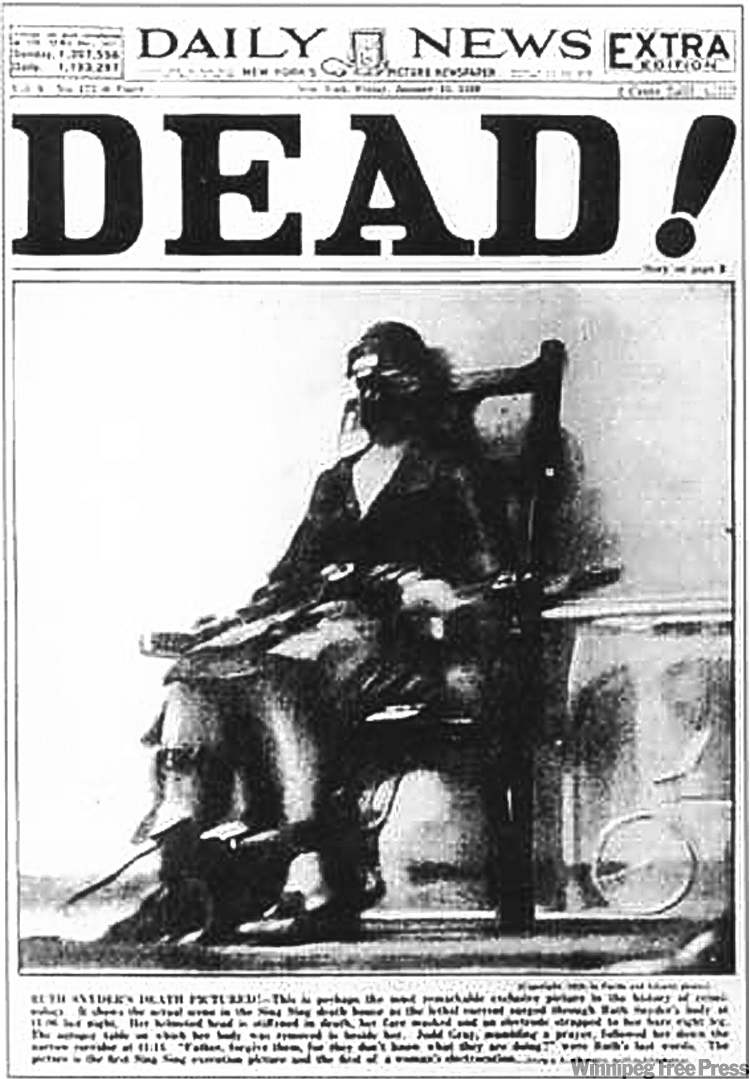
The Daily News gave Tom Howard, a Chicago newspaper photographer not known to New York prison authorities, the assignment of obtaining a picture of Ruth Snyder’s execution. She was to be the first woman put to death in this manner.
Showing a lot of ingenuity, Howard attached a miniature camera to his ankle with a long shutter release that went up his pant leg into his pocket.
He gained access to the execution and then, just as the executioner pulled the switch, he snapped a photograph.
The next day, to an outcry of horror mixed with fascination, the grisly shot ran on the front page of the Daily News with the large bold-faced headline: DEAD! The Daily News could not keep up with demand for the paper.
Modern journalistic practices would never be the same.
As the News of the World scandal has shown once again, the public’s craving for shocking stories rarely can be satisfied.
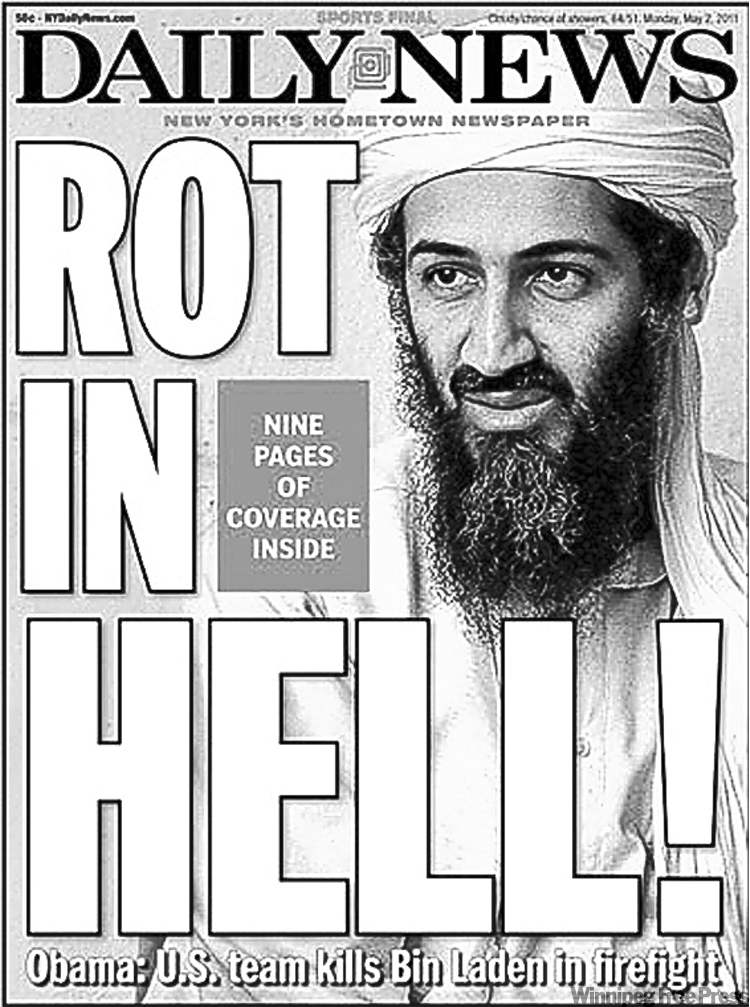
Nor it seems, can the desire of editors and reporters to feed that hunger.
Now&Then is a column in which historian Allan Levine brings a historical perspective to the major events of today.
Selection of headlines from New York tabloids
Obama Beats Weiner
(Prez says he would resign, New York Post, 2011)
Tiger’s Worst Drive
(Daily News, 2009)
Axis of weasel
(France Germany refuse to attack Iraq, Post 2003)
Close but no cigar
(Senate fails to convict Clinton; News 1999)
Kiss your asteroid goodbye!

(Meteor misses earth; Post 1998)
Headless body in topless bar
(Post, 1982)