Spelt is just what the doctor ordered

Bygone grain a healthy alternative for the gluten-allergic

Advertisement

Advertise with us

NEAR BRANDON -- The golden wheat fields don't sway like they used to.

Read this article for free:


or

Already have an account? Log in here »

To continue reading, please subscribe:

Subscribe and receive a limited-edition Free Press branded hat or tote.

Digital Subscription

One year of digital access for only $205*

  • Enjoy unlimited reading on winnipegfreepress.com
  • Read the E-Edition, our digital replica newspaper
  • Access News Break, our award-winning app
  • Play interactive puzzles

*First annual payment billed as $205.00 + GST for one year. This annual subscription will automatically renew at $233.00 + GST every 52 weeks (10% off the regular annual price of $259.35). Offer available to new and qualified returning subscribers only. Cancel any time.

To continue reading, please subscribe:

Add Free Press access to your Brandon Sun subscription for only an additional

$1 for the first 4 weeks*

  • Enjoy unlimited reading on winnipegfreepress.com
  • Read the E-Edition, our digital replica newspaper
  • Access News Break, our award-winning app
  • Play interactive puzzles
Start now

*Your next Brandon Sun subscription payment will increase by $1.00 and you will be charged $17.95 plus GST for four weeks. After four weeks, your payment will increase to $24.95 plus GST every four weeks.

Hey there, time traveller!
This article was published 26/08/2011 (5468 days ago), so information in it may no longer be current.

NEAR BRANDON — The golden wheat fields don’t sway like they used to.

That poetic imagery was born a century ago when wheat was much taller.

Plant scientists have bred shorter wheat varieties over the years because tall ones “lodge” — like when someone falls down and can’t get back up — making crops more difficult to harvest. Varieties like ancient spelt wheat were bred out of the picture.
Colin Corneau/Brandon Sun
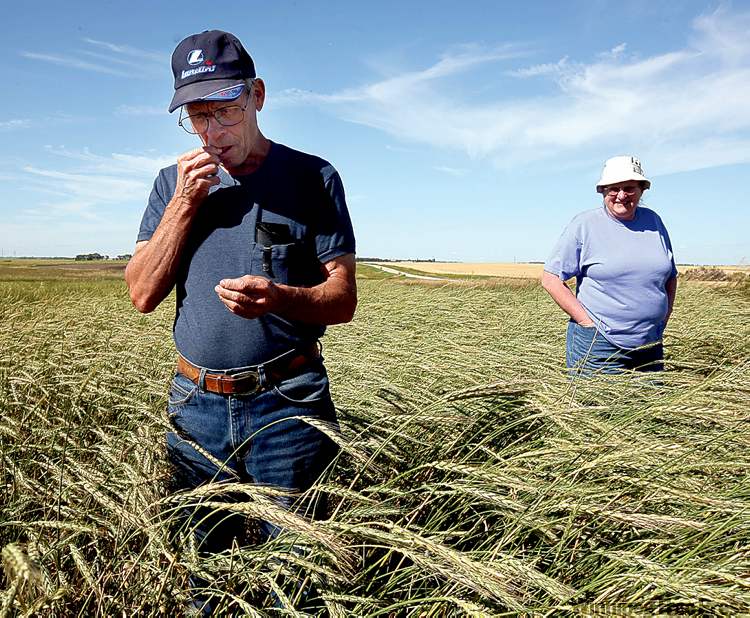
Larry and Pat Pollack grow spelt wheat for the local market on their organic farm north of Brandon.
Colin Corneau/Brandon Sun Larry and Pat Pollack grow spelt wheat for the local market on their organic farm north of Brandon.

But spelt has been making a comeback, especially for consumers with wheat allergies. It has higher protein and fibre than today’s wheats, and much lower gluten content.

“The spelt market is increasing all the time. Some researchers say by 2020 a full 10 per cent of the population will have issues with gluten,” said Pat Pollock, who grows spelt with husband, Larry, just north of Brandon. The Pollocks supply all the spelt for Tall Grass Bakery in Winnipeg and Integrity Foods in Riverton.

The Pollocks have been certified organic growers since 2000. Larry was a conventional farmer from the age of 16. He’s now 62. In the late 1990s, he had an epiphany. Virtually all his income was going to pay for farm inputs like chemicals and fertilizers. He wasn’t feeding the world so much as on intravenous to agribusiness.

So he started turning over fields to legumes like alfalfa to return nutrients to the soil and gradually converted to full organic farming. It works for the Pollocks to service a niche market such as spelt because they are small farmers with just a section of land.

Spelt has never been cross-bred or hybridized in its estimated 8,000-year lifetime. It’s referenced in the Bible several times. A description of a plague of hail in Exodus says the hail ruined flax and barley crops but not spelt because it is later maturing.

Over time, spelt became regarded as a poorer wheat for the lower classes, according to Collier’s Encyclopedia. And the online encyclopedia, Wikipedia, says it was a staple food in Europe from the Bronze Age to medieval times. It was grown in the United States in the 1890s but replaced by newer bread wheats in the last hundred years. Spelt matzo is baked in Israel for Passover.

It was removed from commercial production more due to difficulties related to production than end-use quality. Besides growing taller — at nearly two metres, it grows to about twice the height of conventional wheat — the kernels from spelt are also protected by very hard husks.

Today’s wheats can be taken directly from the field to the mills. But the husk of spelt is hard, similar to a sunflower seed shell, protecting the kernel inside. So the Pollocks have to break and remove the hulls of spelt before it’s ready to mill and have had to develop their own machinery to do that.

Spelt also has a longer growing season, making it susceptible to frost. Its growing season is 112-115 days versus 90-95 days for today’s wheat varieties. For that reason, the Pollocks hold back up to two years supply of spelt in their bins to ensure they can still service customers in case of crop failure.

Spelt isn’t covered by provincial crop insurance.

The above factors, including lower yields, all add to the cost of spelt flour and baking products.

But it is divine flour for baking, says Dora Friesen, who runs Integrity Foods with husband, Cornelius. The Friesens were having to source their spelt from Ontario and Saskatchewan before the Pollocks came to the rescue.

“It’s absolutely my favourite grain to bake with. It just performs so beautifully. The loaf has good volume, it’s easy to mix by machine or hand and it has good fibre content,” said Friesen. For consumers, it’s very easy to digest, she said.

While spelt still contains gluten, many people with allergies to gluten can still consume spelt. Spelt also gets better with age. “The older it is, the better the baking quality. Some bakeries won’t use it until it’s at least two years old,” said Pat Pollock.

bill.redekop@freepress.mb.ca
Report Error Submit a Tip

More Stories

Spelt is just what the doctor ordered

By Bill Redekop 4 minute read Preview

Spelt is just what the doctor ordered

By Bill Redekop 4 minute read Friday, Aug. 26, 2011

NEAR BRANDON -- The golden wheat fields don't sway like they used to.

That poetic imagery was born a century ago when wheat was much taller.

Plant scientists have bred shorter wheat varieties over the years because tall ones "lodge" -- like when someone falls down and can't get back up -- making crops more difficult to harvest. Varieties like ancient spelt wheat were bred out of the picture.

But spelt has been making a comeback, especially for consumers with wheat allergies. It has higher protein and fibre than today's wheats, and much lower gluten content.

Read
Friday, Aug. 26, 2011

Puzzles Palace

1 minute read Monday, Jul. 27, 2026

To solve our puzzles, please subscribe with this special offer: |

Rise of social media reflects rise of self-promotion — to the detriment of genuine storytelling

Reviewed by Matt Henderson 5 minute read Preview

Rise of social media reflects rise of self-promotion — to the detriment of genuine storytelling

Reviewed by Matt Henderson 5 minute read 3:00 AM CDT

A conversation is overheard between two people; one congratulates the other on their success, evident through countless posts on LinkedIn, but the other confesses the prolific aggrandizement is due to slumping success.

A young man on an airplane spends three hours poring over selfies taken on a vacation, zooming in on his biceps and using AI to retouch photos before posting on Instagram.

Anonymous and cowardly trolls on Reddit attempt to end another person’s career.

All this “storytelling” was observed in one day by this reviewer.

Read
3:00 AM CDT

Meetings accomplish something that an email never could while respecting people’s time, building relationships

Tory McNally 7 minute read Preview

Meetings accomplish something that an email never could while respecting people’s time, building relationships

Tory McNally 7 minute read 3:00 AM CDT

There are few workplace experiences that unite employees quite like complaining about meetings. Ask almost anyone what frustrates them at work, and somewhere on the list will be the meeting that could have been an email. We’ve all been there. Thirty minutes scheduled for a simple update somehow turns into an hour. Half the attendees don’t need to be there. Someone shares their screen for ten minutes trying to find the right document. The meeting ends with everyone wondering what was actually decided.

It’s no surprise that organizations are looking for ways to reduce meeting fatigue. Every hour spent in a meeting is an hour that isn’t spent serving customers, solving problems, writing reports, or completing projects. As calendars become increasingly crowded, employees often find themselves working longer days simply to catch up on the work they couldn’t accomplish because they were in meetings.

The obvious solution seems simple: hold fewer meetings. In many cases, that’s exactly the right answer. Routine updates, policy reminders, project status reports, and information that doesn’t require discussion can often be shared through email and chat platforms. Not every piece of information deserves everyone’s calendar.

But eliminating meetings altogether would create a different problem, especially as more organizations embrace hybrid and remote work.

Read
3:00 AM CDT

Proposed Transcona development — which could add 20,000 people — gets thumbs down from residents

Joyanne Pursaga 5 minute read Preview

Proposed Transcona development — which could add 20,000 people — gets thumbs down from residents

Joyanne Pursaga 5 minute read Yesterday at 6:15 PM CDT

Dozens of Winnipeggers fear plans to make way for up to 20,000 more people to live in south Transcona would dramatically alter their neighbourhood and tie hefty fees for new services to their property titles.

If city council adopts the proposed South Transcona secondary plan, all future development applications would need to conform to its goals. The affected area is located south of Dugald Road, north of St. Boniface Road, east of Plessis Road and west of Murdock Road.

Homeowner Virginia Page Jähne fears the plan could add a massive tab to the title of her 4.3-acre property to cover services required for the development.

“My main concern is that they are wanting to put $1.4 million onto my title to pay for this. Now, they say that I will not have to pay it unless I subdivide. But if a person comes by and wants to buy from me … and they see that $1.4 million … what’s the first thing (they’re) going to do?” said Page Jähne, in an interview.

Read
Yesterday at 6:15 PM CDT

Aunt’s hidden, mysterious life unlocks a moving meditation on humanity and family

Reviewed by Joel Boyce 4 minute read Preview

Aunt’s hidden, mysterious life unlocks a moving meditation on humanity and family

Reviewed by Joel Boyce 4 minute read 3:00 AM CDT

Valérie Perrin is not a household name on this side of the pond, but in France her novels have garnered multiple awards. In Tata, Perrin’s fourth novel but the second translated to English, a simple but intriguing premise unfolds into a complex, multi-faceted story, one that seemingly incorporates the lessons of not only her three prior novels but also her several produced screenplays.

Scene 1: Paris, an upscale apartment in the autumn of 2010. Agnes, a celebrated film director, is publicly lauded but privately still reeling from her divorce three years ago. The phone rings. On the other end is a provincial police officer from Gueugnon, who regretfully informs her that her aunt, Colette Septembre, was found dead in her home that morning.

But Agnes reacts with confusion, not grief — Aunt Colette died three years ago.

It’s a great set-up for a thriller, although this isn’t one.

Read
3:00 AM CDT