

Millions and billions and trillions
The presses churn out $64 million stacks of cash, but compared to U.S. deficit, it's nothing
Advertisement
Read this article for free:
or
Already have an account? Log in here »
To continue reading, please subscribe:
Monthly Digital Subscription
$1 per week for 24 weeks*
- Enjoy unlimited reading on winnipegfreepress.com
- Read the E-Edition, our digital replica newspaper
- Access News Break, our award-winning app
- Play interactive puzzles
*Billed as $4.00 plus GST every four weeks. After 24 weeks, price increases to the regular rate of $19.95 plus GST every four weeks. Offer available to new and qualified returning subscribers only. Cancel any time.
Monthly Digital Subscription
$4.99/week*
- Enjoy unlimited reading on winnipegfreepress.com
- Read the E-Edition, our digital replica newspaper
- Access News Break, our award-winning app
- Play interactive puzzles
*Billed as $19.95 plus GST every four weeks. Cancel any time.
To continue reading, please subscribe:
Add Free Press access to your Brandon Sun subscription for only an additional
$1 for the first 4 weeks*
- Enjoy unlimited reading on winnipegfreepress.com
- Read the E-Edition, our digital replica newspaper
- Access News Break, our award-winning app
- Play interactive puzzles
*Your next Brandon Sun subscription payment will increase by $1.00 and you will be charged $17.95 plus GST for four weeks. After four weeks, your payment will increase to $24.95 plus GST every four weeks.
Read unlimited articles for free today:
or
Already have an account? Log in here »
Hey there, time traveller!
This article was published 24/09/2011 (5341 days ago), so information in it may no longer be current.
WASHINGTON — Morning at the last factory in America that actually makes something begins with 18 of us poor folks on benches, waiting for the ten o’clock tour. Many of us are out-of-towners and a few, to my surprise, never have been in Washington, D.C., before. But it’s a pretty safe bet that we’ve all been customers of this country’s most unstoppable assembly line.
First, we are shown a video that details all the measures that are being taken here to ensure impeccable quality control. We are told that the building we are visiting cost a whopping $3 million back in 1914. And we learn about the Super Orlof Intaglio Press and the Kobeau-Giori-DeLaRue Super Simultan 212 roller that we’re going to see when we go up on the catwalks and look down on the production floor.
“The quality of our product is superior,” the film’s narrator boasts. Then we are told that if we dare to snap a single picture during the tour, the guide will take our cameras away.
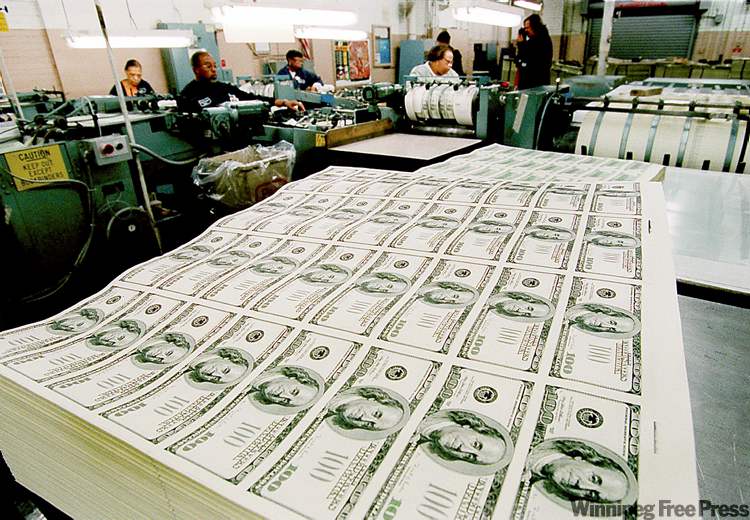
We ride up an escalator and march along a narrow hallway to a vantage point above a whirling, roaring, monster machine that sloshes with bilious lava and hums with fiduciary pride. Down we stare with awe and avarice.
The beast is making $20 bills!
Welcome to the Bureau of Engraving and Printing, established by Abraham Lincoln early in the Civil War to standardize U.S. paper currency and render null and void the notes in circulation in the rebellious South. The war ended in 1865, but the Super Orlof never stopped rolling. Tourists are admitted every 15 minutes. They don’t dare charge a dime.
The blue-robed printers below us are a devilish crew. We note a sign above the counting-house floor:
TOMORROW ONLY
FREE SAMPLES
And another:
JUST THINK HOW I FEEL
I PRINTED MY LIFETIME SALARY
IN A FEW MINUTES
An affable young guide with Ashton Kutcher hair named Derek Mohlman is leading us along. He tells us that this ancient plant — and a newer one in Texas — will continue to stamp out up to 38 million one-, two-, five-, 10- 20- 50- and 100-dollar bills a day, every day, until Ben Bernanke waves the white flag.
“If you have any questions about inflation,” he informs us, “take it to the Federal Reserve. We just print whatever they order.”
Now we see a pallet that is carrying two shoulder-high stacks of Franklins for delivery to the central bank, and from there, inevitably, to the oligarchs of Moscow, the sweatshops of Shanghai, and the gentle lords of Tijuana.
Each pile contains 20,000 sheets of 32 bills each: that’s $64 million in one swallow, the first of 218,750 swallows needed to slake America’s national debt.
(It has become a popular diversion here to try to visualize the sum of $14.2 trillion in comprehensible terms. For example: a mountain of $100 bills as long and wide as two football fields and stacked as high as the armpit of the Statue of Liberty.)
“After the printing and checking process is complete,” Derek Mohlman joshes, “the bills are bundled and shrink-wrapped and brought downstairs to await pickup by Bill Gates.”
The workshop tour concludes with the four most dangerous words in the English vocabulary: “Exit through gift shop.” Down there, I meet a first-time Washingtonian named Ed Urban, 76, from little Blackwell, Okla., and ask him what he thinks this country should do to get out of debt.
“Well, I have a lot of wild theories,” says Urban, a homebuilder who, like nearly everyone else in this country, seems to have been waiting impatiently for decades for someone to come along and interview him.
“For example, my experience here is that the whole population spends a lot of time sitting in traffic jams, just getting mad and burning gas and wasting money. Why doesn’t the government move some of these big agencies to smaller towns?”
“Because then they would be big towns, Ed,” I venture.
But Urban is unswayed. He’s a tall gent, with a belt buckle the size of Tulsa on his trousers and, he confides, more than $1,000 in bills in his pocket.
“Whenever I go to Vegas or come East,” he says, “I roll up enough to get by.”
“Here’s another crazy idea,” Urban theorizes. “All our jobs and our manufacturing have gone overseas. Wouldn’t it make sense to pay a little more for a shirt or a cellphone or a pair of shoes and keep those jobs at home?”
Over by the souvenir counter, which offers Ben Franklin neckties and Christmas ornaments made from shredded fifties, I meet a young couple named Pickens from Sacramento, Calif. Jonathan’s a firefighter and Amy’s a trauma-room nurse. They’ve got about $140 cash between them, but plastic gets them by.
“You just can’t keep printing money,” Amy says, a plea that is ignored by the shop-floor workers in the blue smocks, all of whom are wearing earplugs. “It just decreases the value of the money that we already have.”
Amy has been to Washington before, but it is Jonathan’s first time and he admits that he choked up when he saw the original Star-Spangled Banner at the Smithsonian’s Museum of American History.
They tell me that they are registered Republicans with a healthy distaste for welfare, Medicaid, food stamps, and other programs that, they say, waste billions of good, green dollars and encourage a culture of sloth.
“People get paid not to work and they get medical care for free and they still abuse me and yell and me and hit me,” Ms. Pickens says. Then she notes that one of her own relatives has stopped searching for a job because it would deprive her of unemployment insurance and food stamps.

“My dad never earned more than thirty thousand dollars a year doing construction,” her husband nods. “But he never put us on welfare. Friends would bring us groceries. The deacon of our church would help us buy food.”
This week’s news that the Department of Justice paid $16 each for muffins to be served at a seminar in 2009 just adds to the tourists’ indigestion. But at the Bureau of Engraving and Printing, the gripes of a bankrupt populace can’t be heard over the roar of the machines.
“We all want to see our factories get back to production again,” Jonathan Pickens is saying. “But our production can’t just be the production of more government.”
Allen Abel is a Brooklyn-born Canadian journalist based in Washington, D.C.