Big questions about Copernicus’s big idea unanswered
Advertisement
Read this article for free:
or
Already have an account? Log in here »
To continue reading, please subscribe:

Digital Subscription
One year of digital access for only $205*
- Enjoy unlimited reading on winnipegfreepress.com
- Read the E-Edition, our digital replica newspaper
- Access News Break, our award-winning app
- Play interactive puzzles
*First annual payment billed as $205.00 + GST for one year. This annual subscription will automatically renew at $233.00 + GST every 52 weeks (10% off the regular annual price of $259.35). Offer available to new and qualified returning subscribers only. Cancel any time.
To continue reading, please subscribe:
Add Free Press access to your Brandon Sun subscription for only an additional
$1 for the first 4 weeks*
- Enjoy unlimited reading on winnipegfreepress.com
- Read the E-Edition, our digital replica newspaper
- Access News Break, our award-winning app
- Play interactive puzzles
*Your next Brandon Sun subscription payment will increase by $1.00 and you will be charged $17.95 plus GST for four weeks. After four weeks, your payment will increase to $24.95 plus GST every four weeks.
Read unlimited articles for free today:
or
Already have an account? Log in here »
Hey there, time traveller!
This article was published 29/10/2011 (5423 days ago), so information in it may no longer be current.
A More Perfect Heaven
How Copernicus Revolutionized the Cosmos
By Dava Sobel
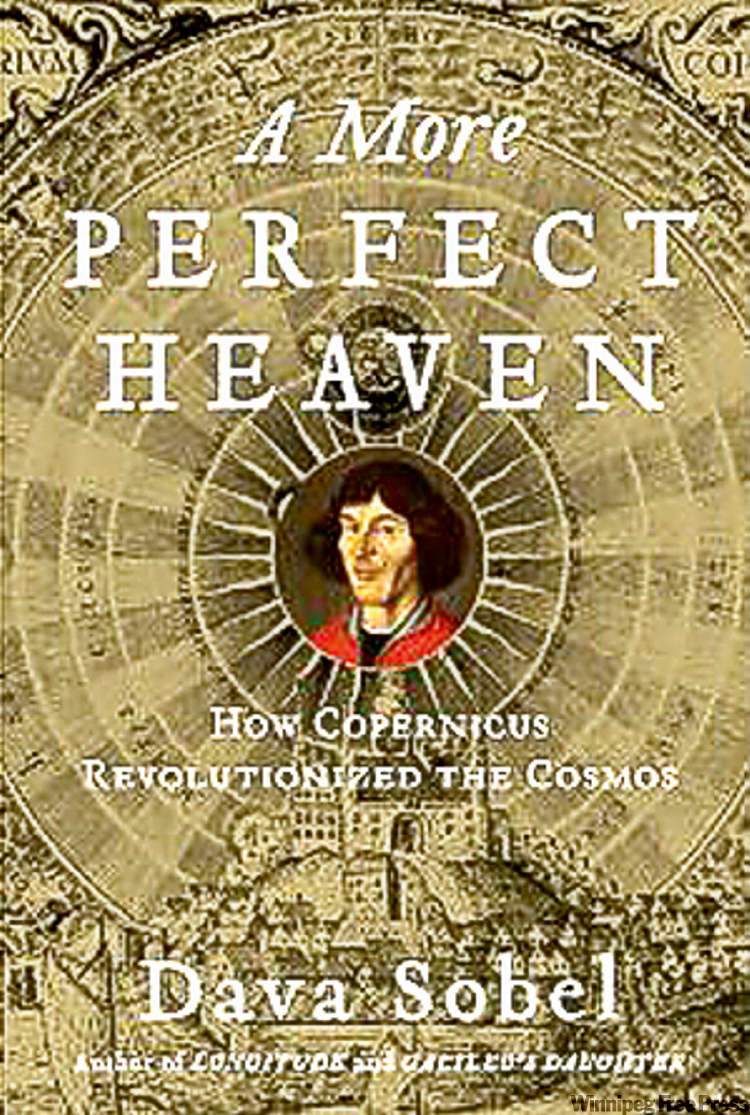
Walker & Company, 274 pages, $28
THE trivia of our lives is deservedly deposited in historical oblivion.
So why write on the details of the life of a 16th-century Polish-Catholic student who studied law and medicine along with astronomy, and who became a rent collector, a legal administrator and a physician?
None of this would have an iota of interest to historians if it were not for his hobby, astronomy, from which he put forth his one big idea — the proposition that the Earth moves.
American writer Dava Sobel’s life of Nicholas Copernicus (1473-1543) covers these non-scientific trivialities because he commenced a revolution that eventually changed the world by replacing our planet with the sun as the centre of the then known universe. Why did he do it? What led him to such a radial idea?
One would think, therefore, that these questions would be central to a book with the subtitle How Copernicus Revolutionized the Cosmos. But no. Except for a few early pages on these matters, the book bypasses the subtitle’s quest.
Popular history of non-contemporary science is rare. Indeed, when reviewed in the popular press, scholarly works in science history are often despairingly dismissed as dry academic tomes.
It was within this climate that Sobel burst on the scene in 1995 with her elegantly written Longitude, a captivating tale of the 18th-century clockmaker John Harrison, who was instrumental in solving a problem that had baffled Galileo and Newton. The book deservedly become a bestseller and was even made into an excellent TV drama.
Sobel followed this in 1999 with Galileo’s Daughter, a wonderfully told account of the relationship between Galileo and his cloistered daughter Sister Maria Celeste. In 2005, Sobel published The Planets, essays merging astronomy and cosmology with mythology, music and astrology.
In short, Sobel has created a genre of popular history of science that sells well because she grabs the reader’s attention by writing engaging stories in stylish prose. A More Perfect Heaven continues that genre.
The book is divided into three parts. Part 1 is a biographical section carrying the story up to Copernicus’s death at the age of 70. He died in the same month that he published his book putting forth the sun-centred universe.
Although he announced this idea earlier in an unpublished document written around the age of 37, copies of which were circulated among astronomers, he hesitated publishing this radical idea.

Towards the end of his life the manuscript grew into a large tome. The nudge to actual publication came from, of all people, a Protestant theologian, Georg Joachim Rheticus. Unfortunately, the details of their important meetings are scant, and this remains one of the great unknowns in science history.
Undeterred, Sobel presents in Part 2 a fictional two-act play, relating how and why Copernicus finally granted Rheticus permission to publish his manuscript. It is a fascinating tale, but only an author of Sobel’s esteem could receive such editorial license to place it in a work of apparent non-fiction.
Part 3 continues with the life of Rheticus (in some ways the book is a dual biography) and the subsequent fate of Copernicus’s idea.
Sobel fills out her book with a breezy trek through Copernicus’s vision as seen by Tycho Brahe, Kepler,and Galileo, right up to the recent forensic reconstruction of Copernicus’s face from the identification of his skull — all in her engrossing style, but nonetheless never answering the big questions about Copernicus’s big idea.
University of Winnipeg history professor David Topper made a stab at steering between rigorous scholarship and popular writing in his non-bestseller, Quirky Sides of Scientists: True Tales of Ingenuity and Error in Physics and Astronomy (Springer, 2007).