Mick Jagger fans won’t get no reading satisfaction
Advertisement
Read this article for free:
or
Already have an account? Log in here »
To continue reading, please subscribe:

Digital Subscription
One year of digital access for only $205*
- Enjoy unlimited reading on winnipegfreepress.com
- Read the E-Edition, our digital replica newspaper
- Access News Break, our award-winning app
- Play interactive puzzles
*First annual payment billed as $205.00 + GST for one year. This annual subscription will automatically renew at $233.00 + GST every 52 weeks (10% off the regular annual price of $259.35). Offer available to new and qualified returning subscribers only. Cancel any time.
To continue reading, please subscribe:
Add Free Press access to your Brandon Sun subscription for only an additional
$1 for the first 4 weeks*
- Enjoy unlimited reading on winnipegfreepress.com
- Read the E-Edition, our digital replica newspaper
- Access News Break, our award-winning app
- Play interactive puzzles
*Your next Brandon Sun subscription payment will increase by $1.00 and you will be charged $17.95 plus GST for four weeks. After four weeks, your payment will increase to $24.95 plus GST every four weeks.
Read unlimited articles for free today:
or
Already have an account? Log in here »
Hey there, time traveller!
This article was published 26/11/2011 (5409 days ago), so information in it may no longer be current.
MICK Jagger has said that he will never write an autobiography, of himself or of the Rolling Stones. You can’t always get what you want.
Is this uneven, often insightful biography by American rock writer Marc Spitz what fans need?
Spitz, not the swimmer, blogs on music for Vanity Fair. He has written plays, novels and books on David Bowie and the Los Angeles punk scene. Here he swoops around Mick Jagger’s life, analyzing the Stones’ co-leader from many different perspectives.
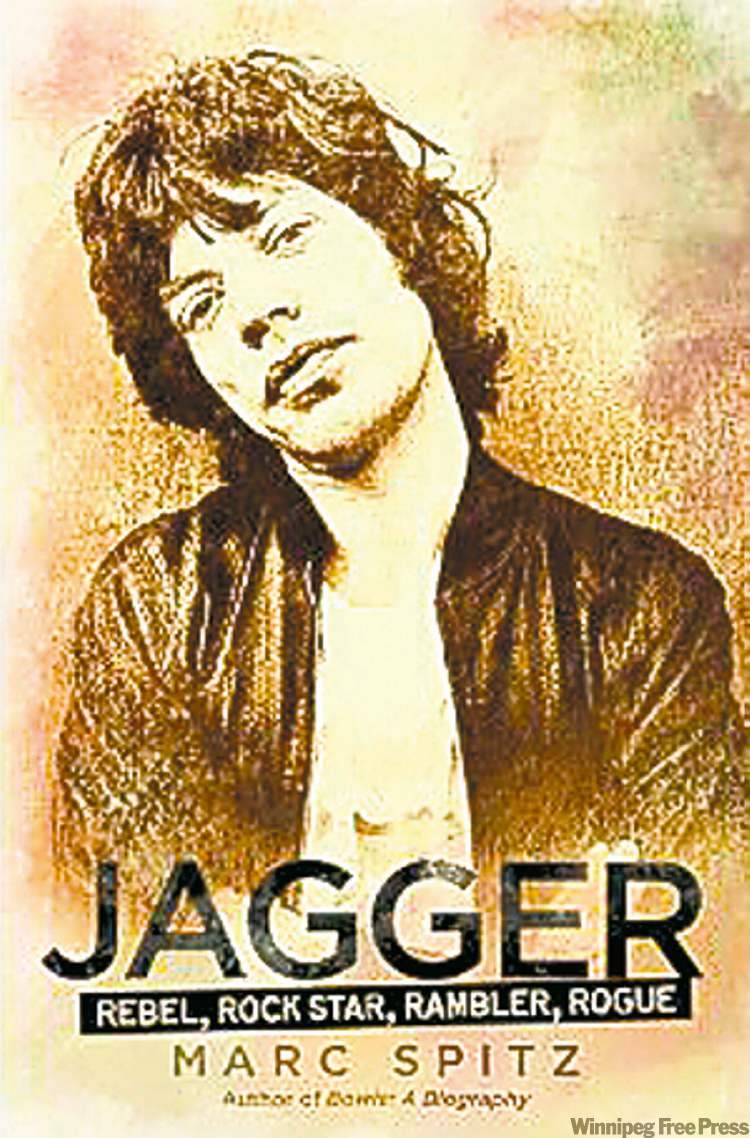
Spitz scrutinizes all the title aspects of Sir Michael Phillip Jagger, and many more. While Jagger is best known as the singer and co-songwriter of the Rolling Stones, Spitz looks at him as a cultural icon and reflection of various zeitgeists of the last five decades.
From his birth in 1943 and middle-class beginnings, to his early and later strained partnership with Keith Richards, through the London School of Economics and numerous trysts and trials (legal and otherwise) Jagger comes off well in this book.
Spitz alludes to Rolling Stones lyrics frequently, a fun and effective way to keep Stones fans engaged. He gives some insights into other band members, especially the equally iconic Richards, who published his own memoir last year, and the tragic Brian Jones, who died in 1969.
Casual acquaintances of Mick and the Stones as well as fans will find much here to ponder. Spitz examines Jagger’s realization that taking part in ’60s protests would be a distraction from the causes. “There was no way, beyond continuing to write and record music, that he could make a difference.”
The middle third of Jagger is the most effective, chronicling the band’s best recordings: Beggars Banquet, Let it Bleed, Sticky Fingers and Exile on Main Street.
That period, from 1968 to 1972, also contained the tour where they were introduced as “the greatest rock ‘n’ roll band in the world,” and which ended tragically at the 1969 Altamont rock festival.
Whether “the spectre of Altamont still hangs, 42 years later, over live rock concerts” everywhere is debatable, but Spitz’s terse, impassive description of the situations that led to the death of Meredith Hunter is exceptionally moving.
Most of the band’s albums are given some brief analysis (readers who think that Exile on Main Street has been skipped will need to wait until its remastered re-release in 2010 is described later in the book).
After the release of Some Girls in 1978, Jagger, like the Stones’ career, seems more and more scattered. “Did Mick somehow realize that the Stones, as the ’70s progressed, were moving at jet-speed towards a creativity-compromised state where they would need all the help they could get?”
Jagger’s best-known women are well-covered, as are various other musicians with whom the Stones recorded and played.
Spitz spends an interesting chapter on Jagger’s film career, and wonders if movie stardom is still in his future.
He also comments on Jagger’s acceptance of a knighthood, mentioning both staid traditionalists’ objections — especially given Mick’s well-known infidelity — and the disdain of Richards and some fans.
Spitz finds much meaning in a Saturday Night Live sketch about Mick, and the parody rockumentary The Rutles. Perhaps too much.
In the end, Jagger may be too esoteric for casual readers. At the same time, it may not go into the kind of depth or detail that serious fans would demand.
Bill Rambo is a Manitoba teacher who knows it’s only rock ‘n’ roll. But he likes it.

Jagger
Rebel, Rock Star, Rambler, Rogue
By Marc Spitz
Gotham Books, 310 pages, $30