

Fiery plane crash kills four
Latest incident involving local airline firm

Advertisement
Read this article for free:
or
Already have an account? Log in here »
To continue reading, please subscribe:
Digital Subscription
One year of digital access for only $1.44 a week*
- Enjoy unlimited reading on winnipegfreepress.com
- Read the E-Edition, our digital replica newspaper
- Access News Break, our award-winning app
- Play interactive puzzles
*Billed as $5.77 plus GST every four weeks. After 52 weeks, price increases to the regular rate of $19.95 plus GST every four weeks. Offer available to new and qualified returning subscribers only. Cancel any time.
To continue reading, please subscribe:
Add Free Press access to your Brandon Sun subscription for only an additional
$1 for the first 4 weeks*
- Enjoy unlimited reading on winnipegfreepress.com
- Read the E-Edition, our digital replica newspaper
- Access News Break, our award-winning app
- Play interactive puzzles
*Your next Brandon Sun subscription payment will increase by $1.00 and you will be charged $17.95 plus GST for four weeks. After four weeks, your payment will increase to $24.95 plus GST every four weeks.
Read unlimited articles for free today:
or
Already have an account? Log in here »
Hey there, time traveller!
This article was published 11/01/2012 (5265 days ago), so information in it may no longer be current.
Federal investigators and the airline involved have few answers why a Piper Navajo plane that left Winnipeg Tuesday morning crashed near a remote northwestern Ontario community and killed four people.
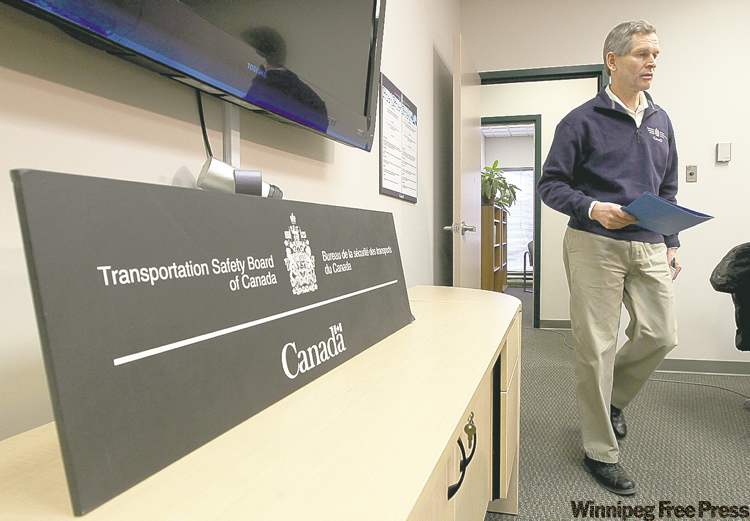
Peter Hildebrand, the Transportation Safety Board’s manager of regional operations, said Tuesday the federal agency has no clue why the Piper Navajo PA 31-250 crashed into the frozen North Spirit Lake at about 10 a.m., just half a kilometre shy of the community’s 1,050-metre gravel airstrip.
He said he expected two investigators will arrive at North Spirit Lake today to begin sifting through what’s left of the airplane.
Community members who snowmobiled to the crash site were able to save one passenger from the fiery wreckage. The Canadian Press reported Tuesday Brian Shead, 36, an employee of Winnipeg-based Aboriginal Strategies Inc., was the lone survivor and suffered a fractured face and ankle.
“I went and saw him. He said, ‘I’ll be OK,'” said Maggie Kakegamic, a North Spirit Lake band councillor.
Shead was reportedly transported to a Winnipeg hospital later in the day. He was listed in stable condition.
Reports say Aboriginal Strategies president Ben Van Hoek and another employee, Colette Eisinger, did not survive the crash. A North Spirit Lake band worker, Martha Campbell, and the pilot, who has not yet been identified, also died.
People in the area heard the plane circling and then a “putt-putt” sound before the crash, said Kakegamic.
“Everybody is just running around crying because they know those people,” she said.
“We will be following up with the survivor,” Hildebrand said at a press conference in Winnipeg.
Witnesses said the plane was trying to land during a severe snowstorm, but Keystone Air Service spokesman George Riopka said there was nothing to indicate the weather was poor.
“The weather was flyable,” he said, but added Keystone, which owns the charter aircraft, only had general weather information for the area. “The weather was acceptable according to the reports that the company had.”
Riopka said the company will pay for grief counselling for family members of the deceased and others who need it.
Hildebrand said because of the Piper Navajo’s smaller size — it can only carry nine passengers — it didn’t have or require voice and flight recorders.
As well, Hildebrand said, because there is no control tower at the community, it’s up to pilots to determine if it is safe to land.
“There was initial communication with the Winnipeg tower and terminal… we are not aware of any other communication,” he said.
Environment Canada meteorologist Natalie Hasell said conditions in Sandy Lake, Ont., about 65 kilometres from North Spirit Lake and the nearest weather station to the crash site, showed winds of about 20 kilometres an hour from the east at the time of the crash.
But Hasell said there is no way of measuring how much snow was falling in the area because the federal weather service’s station there doesn’t have the equipment.
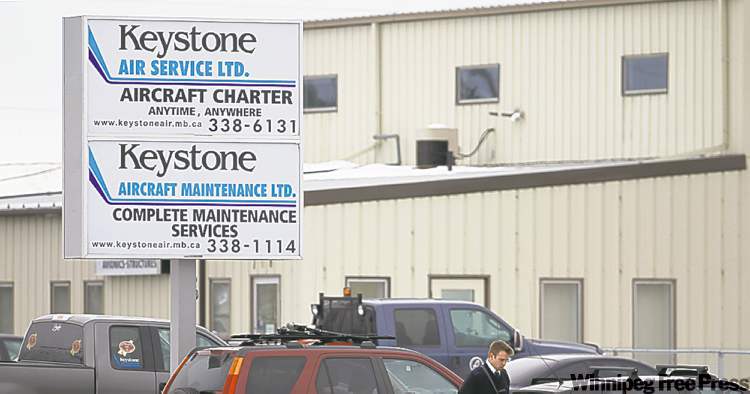
Tuesday’s crash is the latest incident in the turbulent history of Keystone Air Service.
The airline, which bills itself as “Your Key to Reliable Air Transportation,” has faced three major crashes — and five fatalities — in less than 12 years, including the latest tragedy.
And while Hildebrand said crash investigators will focus on the latest crash, he didn’t rule out expanding the investigation to include the company, if necessary. The company, which was formed to fly scheduled commercial flights from Swan River to Winnipeg in 1985, began operating only charter services in 2005. It lost its air operator certificate for several days after a Transport Canada investigation in 2004.
In November 2000, a Keystone twin-engine Piper Navajo Chieftain was forced to crash land into the Assiniboine Forest in Winnipeg when water in the fuel tank froze and caused the right engine to stall during its approach to Winnipeg’s airport.
Two of the plane’s eight occupants were injured, but a Transportation Safety Board report later praised the pilot, saying the injuries could have been worse if he hadn’t taken action before the aircraft dropped into the forest’s trees.
Less than two years later, in June 2002, a Keystone twin-engine Piper Navajo Chieftain made international headlines when it ran out of fuel and slid through a busy Winnipeg intersection, striking a Winnipeg Transit bus, knocking down a light standard and slicing through the cargo area of a three-tonne truck before coming to rest just west of McPhillips Street on Logan Avenue.
Initially, Mark Tayfel, the pilot, was hailed as a hero, because all six of the American passengers on board survived. But three months later, 79-year-old Chester Jones of Kansas died of his injuries. Tayfel was later convicted of dangerous operation of an aircraft causing death and four counts of dangerous operation of an aircraft causing bodily harm.

The company was grounded in 2002, after Transport Canada’s review of documentation following the crash.
Keystone was again grounded in February 2004, after Transport Canada determined the company did not meet the required rules and regulations for having an air operator certificate following an inspection of the airline’s operation and maintenance practices.
— With files from The Canadian Press
kevin.rollason@freepress.mb.ca
Kevin Rollason is a general assignment reporter at the Free Press. He graduated from Western University with a Masters of Journalism in 1985 and worked at the Winnipeg Sun until 1988, when he joined the Free Press. He has served as the Free Press’s city hall and law courts reporter and has won several awards, including a National Newspaper Award. Read more about Kevin.
Every piece of reporting Kevin produces is reviewed by an editing team before it is posted online or published in print — part of the Free Press‘s tradition, since 1872, of producing reliable independent journalism. Read more about Free Press’s history and mandate, and learn how our newsroom operates.
Our newsroom depends on a growing audience of readers to power our journalism. If you are not a paid reader, please consider becoming a subscriber.
Our newsroom depends on its audience of readers to power our journalism. Thank you for your support.
Atleo shares condolences
Shawn A-in-chut Atleo, National Chief of the Assembly of First Nations, offered his condolences to the families of the victims in the North Spirit Lake crash.
“I offer sincere condolences to the families and communities of those lost in (Tuesday’s) tragic plane crash,” Atleo said in a prepared statement released this morning. “Our thoughts and prayers are with the leadership and citizens of North Spirit Lake First Nation, as well as our brothers and sisters across Treaty 9 and Treaty 5 territory impacted by this tragedy.”
Kevin Rollason is a general assignment reporter at the Free Press. He graduated from Western University with a Masters of Journalism in 1985 and worked at the Winnipeg Sun until 1988, when he joined the Free Press. He has served as the Free Press’s city hall and law courts reporter and has won several awards, including a National Newspaper Award. Read more about Kevin.
Every piece of reporting Kevin produces is reviewed by an editing team before it is posted online or published in print — part of the Free Press‘s tradition, since 1872, of producing reliable independent journalism. Read more about Free Press’s history and mandate, and learn how our newsroom operates.
Our newsroom depends on a growing audience of readers to power our journalism. If you are not a paid reader, please consider becoming a subscriber.
Our newsroom depends on its audience of readers to power our journalism. Thank you for your support.
Related Articles
Crash survivor to speak publicly tomorrow
Advertisement Advertise With Us
Advertisement Advertise With Us
History
Updated on Wednesday, January 11, 2012 11:44 AM CST: Adds fact box