Hockey helps aboriginal boy escape racism
Advertisement
Read this article for free:
or
Already have an account? Log in here »
To continue reading, please subscribe:

Digital Subscription
One year of digital access for only $205*
- Enjoy unlimited reading on winnipegfreepress.com
- Read the E-Edition, our digital replica newspaper
- Access News Break, our award-winning app
- Play interactive puzzles
*First annual payment billed as $205.00 + GST for one year. This annual subscription will automatically renew at $233.00 + GST every 52 weeks (10% off the regular annual price of $259.35). Offer available to new and qualified returning subscribers only. Cancel any time.
To continue reading, please subscribe:
Add Free Press access to your Brandon Sun subscription for only an additional
$1 for the first 4 weeks*
- Enjoy unlimited reading on winnipegfreepress.com
- Read the E-Edition, our digital replica newspaper
- Access News Break, our award-winning app
- Play interactive puzzles
*Your next Brandon Sun subscription payment will increase by $1.00 and you will be charged $17.95 plus GST for four weeks. After four weeks, your payment will increase to $24.95 plus GST every four weeks.
Read unlimited articles for free today:
or
Already have an account? Log in here »
Hey there, time traveller!
This article was published 11/02/2012 (5336 days ago), so information in it may no longer be current.
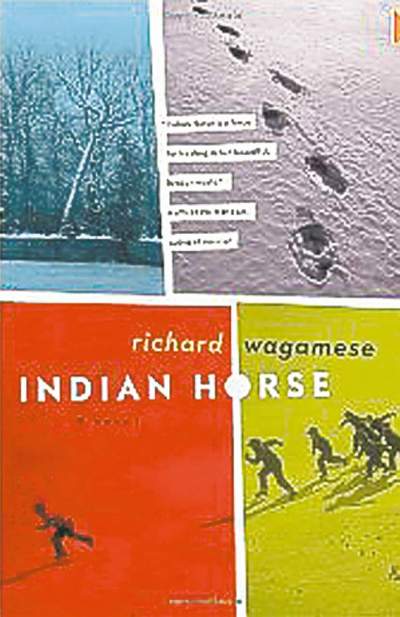
Indian Horse
By Richard Wagamese

Douglas & McIntyre, 186 pages, $23
HE may not have meant to, but B.C. author Richard Wagamese captures the beauty of hockey as few sportswriters could hope to match.
His new novel, Indian Horse, is not essentially about hockey. But Wagamese’s elegance in describing the game’s power to fulfil, however temporarily, the needs of an aboriginal boy raises hockey to a kind of spiritual level.
The novel is about racism in its rawest form, brutally expressed by the residential school, and generally supported by the larger culture.
Richard Wagamese is as an Ojibwa from northwestern Ontario. The author of numerous books of fiction and non-fiction, he knows the realities of racism from the inside of personal experience.
His writing here is lean yet evocative in revealing just how mean-spirited the non-native treatment of native people has been. Through his knowledge of Ojibwa spirituality and cultural practices, he makes believable the survival of aboriginal lifestyles in spite of the assault of mainstream institutions; that is, combined assault by governments, churches, schools.
His narrator, Saul Indian Horse, says, “I had the eyes of one born to a different plane. Our medicine people would call me a seer.”
Not that he so describes himself at the beginning of the tale. We first meet Indian Horse drying out in a treatment centre in the northern Ontario township of Manitouwadge from many years of being “a hard-core drunk.”
Saul implies that others needing treatment try the sharing circle kind of therapy offered by the social workers. He rejects that, and is able to persuade his counsellor Moses to let him express himself in writing.
He reports the events involving deaths of his grandmother and other members of his family that lead to his being placed in residential school.
One grim event after another interrupts Saul’s peace of mind. “I saw kids die of tuberculosis, influenza, pneumonia and broken hearts at St. Jerome’s. I saw young boys and girls die standing on their own two feet…. I saw runaways carried back, frozen solid as boards.”

Yet Saul personally seemed, at first, to have lucked out. As a young teenager in the ’60s, he caught the eye of the priest who coached the hockey team. Equipped with skates and other equipment, he is encouraged by his priestly mentor to indulge his exceptional natural talent for skating and puck-handling.
Saul reports the dreams he was able to have, in spite of the horrors of the residential-school setting:
“At night in the dormitory, when all the other boys were asleep, I pictured myself barrelling across the blue line with the puck tucked neatly on the blade of my stick.”
Saul’s hockey skills eventually took him away from the residential school, and a place on a team in Toronto. Wagamese takes the reader on an emotional journey. You suffer with Saul Indian Horse in his bad times, but you smile with him when he personally triumphs.
Ron Kirbyson is a Winnipeg educator and writer.
Related Articles
PAPER CHASE: Brooks' novel getting notice in U.S.
Advertisement Advertise With Us
Advertisement Advertise With Us