2013 CHEVY MALIBU ECO: A no-boo-boo Malibu
The 2013 Eco with eAssist looks pugnacious, performs smoothly
Advertisement
Read this article for free:
or
Already have an account? Log in here »
To continue reading, please subscribe:

Digital Subscription
One year of digital access for only $205*
- Enjoy unlimited reading on winnipegfreepress.com
- Read the E-Edition, our digital replica newspaper
- Access News Break, our award-winning app
- Play interactive puzzles
*First annual payment billed as $205.00 + GST for one year. This annual subscription will automatically renew at $233.00 + GST every 52 weeks (10% off the regular annual price of $259.35). Offer available to new and qualified returning subscribers only. Cancel any time.
To continue reading, please subscribe:
Add Free Press access to your Brandon Sun subscription for only an additional
$1 for the first 4 weeks*
- Enjoy unlimited reading on winnipegfreepress.com
- Read the E-Edition, our digital replica newspaper
- Access News Break, our award-winning app
- Play interactive puzzles
*Your next Brandon Sun subscription payment will increase by $1.00 and you will be charged $17.95 plus GST for four weeks. After four weeks, your payment will increase to $24.95 plus GST every four weeks.
Read unlimited articles for free today:
or
Already have an account? Log in here »
Hey there, time traveller!
This article was published 16/03/2012 (5276 days ago), so information in it may no longer be current.
When it comes to cars, Americans buy more mid-size autos — or D-segment cars, in automaker parlance — than any other country. The rest of the world prefers compact C-class cars, vehicles the size of a Chevrolet Cruze.
Not surprisingly, the Cruze is Chevy’s most popular vehicle worldwide. The subcompact Sonic, also sold internationally, is a B-class, and the forthcoming Chevy Spark, a micro-car, is considered an A-class car.
This creeping internationalization of Chevrolet’s fleet predates GM’s trip into insolvency and rebirth. But the effects are only now being felt. Consider this: Sixty per cent of Chevy’s sales are now overseas, according to GM.
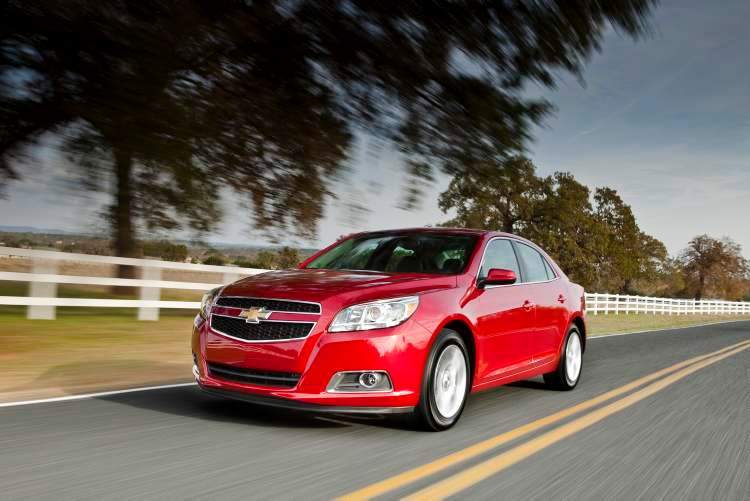
The redesigned 2013 Chevrolet Malibu should increase that number, as it trades its American platform for one shared worldwide with other mid-size GM cars such as the Opel Insignia and Buick Regal. It’s Chevrolet’s first global mid-size car, one that will be built in four plants worldwide: two in the United States, one in China and one in Korea.
As a result of becoming an international citizen, the 2013 Chevrolet Malibu has a 4.5-inch (114.3 mm) shorter wheelbase than the 2012 Malibu but is two inches (50.8 mm) wider. Gone are the 2012 model’s long, flowing lines that imparted a sense of elegance to a nameplate that hadn’t seen sublime styling in decades.
The new Malibu has a more pugnacious, muscular stance that seems cautiously conservative next to the more daring 2012 Hyundai Sonata, Kia Optima and the stunning 2013 Ford Fusion.
Initially, the front-wheel-drive Malibu is being offered only in Eco trim, which employs a revised version of GM’s mild hybrid system, which GM calls “eAssist.” The term refers to a system that uses a 182-horsepower, 2.4-litre, four-cylinder engine teamed with a 15-hp electric motor-generator and six-speed automatic transmission.
The eAssist driveline never runs solely on electricity like a full hybrid. Instead, the electric motor merely aids performance, allowing a lower-powered gas engine and fewer batteries to be used. This improves fuel economy by 12 per cent at a lower cost than full hybrids, according to GM.
Like other hybrids, the Eco captures energy during braking to recharge the electric motor’s lithium-ion battery pack. This gives the brakes a grabby feel, although it’s less noticeable than in many hybrids. When the car starts to decelerate, fuel is shut off to the engine, which in turn shuts off when the Malibu comes to a stop. The whole driveline restarts once your foot is lifted from the brake pedal.
Chevy engineers took other steps to improve fuel economy by designing the car with aerodynamic underbody panels and by using electronically controlled shutters in the lower grille that close at higher speeds to push air around the car. In addition, lightweight components, such as an aluminum hood, are used throughout.
So what’s it like to drive?
Like the 2012 Malibu, the car’s solid platform and dynamic personality make it a rewarding car to pilot. The new Malibu’s ride is absorbent, insulating passengers from road shocks, yet still communicating that you’re traversing broken pavement. Body motions are well controlled, striking the right balance between bump absorption and a firm ride.
The Malibu Eco feels European in its power delivery. Acceleration off the line isn’t as brisk as it is once the revs build. Throttle response is lively, and the six-speed automatic shifts smoothly. The Malibu Eco’s responsive personality feels like a normal car rather than a miserly hybrid that’s stingy with power, upshifting too quickly and leaving too little power for passing.
Like other cars of its kind, the Malibu Eco has low-rolling-resistance tires that, when accelerating through a corner on wet pavement, lose grip quickly, but they prove fine on dry pavement.
Chances to measure fuel economy were limited to preview drives of pre-production models through hills outside Austin, Texas. Overall, the Malibu Eco is rated at 8.1 L/100km in the city and 5.3 on the highway. That’s superior to regularly-aspirated four-cylinder Malibus.
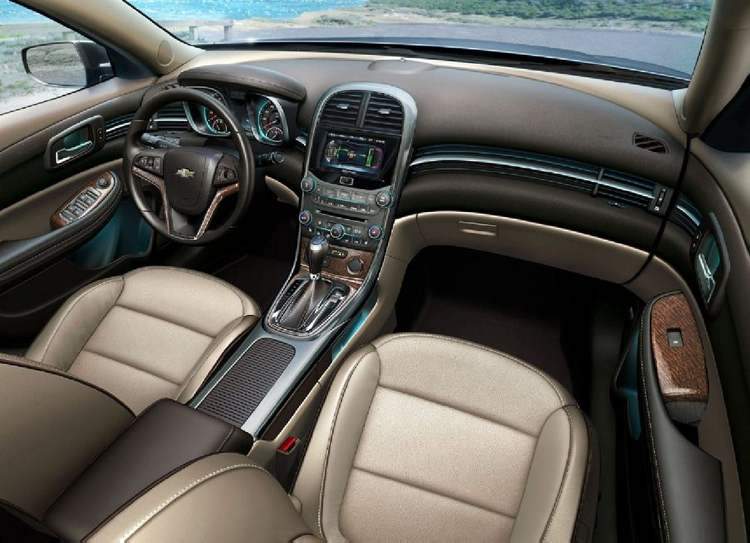
The spacious cabin is as quiet as a college library on Saturday night, with materials a clear cut above the outgoing car, not to mention its mid-size competition. Looking around the cabin, it’s clear attention was paid to the finest details throughout the passenger compartment.
The instrument cluster reflects the car’s smartly designed balance of sport and elegance. The gauges are clear and easy to understand, a refreshing departure from its hybrid rivals.
The Malibu gets a much-needed high-tech upgrade with Chevy’s new MyLink infotainment system, which seamlessly integrates online services such as Pandora Internet radio and smartphone applications, using voice commands or touch-screen controls through your Bluetooth-enabled phone. It makes the AM/FM/Audio CD/MP3/Sirius XM audio system seem like old hat.
MyLink supports Gracenote, so a song’s album art appears on the system’s seven-inch screen. It also allows you to ask for a Bruce Springsteen track simply by asking for “The Boss.” Thoughtfully, you can customize the buttons on MyLink’s home page, similar to customizing your smartphone. Unlike some automotive infotainment systems, this screen has graphics that are easy to read, and the system is easy to use.
When it comes to trunk space, you’ll find it adequate at 14.3 cubic feet, two cubic feet less than in other Malibus due to the hybrid components, which take up the remaining space.
Safety equipment includes eight airbags, stability control, traction control, four-wheel disc brakes with anti-lock and optional forward-collision alert and lane-departure warning systems.
Initially, all Malibus will come in Eco trim with “eAssist” driveline. If you’re more of a driving enthusiast or you want more trunk space, you might want to wait until summer, when you can opt for a 190-hp, 2.5-litre, four-cylinder engine or a 2.0-litre turbocharged four.
But for those who want comfort, a modicum of driving fun and a fuel-efficient ride at a modest price, the Malibu Eco may fill that perfect spot in your garage.
— The Virginian-Pilot
THE SPECS
Type of vehicle: midsize sedan
Engine: 2.4-litre four-cylinder with 11 kW electric motor
Power: 182 hp @ 6,200 rpm; 172 lb-ft of torque @
Transmission: 6-speed automatic
Brakes: disc
Wheels: 17-in. alloy
Tires; P225/55R17
Wheelbase: 2,738 mm
Length: 4,859 mm
Cargo space: 14.3 cubic feet
Fuel consumption (L/100 km): 8.1 city, 5.3 highway
Base price: $27,000 (estimated)