

AI literacy course mandatory at U of W Collegiate

Advertisement
Read this article for free:
or
Already have an account? Log in here »
To continue reading, please subscribe:

Digital Subscription
One year of digital access for only $205*
- Enjoy unlimited reading on winnipegfreepress.com
- Read the E-Edition, our digital replica newspaper
- Access News Break, our award-winning app
- Play interactive puzzles
*First annual payment billed as $205.00 + GST for one year. This annual subscription will automatically renew at $233.00 + GST every 52 weeks (10% off the regular annual price of $259.35). Offer available to new and qualified returning subscribers only. Cancel any time.
To continue reading, please subscribe:
Add Free Press access to your Brandon Sun subscription for only an additional
$1 for the first 4 weeks*
- Enjoy unlimited reading on winnipegfreepress.com
- Read the E-Edition, our digital replica newspaper
- Access News Break, our award-winning app
- Play interactive puzzles
*Your next Brandon Sun subscription payment will increase by $1.00 and you will be charged $17.95 plus GST for four weeks. After four weeks, your payment will increase to $24.95 plus GST every four weeks.
Read unlimited articles for free today:
or
Already have an account? Log in here »
The University of Winnipeg Collegiate is requiring new students to complete artificial intelligence 101 lessons and offering a first-of-its-kind elective for those who want to perfect their chatbot prompts.
The private high school is piloting two projects this year in a bid to improve digital literacy on the downtown campus.
Every Grade 9 and 10 student will have to pass an approximately two-hour long online course about “AI essentials.”
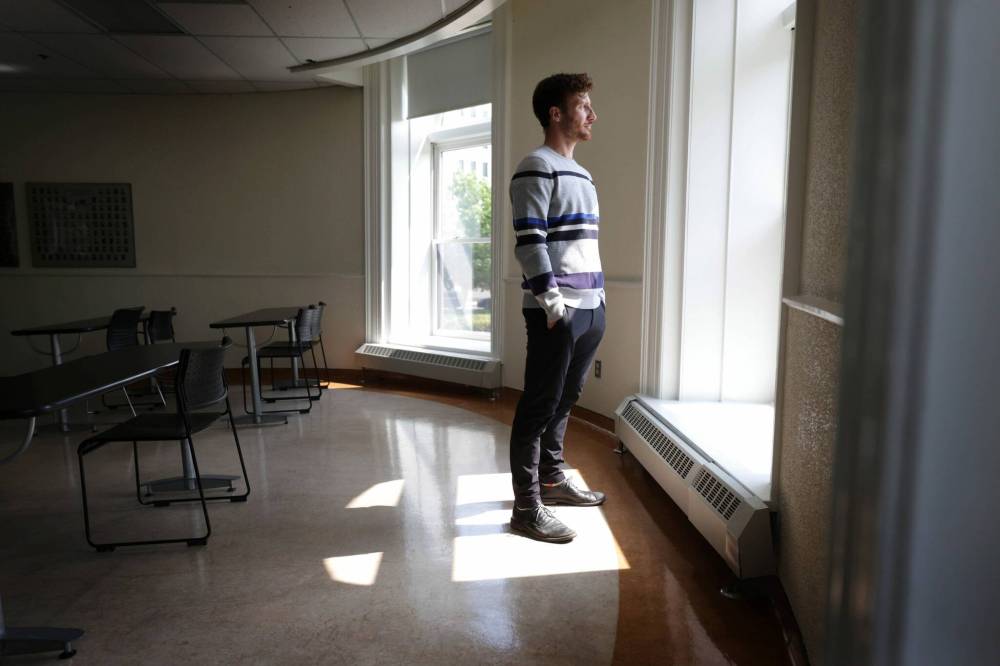
Ruth Bonneville / Free Press
Cameron Cerasani, a mathematics and physics instructor, has designed a new course he calls a “critical thinking course” and will be delivering it to University of Winnipeg Collegiate Grade 10 students for the first time this fall.
Dean Osaed Khan likened the mandatory e-learning sessions to requiring students to complete a safety course before they can participate in a science lab.
The school has also received government approval to run a Grade 10 elective that will, according to the course description, “help students understand the growing role of AI in modern society.”
Khan said he wants all students to know how to, when it’s appropriate, leverage this technology in a safe and effective manner.
“You shouldn’t think of it as a shortcut to actual learning,” he said.
A growing body of research suggests the majority of Canadian teenagers are using AI to help them with academic assignments.
A 2025 study on usage among Toronto high schoolers found 55 per cent of respondents were using it for school multiple times a week.
The quantitative research project, undertaken last year by LinkedKey Foundation in partnership with the University of Toronto, is among the first to explore student use and perceptions of AI.
“What a lot of schools are recognizing is, if you’re not having these conversations with students, they’re having them on their own — with an AI tool or with a friend, which may or may not be giving them safe guidance,” said Michael Holden, an assistant professor in the faculty of education at U of W.
As far as Holden is concerned, public and private schools have a key role to play “in helping students navigate this really weird information landscape.”
The university researcher applauded his colleagues who teach high school on their shared campus for their efforts to better understand AI and help students do the same.
The U of W Collegiate invited Holden, who studies AI’s impact on teacher evaluations, to run a professional development session last year.
The new initiatives were born out of associate dean Cameron Cerasani’s personal interest in the AI boom and what he and his colleagues have observed — including acts of plagiarism and shortcuts — since ChatGPT went public in late 2022.
Cerasani has created software, using a paid edition of ChatGPT, to help the administrative team create student timetables.
His latest project, a new elective that he insists is “not a computer science course,” is targeted at both tech-savvy teenagers and high schoolers who are hesitant about AI.
“This is not a course that is going to teach students how to get AI to do their homework,” said the instructor, who typically teaches mathematics and physics.
“It’s a course exploring AI and how we think about it critically, ethically, responsibly, and make sure we are staying within the guardrails that haven’t really existed. It is a critical-thinking course, is what it is.”
The course description states students will learn how AI systems are trained and study the influence the tools have on communication, education, media and decision-making, among other items.
Introduction to Artificial Intelligence 21G is anticipated to encompass inquiry, discussions, case studies and hands-on exploration.
The first intake is full. It is made up of students with wide-ranging interests, from philosophy to environmentalism.
Cerasani said his job isn’t to force anyone to take a side — pro- or anti-AI — but rather get students to reflect on their relationship to the technology and how to navigate a post-Grade 12 world with it.
He intends to teach them to write effective prompts and understand the limitations and consequences of AI tools.
He also plans to regularly discuss current events related to breakthroughs, ethics and regulations as the technology continues to evolve at a rapid pace.
Manitoba Education does not have a syllabus on the topic, although the province hosted a summit in January for school leaders to discuss AI’s impact on their field and opportunities to leverage it for classroom learning. During the event, the provincial association of education technology leaders circulated its guidelines for responsive use.
The guidelines recommend teachers only use licensed tools endorsed by their employer, review platform terms of service, as well as any AI-generated content, and prioritize their professional judgment above all else. They were finalized about 12 months ago.
Cerasani described 2026-27 as “an exciting” and “absolutely scary” time to be a teacher.
Ultimately, he said his goal is for students to become more comfortable with AI and understand their original voices matter.

Khan, the equivalent of a principal at the high school, echoed those comments.
The dean recalled the school’s cafeteria was filled with students using laptops with AI tools open in their browsers last year. Chatbots were being used as a study partner, therapist and restaurant reviewer, among other things.
Khan and Cerasani said they want to make it explicitly clear to students that teachers genuinely want to hear their perspectives, rather than a robot’s take.
“We don’t care for the AI version. We want your version,” Khan said, adding he’s optimistic the universal e-learning lessons will be a proactive resource that encourages healthy habits.
maggie.macintosh@freepress.mb.ca
Maggie Macintosh
Education reporter
Maggie Macintosh reports on education for the Free Press. Originally from Hamilton, Ont., she first reported for the Free Press in 2017. Read more about Maggie.
Funding for the Free Press education reporter comes from the Government of Canada through the Local Journalism Initiative.
Every piece of reporting Maggie produces is reviewed by an editing team before it is posted online or published in print — part of the Free Press‘s tradition, since 1872, of producing reliable independent journalism. Read more about Free Press’s history and mandate, and learn how our newsroom operates.
Our newsroom depends on a growing audience of readers to power our journalism. If you are not a paid reader, please consider becoming a subscriber.
Our newsroom depends on its audience of readers to power our journalism. Thank you for your support.
Responsible AI use in education guidelines
- Only use AI tools supported by your division, particularly those hosted within your domain (Microsoft 365, Google Workspace) as these protect student data, organizational data and personal data
- Understand the difference between licensed and unlicensed AI tools and platforms
- Never upload student work, personal information or confidential data into public AI platforms
- Respect intellectual property when sharing or generating content
- Ask yourself who owns the data you are uploading and review a tool’s terms of service
- Ensure consent is obtained before collecting any user data
- AI should not be used to replace teacher judgment, but rather to support planning, drafting, brainstorming and communication
- Teachers should understand they are solely responsible for the assessment and marking of student work
- Proofread, verify and adapt AI-generated content for accuracy, context and tone
- Understand that AI consumes energy and resources so use it intentionally to avoid unnecessary waste
- Use AI as a digital assistant to summarize documents, organize ideas, generate writing prompts and help with administrative tasks
- Consider the environmental, community and social impacts of adopting AI tools
- Be aware that AI is trained on data that reflect systemic bias, privilege and inequities
- Use AI to elevate diverse voices and foster dialogue on real-world issues relevant to students and their communities
- Encourage students to explore AI’s role in society by considering who controls AI outcomes, how algorithmic bias upholds inequity and what the ethical impacts of automation, surveillance and data use are on people
— Manitoba Association of Education Technology Leaders, released in September 2025
Maggie Macintosh
Education reporter
Maggie Macintosh reports on education for the Free Press. Originally from Hamilton, Ont., she first reported for the Free Press in 2017. Read more about Maggie.
Funding for the Free Press education reporter comes from the Government of Canada through the Local Journalism Initiative.
Every piece of reporting Maggie produces is reviewed by an editing team before it is posted online or published in print — part of the Free Press‘s tradition, since 1872, of producing reliable independent journalism. Read more about Free Press’s history and mandate, and learn how our newsroom operates.
Our newsroom depends on a growing audience of readers to power our journalism. If you are not a paid reader, please consider becoming a subscriber.
Our newsroom depends on its audience of readers to power our journalism. Thank you for your support.
Related Articles
Schools are starting to teach AI literacy. For many, that means helping kids see chatbots' flaws



Advertisement Advertise With Us
Advertisement Advertise With Us
History
Updated on Tuesday, August 25, 2026 9:25 AM CDT: Corrects that Michael Holden is an assistant professor in the faculty of education