
Film examines Olympic hero’s German triumph, U.S. tragedy

Advertisement

Advertise with us

The one thing Jesse Owens never needed -- unless, that is, he was sprinting against a thoroughbred racehorse -- was a head start.

Read this article for free:


or

Already have an account? Log in here »

To continue reading, please subscribe:

Subscribe and receive a limited-edition Free Press branded hat or tote.

Digital Subscription

One year of digital access for only $205*

  • Enjoy unlimited reading on winnipegfreepress.com
  • Read the E-Edition, our digital replica newspaper
  • Access News Break, our award-winning app
  • Play interactive puzzles

*First annual payment billed as $205.00 + GST for one year. This annual subscription will automatically renew at $233.00 + GST every 52 weeks (10% off the regular annual price of $259.35). Offer available to new and qualified returning subscribers only. Cancel any time.

To continue reading, please subscribe:

Add Free Press access to your Brandon Sun subscription for only an additional

$1 for the first 4 weeks*

  • Enjoy unlimited reading on winnipegfreepress.com
  • Read the E-Edition, our digital replica newspaper
  • Access News Break, our award-winning app
  • Play interactive puzzles
Start now

*Your next Brandon Sun subscription payment will increase by $1.00 and you will be charged $17.95 plus GST for four weeks. After four weeks, your payment will increase to $24.95 plus GST every four weeks.

Opinion

Hey there, time traveller!
This article was published 01/05/2012 (5278 days ago), so information in it may no longer be current.

The one thing Jesse Owens never needed — unless, that is, he was sprinting against a thoroughbred racehorse — was a head start.

But PBS gives the famed U.S. Olympian a chance to get out of the gate early, airing its new American Experience profile a couple of months before the inevitable crush of Olympic-year programming overwhelms the prime-time lineup.

It’s a smart move — Jesse Owens, which airs tonight at 7 on Prairie Public TV, is a fascinating and surprisingly in-depth biography that deserves not to be lost in the looming wave of London-games clutter.
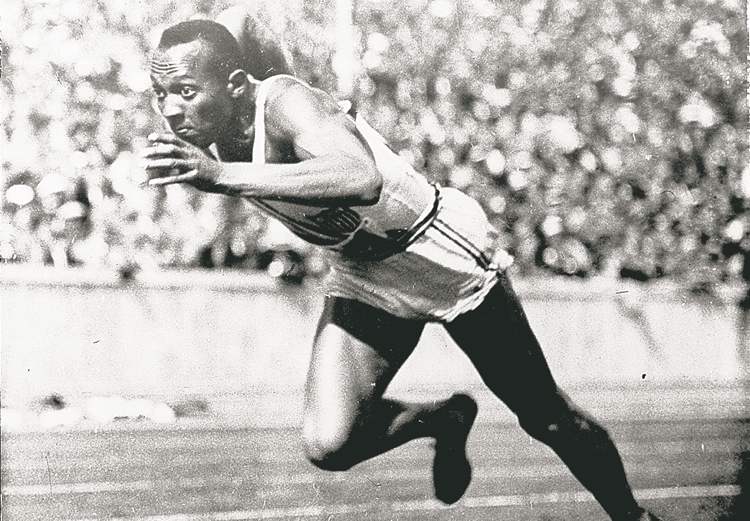
CP
This 1936  file photo  shows Owens  in action  in a 200-metre preliminary  heat at the  Summer Olympic Games in Berlin.
CP This 1936 file photo shows Owens in action in a 200-metre preliminary heat at the Summer Olympic Games in Berlin.

The hour-long documentary, produced and directed by Laurens Grant and narrated by Andre Braugher, offers the expected overview of Owens’ athletic achievements and the sociopolitical impact of his quartet of gold-medal wins at the 1936 Olympics in Hitler-ruled Germany. But it also provides a deftly layered portrait of the track star as a human being whose worldwide fame and popularity were ultimately not enough to break down the barriers of racism he faced in his own country.

The film opens with a look at Owens’ early life, from his birth in Alabama in 1913 and his family’s move to Cleveland in the early ’20s to escape the south’s racial oppression; his early athletic exploits are described, including his rise to national prominence as a member of Ohio State University’s track team.

It’s then that Jesse Owens becomes really interesting, as the film traces the parallel lines of the sprinter’s early success and the rise of Nazi fanaticism in Hitler’s Germany.

Owens, for his part, nearly opted out of the games, having joined a group of U.S. athletes calling for a boycott of the ’36 Olympics because of Germany’s rising tide of anti-Semitism. Pressure from American Olympic Committee president Avery Brundage — a known Hitler sympathizer — eventually forced Owens and others to keep quiet and participate in the games.

After his first gold-medal triumph, in the 100 metres, Owens was denied the traditional privilege of being congratulated by the host nation’s leader. “Do you really think I will allow myself to be photographed shaking hands with a Negro?” said Hitler.

Two more events (long jump, 200 metres), two more gold medals. Officially, Owens’ Olympic commitment was fulfilled, but at the last minute, he and African American teammate Ralph Metcalfe were added to the 4 x 100 relay team in place of Jewish sprinters Marty Glickman and Sam Stoller — after U.S. officials bowed to pressure from the Germans, who would apparently rather have had blacks win medals than Jews.

Owens, again, was a reluctant participant, but his fourth gold medal simply added to his fame.

Unfortunately, when Owens returned to the U.S., wondering which of the many lucrative offers he’d received in Berlin he would accept, he found the back-home reality to be rather stark and depressing. On a hero’s-welcome tour of New York City, he and his wife were unable to find a hotel that would accept black customers; when one manager reluctantly agreed to take them in, it was with the condition that Owens enter and leave through the service entrance.

Employment proved hard to come by; eventually, Owens became a novelty act, accepting exhibition races against horses for the public’s amusement.

“A lot of people felt that he was not dignifying himself,” says daughter Beverly Owens Prather. “But when you have a family to feed and you have no job, you do what you have to do to feed your family, as long as it’s honest.”

Shortly after having been the most beloved athlete in the world, Owens was jobless, broke and in trouble with the IRS. He faded into anonymity for more than a decade; it wasn’t until the late ’50s, at the dawn of the Cold War, that he returned to public life as what one observer describes as “a professional good example” of what America aspired to be.

As much as it is a story of triumph, Jesse Owens is — as PBS producer Mark Samels offers — “a cautionary tale of the ephemeral life of an athlete … (and) an emblematic story about sports in America.”


Report Error Submit a Tip

More Stories

Manitoba e-scooter legislation changes set to impose speed limit, age restrictions, sidewalk ban

Matthew Frank 5 minute read Preview

Manitoba e-scooter legislation changes set to impose speed limit, age restrictions, sidewalk ban

Matthew Frank 5 minute read Sunday, Oct. 11, 2026

People riding e-scooters and other personal electric vehicles in Manitoba will have to strap on a helmet, stay off sidewalks and follow new age limits once new provincial rules for the devices take effect next year.

The vehicles, which also include electric skateboards, hoverboards and unicycles, will fall under The Highway Traffic Act starting in 2027, according to the province’s website. E-bikes are excluded from the new rules, according to the province’s frequently-asked-questions page.

All riders must be at least 16 years old and wear properly fitting helmets — that goes for passengers, too, the province said.

The proposed new legislation sets a speed limit of 25 km/h and would prohibit personal electric vehicles from sidewalks unless signs specifically allow sidewalk use. Riders would be using shared paths or roads with speed limits of 50 km/hr or less. They won’t be allowed to operate the vehicles under the influence of alcohol or drugs and they must use hand signals and obey traffic signs.

Read
Sunday, Oct. 11, 2026

Riding the Unity Bus to rally support for Canada in Alberta

Melissa Martin 8 minute read Preview

Riding the Unity Bus to rally support for Canada in Alberta

Melissa Martin 8 minute read Updated: Yesterday at 9:57 PM CDT

WAINWRIGHT, Alta. — The Unity Bus arrives right on time, pulling into a parking lot on the edge of this town of about 6,600 people close to the Alberta-Saskatchewan border. As the vehicle slows to a halt, resplendent in its patriotic red-and-white paint, a small group of supporters stand waiting, decked in their own maple leaf garb.

The Unity Bus’s doors open and former Alberta deputy premier Thomas Lukaszuk bounds to the ground. The supporters, volunteers with Lukaszuk’s Forever Canadian campaign, welcome him with applause; he greets them with open arms. He knows many by name, having been to Wainwright four times; some of them fondly call him “the boss.”

“Do you need some stickers?” he asks. “Do you need some swag to give away?”

It’s a chilly Thanksgiving Monday morning on the eastern edge of Alberta. A sharp wind nips at exposed skin and drab grey clouds hang low in the sky. Such weather does not encourage high spirits, but Lukaszuk and these volunteers can’t afford to let theirs falter: in just one week, on Oct. 19, Albertans will vote on a historic question on whether to remain in Canada.

Read
Updated: Yesterday at 9:57 PM CDT

Creatures’ comfort key to coping with loss

Maureen Scurfield 5 minute read 2:00 AM CDT

DEAR MISS LONELYHEARTS: Not long ago I lost my husband to illness at far too young an age. My spouse was a great guy, but I do want another one.

I just want to pass on a little tip. When my husband was dying, he encouraged me to bring home warm and loving pets to our acreage just outside the city. They were my saviours when my husband was ill.

Since he has died, they continue to help me keep warm, happy and affectionate. They were my greatest comfort in the later stages when my man was in too much pain to hold me or be held. The cats and the dog would welcome me home from the hospital and transfer their cuddling to me, giving me all the attention I needed, and I always felt so loved.

I have been dating a fair bit for a fairly recent widow because I’m ready to be held and loved, and I feel my husband and the pets saying, “Way to go.”

Israel and Palestine: 30 wasted years

Gwynne Dyer 5 minute read 2:00 AM CDT

Here is how the high command of the Israel Defence Forces (IDF) laid down the rules for “remotely” killing suspected Palestinian activists in the densely populated Gaza Strip after the surprise Hamas attack on Israel on Oct. 7, 2023.

Gianmarco Soresi coming to Winnipeg

1 minute read Yesterday at 2:26 PM CDT

Stand-up comedian and actor Gianmarco Soresi is set to perform at Club Regent Event Centre in the spring.

Soresi's The Misery Loves Tour stops in Winnipeg May 28, 2027. The New York-based comedian released his debut comedy special Thief of Joy on YouTube last year.

Tickets go on sale Oct. 16 at ticketmaster.ca.

A question of public utility

Tom Pearson 5 minute read 2:00 AM CDT

The editorial page of the Free Press often provides perspectives that are thought-provoking and sometimes contradictory. “Keeping the lights on,” (Oct. 5) by Hal Turner and “Wasteful operations should be held accountable,” (Oct. 6) by Barry Prentice are both thought-provoking. They are not contradictory because they cover two quite different topics. Where they differ is in their delivery and the quality of the underlying facts.

Mr. Turner provides what is, in my view, the most cogent rationale for gas-fuelled generation that I have read. He highlights the essential aspect of power supply to Manitobans. He supports the argument for natural gas generation with succinct, relatable facts and anecdotes relating to what other comparable utilities have done. He states that, “Manitoba Hydro’s experts are neither anti-wind nor pro-fossil fuel.” They are simply seeking the best possible solution for Manitobans — a fact many special-interest groups either ignore or sadly, impugn.

Although some would argue the contrary, I believe that Mr. Turner’s position and longevity in the Manitoba Hydro organization lend gravitas to his column. Mr. Turner understands that “keeping the lights on” is a non-negotiable requirement and a public trust.

Before I turn to Mr. Prentice’s column, I should disclose that before I retired (it’s been a while), I was responsible at different times for Winnipeg’s regional water system and subsequently water supply from source to tap. In that context I was also responsible for the operation of the Greater Winnipeg Water District (GWWD) railway. Like Mr. Turner’s perspective on the supply of electricity to Manitobans, I regard the supply of safe drinking water to Winnipeggers as a public trust.