

‘Crescent moons’ stave off starvation
Women, children dig shallow holes to trap precious water for growing
Advertisement
Read this article for free:
or
Already have an account? Log in here »
To continue reading, please subscribe:
Digital Subscription
One year of digital access for only $1.44 a week*
- Enjoy unlimited reading on winnipegfreepress.com
- Read the E-Edition, our digital replica newspaper
- Access News Break, our award-winning app
- Play interactive puzzles
*Billed as $5.77 plus GST every four weeks. After 52 weeks, price increases to the regular rate of $19.95 plus GST every four weeks. Offer available to new and qualified returning subscribers only. Cancel any time.
To continue reading, please subscribe:
Add Free Press access to your Brandon Sun subscription for only an additional
$1 for the first 4 weeks*
- Enjoy unlimited reading on winnipegfreepress.com
- Read the E-Edition, our digital replica newspaper
- Access News Break, our award-winning app
- Play interactive puzzles
*Your next Brandon Sun subscription payment will increase by $1.00 and you will be charged $17.95 plus GST for four weeks. After four weeks, your payment will increase to $24.95 plus GST every four weeks.
Read unlimited articles for free today:
or
Already have an account? Log in here »
Hey there, time traveller!
This article was published 12/05/2012 (5153 days ago), so information in it may no longer be current.
GALMA COMMUNE, Niger — Beneath a sweltering midday sun, women and children use pickaxes, hoes and bowls to scrape away at hard orange soil on a rocky hillside west of the town of Madaoua.
The unlikely work crew includes young mothers with babies on their backs, older women with remarkably defined biceps and little kids barely as tall as their shovels. There are a few adult men on the hill, but most are acting as supervisors.
To North American eyes, this looks like some bizarre form of chain gang. But these women and children are here of their own accord.
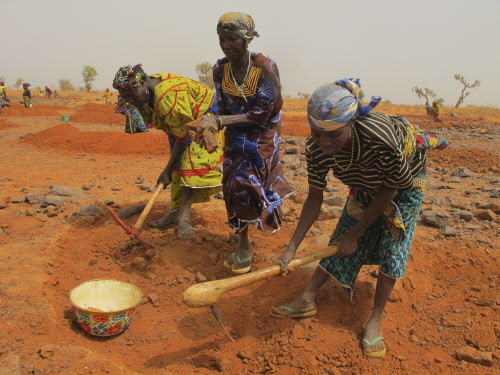
They’re taking part in a food-for-work program that allows Nigeriens at risk of going hungry to receive grain in exchange for helping restore vegetation in this environmentally degraded African nation.
Work-for-food programs can take several guises, but today the women and children are digging “crescent moons,” semi-circular shallow holes that have proven an effective climate-change adaptation strategy in some parts of the Sahel.
During recent decades, the short growing season in this semi-arid belt of Africa has become increasingly unpredictable, confounding the age-old planting routines of subsistence farmers.
In years such as 2011, the rains stopped more than a month early in many parts of Niger, leaving stunted crops of millet, the staple foodstuff. Other growing seasons have featured short bursts of torrential rains that carry away the crops, along with topsoil.
Since no one can control precipitation, the main adaptive strategy in the Sahel is to capture more rain, whenever possible. Hence the low-tech solution of crescent moons, which are arranged on slopes to capture surface runoff following rains, as well as any grass seeds that may flow in.
In areas where they’ve been dug properly, crescent moons can help grasses return to barren hills denuded of vegetation by soil erosion, overgrazing by sheep and goats and far-too-intensive millet farming.
At the centre of the crescent, villagers are encouraged to plant drought-resistant indigenous acacia trees, whose roots can further stabilize the soil. Protecting the young saplings from voracious goats can be a tall order, but the shallow holes can be effective even without the trees.
“No single (agricultural) technique can solve all the problems in the Sahel,” said Jason Brooks, Niger director for humanitarian group ADRA, whose activities include work-for-food programs.
“What we’re seeing here is climate disruption. Everything is out of whack. That makes the job of the farmer more difficult.”
To bring more vegetation back to the Sahel, which is growing hotter and less hospitable to trees, grasses and crops, farmers also need to plant windbreaks, build low earthen dikes to capture rainfall on flatter ground, prune trees to foster the strongest stalks and get used to new, faster-maturing seed varieties.
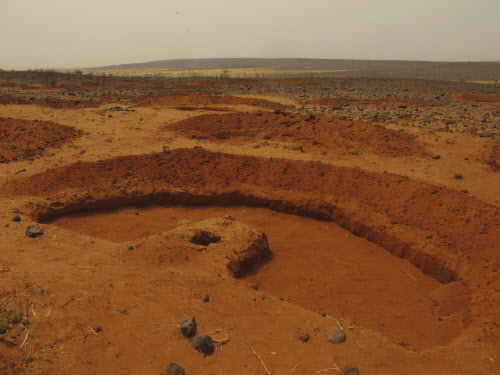
Another adaptation strategy that involves capturing more rain is the use of “zai holes,” small depressions in the earth for individual plants. Research conducted across the Sahel suggests zai holes can dramatically improve crop yields, when manure and micro-doses of chemical fertilizer are applied to the holes, according to the United Nations Environment Program.
Brooks said rural Nigeriens also need to diversify their diet. Farmers could eat more of the protein-rich cowpeas they typically grow to sell and get used to making flour from the nutritious seeds of Australian acacia trees, which are also drought-resistant. Acacia flour is apparently tasty and can be mixed with millet, if Nigeriens can get past the green colour, Brooks said.

The work-for-food program his organization runs calls for participants to build two crescent moons per day, 10 days per month. For that, they receive 3.5 kilograms of food.
The women and children working on the hill near Madaoua are short on food but not yet desperate. Yet their community has already been affected by the nation-wide food shortage, as most of the adult men have left to seek employment in places like Nigeria and Benin, said the mayor of Galma Commune, speaking through a translator.
Migration, another common climate-change adaptation strategy, comes with pros and cons. Villagers say the men often don’t make enough money to send back home and some do not survive the journey. But without them, there’s one less mouth to feed at home.
Such are the cold calculations of survival in one of the hottest places on Earth.
bartley.kives@freepress.mb.ca