New census data shows Canada aging quickly, despite new burst of toddlers
Advertisement
Read this article for free:
or
Already have an account? Log in here »
To continue reading, please subscribe:

Digital Subscription
One year of digital access for only $205*
- Enjoy unlimited reading on winnipegfreepress.com
- Read the E-Edition, our digital replica newspaper
- Access News Break, our award-winning app
- Play interactive puzzles
*First annual payment billed as $205.00 + GST for one year. This annual subscription will automatically renew at $233.00 + GST every 52 weeks (10% off the regular annual price of $259.35). Offer available to new and qualified returning subscribers only. Cancel any time.
To continue reading, please subscribe:
Add Free Press access to your Brandon Sun subscription for only an additional
$1 for the first 4 weeks*
- Enjoy unlimited reading on winnipegfreepress.com
- Read the E-Edition, our digital replica newspaper
- Access News Break, our award-winning app
- Play interactive puzzles
*Your next Brandon Sun subscription payment will increase by $1.00 and you will be charged $17.95 plus GST for four weeks. After four weeks, your payment will increase to $24.95 plus GST every four weeks.
Read unlimited articles for free today:
or
Already have an account? Log in here »
Hey there, time traveller!
This article was published 29/05/2012 (5192 days ago), so information in it may no longer be current.
OTTAWA – Canada is becoming a nation of the aging and the very young.
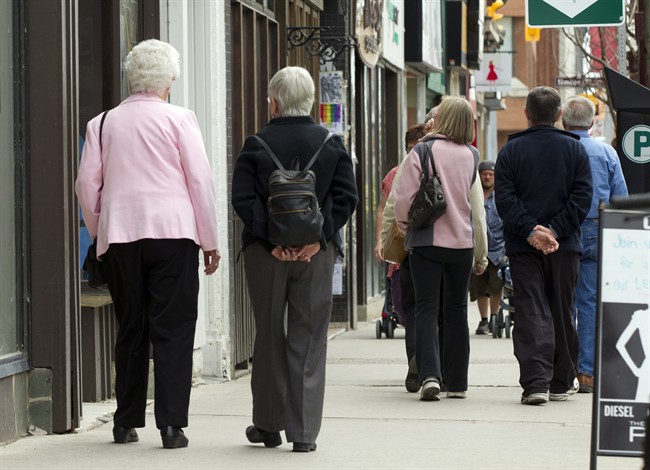
New census data shows Canada now has a higher proportion of seniors than ever before — a development that has crept up on society with far-reaching implications for health, finance, policy and everyday family relationships.
At the same time, the latest tranche of 2011 census information shows a surprising 11-per-cent resurgence of toddlers — a burst of growth in the under-five population that is a complete reversal of trendlines a decade ago and is rejuvenating every region of the country.
“I wouldn’t call it a baby boom, although I think we can call it a significant increase,” Laurent Martel, a demography expert at Statistics Canada, said in an interview.
Generally, though, the census shows in great detail what most people already know intuitively: Canada is aging quickly as the baby boomers mature.
The population of over-65ers has surged to nearly five million over the past five years, growing 14.1 per cent since the last official count, Statistics Canada says.
That’s more than double the 5.9 per cent increase for the population as a whole.
It’s a trend that’s poised to take on momentum. That’s because near-seniors — people aged 60 to 64 — grew faster than any other group. Their population soared 29.1 per cent over the past five years, a pattern that will persist as they move up the age ladder.
They are the oldest edge of the baby-boom generation that includes three out of 10 Canadians, and has so dramatically shaped Canada’s landscape for decades.
Young people, on the other hand, are a stagnating generation — despite the torrent of toddlers. The under-15 cohort is barely expanding, having edged up just 0.5 per cent over the past five years.
Children under 15 make up just 16.7 per cent of the population now, while seniors are at a record high of 14.8 per cent, and growing.
In just four years, Canada will face what demographers have dubbed “the cross-over”: the day when there are more seniors than children.
The median age in Canada is now 40.6, the oldest ever, up from 39.5 five years ago, and from 33.5 two decades ago.
Canada’s population aging is a mix of longer lives and a growing number of people in their senior years, Martel said.
In 2011, there were 4,870 women and 955 men aged 100 or more — the second fastest growing age group with a 25.7 per cent rate of expansion. By 2031, Statscan projects the number of centenarians will reach 17,000, rising to close to 80,000 by 2061 as the bulk of the remaining baby boomers moves into the triple digits.
By region, the Atlantic provinces and Quebec are aging more quickly than the West.
In the Prairie provinces, the proportion of seniors did not change at all. But in the Atlantic provinces and Quebec, seniors gained significant ground.
Alberta has the lowest proportion of seniors, with just 11.1 per cent of the province’s population over the age of 65 — mainly because the number of young women is on the rise, and they are having lots of babies.
Saskatchewan’s proportion of seniors actually decreased, as the number of young people swelled and fertility was high, partly because of a large First Nations population.
In the East, on the other hand, as younger people head out of the region in search of jobs, the population continues to age more quickly.
Compared to other G8 countries, Canada’s population is relatively young, and the proportion of seniors in Canada is among the lowest in the G8.
That’s about to change, Martel warned: Canada had a bigger baby boom than other countries, and as they retire in droves, Canada’s aging trend will pick up speed.
“We’ll be catching up fairly quickly,” he said. “Up to now, baby boomers … have slowed the process of population aging, but they’re about to accelerate it in the next 20 years.”
None of this is a surprise to anyone who has kept an eye on projections over the years, analysts say, but the reconfiguration of the Canadian population will require fundamental change in many different areas in the next years.
“We’re still not ready,” said Verena Menec, director of the Centre on Aging at the University of Manitoba. “This is interesting, because we’ve been talking about this for decades.”
The reality of aging and its far-reaching implications are only just starting to sink in, Menec said, and society — from business and government to families and health care providers — will have to undergo major adjustments in the next five years.
“It’s now becoming much more urgent,” she said. “I think we’re going to see many changes in the next five years or so.”
But Menec cringed at the rhetoric that the older cohort is a heavy burden for the rest of society, driving up health costs and depriving the younger generation of benefits.
“Yeah, we’re aging. That’s good news, right? We all want to live long,” she said.
The older cohort has different needs than the young, no doubt. But seniors are also a major source of child care, of elder care, of donations, and of volunteer work, she noted.
“They’re filling in.”
Some of the biggest changes will have to be in the workplace, said Lynn McDonald, director of the Institute for Life Course and Aging at the University of Toronto.
The census shows that the traditional working age population — aged 15 to 65 — makes up 68.5 per cent of the total, giving Canada one of the largest workforces in the G8 relative to its size. But a large proportion of the country’s workers were on the older end of that spectrum, with 42.4 per cent between 45 and 64 years old.
It means a record number of people are in the twilight of their careers, reconsidering their options, measuring up their savings, and recalculating their years left in the nine-to-five world of traditional work.
For the first time, the census showed there were more people readying for retirement than there were people about to enter the workforce. For every person aged 55 to 65, there was just one person in the age group 15 to 24 — a ratio that Martel said is expected to continue to fall.
However, little thought has been given to how society will take care of people who aren’t physically capable of working past 65, McDonald said — or how those who are working until they’re 70 will take care of their aging parents.
Within workplaces, all generations need to come to terms with the fact that there will be more older workers in their midst, she noted.
“They are knowledgeable, they are reliable and they do good work. But they aren’t used to their capacity.”
One area that won’t suffer a shock from Canada’s aging demographics is politics, said pollster Doug Anderson, senior vice-president of Harris-Decima.
The effect of aging baby boomers is already well entrenched in electioneering, with every party well aware that not only do older people hold more votes, they are more inclined to cast them.
“Older people vote. And younger people vote to a lesser degree,” Anderson said.
That’s why pensions, health care and home care are firmly on the political agenda, he said.
“It will probably be a long time before we see the effect of boomers receding.”
Still, Anderson said his polling research has shown that young people today have more or less the same top priorities as the aging boomers did when they were young — long-term issues such as the environment, which boomers put on the political agenda in the 1970s, and immediate bread-and-butter issues such as how to get a job after finishing school.
Related Articles
Letting the numbers tell the story behind Canada's 2011 census Canada's oldest and youngest communities, according to 2011 census Anything you can do: women shatter job stereotypes to feed workforce demand





Advertisement Advertise With Us
Advertisement Advertise With Us