

Gay rights making tremendous strides
Annual Pride parade proves city's tolerance
Advertisement
Read this article for free:
or
Already have an account? Log in here »
To continue reading, please subscribe:

Digital Subscription
One year of digital access for only $205*
- Enjoy unlimited reading on winnipegfreepress.com
- Read the E-Edition, our digital replica newspaper
- Access News Break, our award-winning app
- Play interactive puzzles
*First annual payment billed as $205.00 + GST for one year. This annual subscription will automatically renew at $233.00 + GST every 52 weeks (10% off the regular annual price of $259.35). Offer available to new and qualified returning subscribers only. Cancel any time.
To continue reading, please subscribe:
Add Free Press access to your Brandon Sun subscription for only an additional
$1 for the first 4 weeks*
- Enjoy unlimited reading on winnipegfreepress.com
- Read the E-Edition, our digital replica newspaper
- Access News Break, our award-winning app
- Play interactive puzzles
*Your next Brandon Sun subscription payment will increase by $1.00 and you will be charged $17.95 plus GST for four weeks. After four weeks, your payment will increase to $24.95 plus GST every four weeks.
Read unlimited articles for free today:
or
Already have an account? Log in here »
Hey there, time traveller!
This article was published 03/06/2012 (5152 days ago), so information in it may no longer be current.
Twenty-five years ago this summer, a crowd marching toward the steps of the Manitoba Legislature included a few folks wearing paper bags over their heads to conceal their identities.
No, these were not Toronto Maple Leaf fans. It was August 1987 and Winnipeg was experiencing its first Gay Pride parade.
As bizarre as it seems right now, at least to anyone too young to remember the ugly 1980s, homophobia was so common in Canada only a quarter-century ago, being out of the closet often meant being out of a job.
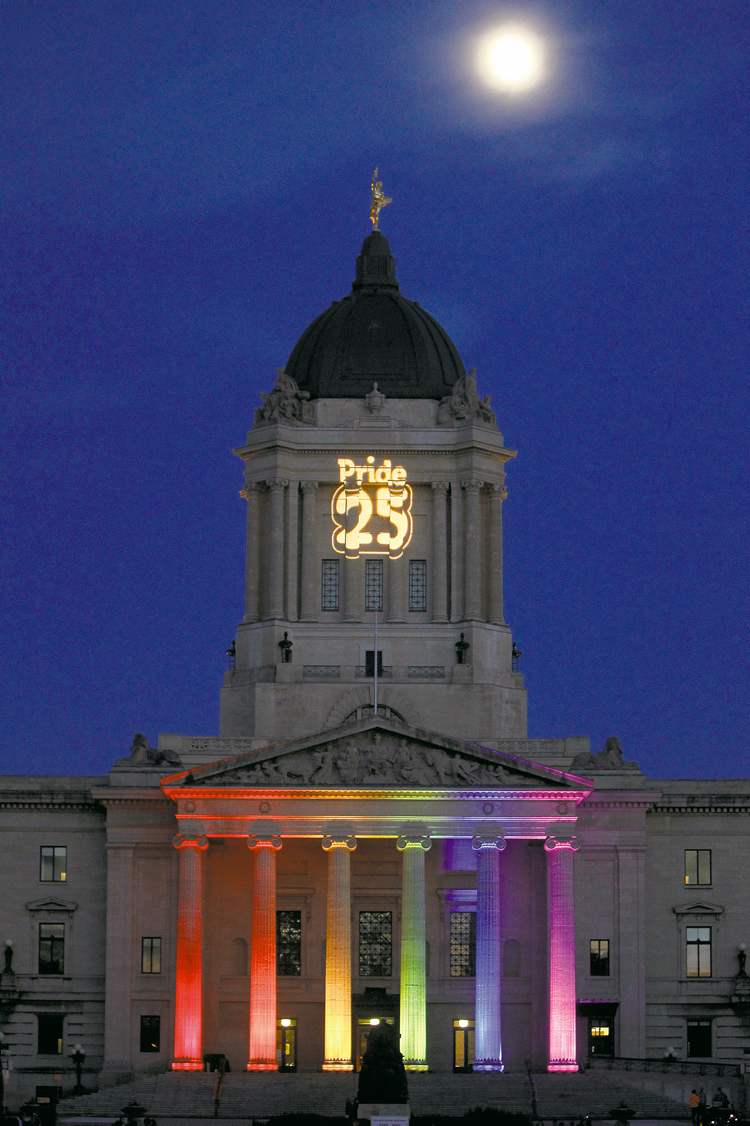
As this city celebrates the 25th anniversary of its first Pride parade, it’s easy to take for granted how far societal attitudes have changed during a relatively short period of time.
One of the most popular movies of 1987 was Eddie Murphy’s Raw, a standup-comedy flick that grossed $51 million. Just like Murphy’s Delirious, a 1983 predecessor whose central joke involved a gay, grunting Mr. T, a big chunk of the humour in Raw involved the outright ridicule of homosexuals, who Murphy simply called “faggots” and imitated with a lisping voice.
“I can’t travel the country freely no more,” Murphy sputtered early on in Raw, feigning persecution at the hands of a nation of angry queers. “I can’t go to San Francisco. They have 24-hour Homo Watch waiting for me in the airport.”
This is what North America was watching at the multiplex in 1987. This was mainstream entertainment.
And whether human-rights activists like to admit it or not, it’s through the prism of entertainment — not just court cases or legislative votes — that our heavily mediated society displays its cultural values.
Do not get me wrong: I’m not arguing against the importance of hard-won legal precedent in establishing the rights of gays, lesbians and the rest of the LGBQTT community in North America.
I’m just saying the only way to gauge the way the vast majority of people really think in this extremely fractious society is to scan pop culture.
Over the space of a generation and a half, popular depictions of gay men and women have gone from the deviant and criminal portrayals of the 1970s (think Frank-n-Furter from The Rocky Horror Picture Show or some of the early James Bond villains) to weak and ineffectual nebbishes in the 1980s (Billy Crystal’s timid and insipid Jodie Dallas in Soap) to mere comic relief in the 1990s (Smithers from The Simpsons). Only over the past decade and a half have there been a much more complex array of properly fleshed-out gay and lesbian characters, not all of them as fabulous or flamboyant as comedian Scott Thompson’s uber-stereotype, Buddy Cole.
Today, the sexuality of public figures in the entertainment world is either irrelevant (ultra-bland pop star Adam Lambert), an historical footnote (talk-show host Ellen DeGeneres will always be remembered for being among the first to come out on television) or a publicity stunt done way too late to have any impact. In May, when Marvel Comics decided to marry off gay Canadian superhero Northstar in an edition of Astonishing X-Men, the geek-world reaction amounted to a collective shrug.
Aside from the mixed metaphor resulting from this decision — the entire X-Men premise, where mutants battle for acceptance within broader society, has long been seen as a parable for the gay-rights struggle in North America — Marvel’s decision to make its gay-marriage pioneer a Canadian is telling.
While Americans are definitely cool with gay entertainers and are grudgingly in support of gay marriage (51 per cent and counting, according to polls taken the week U.S. President Barack Obama finally slid off the fence), the average Canadian is far more likely to embrace the LGBQTT community as an integral part of our societal fabric.
Canada’s relatively gay-friendly disposition could be explained away by factors as diverse as our history (from the beginning of colonization, the U.S. has always had a much more fundamentalist streak), our cultural philosophy (we’re a “vertical mosaic,” while they’re a “melting pot”) or our political leadership (Trudeau famously got the government out of the bedrooms of the nation 43 years ago, when homosexual acts were decriminalized).
Or it may simply be that Canada is just a slightly more civil society, where ordinary people can’t stand the idea of their neighbours being denied the same rights. To put it bluntly, you don’t have to march in a Pride parade to be proud of the relative absence of bigotry.
Winnipeg in particular can take pride in electing North America’s first openly gay big-city mayor. We can be even more proud of judging Glen Murray’s legacy on the basis of his record alone.
Murray will be remembered as a mayor who got downtown revitalization right but failed to seal the New Deal and allowed his federal political ambitions to get the best of him. His sexuality proved just as irrelevant as current Mayor Sam Katz’s status as Winnipeg’s first Jewish mayor: Both “firsts” simply make for interesting political factoids.

Katz does, however, give Winnipeggers another reason to feel a little smug right now. By simply attending a Pride Week flag-raising on May 25, our mayor showed up his peevish Toronto counterpart, Rob Ford, who plans to snub his city’s massive Pride festivities yet again this summer.
No one would argue Winnipeg or Canada or North America are free from homophobia. If that was the case, we wouldn’t need It Gets Better or You Can Play campaigns to combat bullying, depression and suicide.
Manitoba remains a place where bigotry and hatred remain intense, as our Cree, Ojibway, Dakota, Dene and Métis citizens are all too well aware.
But we can take pride in knowing no one has to wear a freaking bag over their head any more when they walk down Memorial Boulevard. Unless, of course, you’re a Leafs fan.
bartley.kives@freepress.mb.ca
Related Articles
Great time to show the Pride
Advertisement Advertise With Us
Advertisement Advertise With Us