Fielding questions about health
Layton's case a lesson for voters: experts
Advertisement
Read this article for free:
or
Already have an account? Log in here »
To continue reading, please subscribe:

Digital Subscription
One year of digital access for only $205*
- Enjoy unlimited reading on winnipegfreepress.com
- Read the E-Edition, our digital replica newspaper
- Access News Break, our award-winning app
- Play interactive puzzles
*First annual payment billed as $205.00 + GST for one year. This annual subscription will automatically renew at $233.00 + GST every 52 weeks (10% off the regular annual price of $259.35). Offer available to new and qualified returning subscribers only. Cancel any time.
To continue reading, please subscribe:
Add Free Press access to your Brandon Sun subscription for only an additional
$1 for the first 4 weeks*
- Enjoy unlimited reading on winnipegfreepress.com
- Read the E-Edition, our digital replica newspaper
- Access News Break, our award-winning app
- Play interactive puzzles
*Your next Brandon Sun subscription payment will increase by $1.00 and you will be charged $17.95 plus GST for four weeks. After four weeks, your payment will increase to $24.95 plus GST every four weeks.
Read unlimited articles for free today:
or
Already have an account? Log in here »
Hey there, time traveller!
This article was published 22/08/2012 (5160 days ago), so information in it may no longer be current.
TORONTO — A year after his death, Canadians are still in the dark about what killed Jack Layton, who had asked voters to let him lead Canada mere weeks before dying.
His family has held firm in keeping the precise cause of Layton’s death a secret. And Canadians in the main don’t seem to care; many chastised journalists who raised questions in the period after Layton’s rapid decline and death last summer.
Widespread admiration and affection for the late NDP leader may be behind the difficulty the electorate seems to have in separating emotion over his passing from the issue at stake. Canadians may be missing a key point about why people should care about the health of their would-be leaders, some experts say.
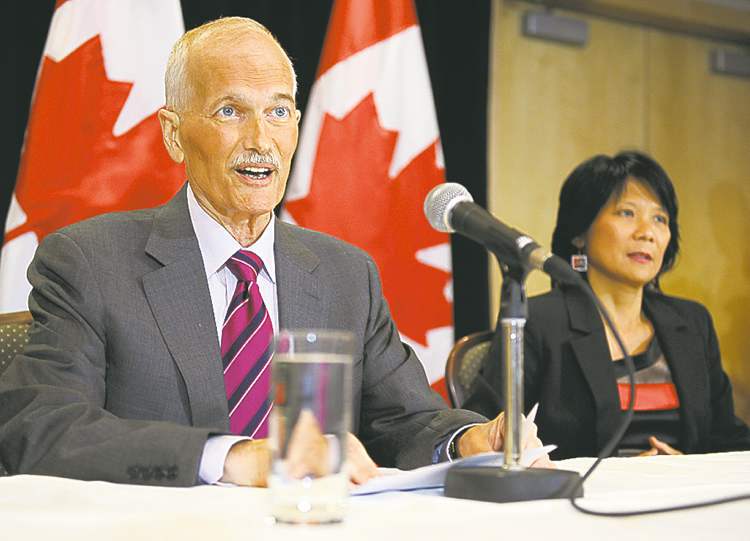
It’s not even about Layton. It’s about whether voters have the right to know if, to the best of their knowledge, politicians believe they’ll be able to fulfil the role they’re asking voters to give them.
Dr. Lawrence Altman has explored the health of U.S. political candidates for decades as the medical reporter for the New York Times.
He says it’s surprising at this point in history a political leader could die of an undisclosed illness — and says it is unlikely American media outlets would have let the issue go easily.
“I think the Times has taken the position that this is information the public is entitled to know,” Altman says of the issue of leading politicians’ health. Altman is researching a book he hopes to write about political leaders and their health status disclosure.
“My position is that there should be transparency,” added Altman, who while still writing for the Times is also a senior fellow at the Woodrow Wilson International Center for Scholars in Washington, D.C.
“There’s no reason any illness should keep somebody from running for office. It’s up to the public to decide whether that illness interferes with the ability to carry out the functions of office or whether that person should be elected. The issue to me is that the electorate should be fully informed.”
Questions linger about the degree of information voters had about the state of the NDP leader’s health when they went to the polls in May 2011.
Layton had disclosed a February 2010 diagnosis of prostate cancer, though he never revealed what form of treatment he received for it. (By contrast, former federal health minister Allan Rock disclosed he had surgery when he was diagnosed with prostate cancer while in office.)
And Layton was vague about surgery he’d undergone to repair a hip fracture incurred while exercising in March 2011 — an unusual event in a seemingly fit man of his age.
(This fracture figures prominently in a theory advanced by Dr. Lorne Brandes, a Winnipeg oncologist and CTV.ca health columnist, that Layton had metastatic prostate cancer. His article can be read here: http://healthblog.ctv.ca/post/Did-prostate-cancer-kill-Jack-Layton.a spx.)
When a shockingly gaunt Layton announced in July 2011 he was temporarily stepping aside to again fight cancer, he told Canadians the new battle was against a second, previously undetected form of the disease.
He declined to name it. And to this day, his widow, MP Olivia Chow, and his children have declined likewise.
Chow says to disclose what killed her husband would discourage people fighting that form of cancer. In a recent interview with The Canadian Press, she said she believes withholding the information is the right way to go.
“I think that (I’m) even more convinced that it was the right decision, that we don’t have to (say more),” she said.
“People know, it’s a cancer, it’s cancer cells. It’s not as if we’re not saying what he died of, he died of cancer. We don’t need to go into what kind of cancer because those people that have that kind of cancer will not react well and why inflict that on people?”
Chow says the only people who ask her about the cause of her husband’s death are reporters.
Journalists who have given voice to suspicions Layton’s second cancer was metastasized prostate cancer have been chided by news consumers.
Patrick Lagace, a columnist for Montreal’s La Presse, wrote a couple of pointed pieces on the issue.
“Readers were absolutely incensed that I would bring up the question. To most of those who did react, it was an entirely private issue,” he says in an email exchange.
“To some of them, which is shocking to me, if Mr Layton did run knowing his odds were grim, well it was up to him and we had nothing to say. All in all, I’d say that a very large majority of my readers thought it was not a matter for reporters to discuss or question.”
Norman Spector, a former senior political aide and now a political commentator, says at this point, the cause of Layton’s death is a matter for historians.
Whether they’ll delve into it, or whether Layton’s family later chooses to reveal which form of cancer killed him, there’s no pressing public interest at this point, Spector says.
There was, however, a public interest before the election, he says. And there is something to be learned for the future.
“The lesson we should draw from this whole experience is that political leaders in Canada, as in the United States, should have regular health exams and should release that information to the public. That’s my view,” says Spector, who was chief of staff to former prime minister Brian Mulroney.
Voters have a right to know if they are likely going to be led by the person seeking their support, he says.
“I think it’s important just as the parties have a responsibility to put forward their platforms and their commitments and their fiscal framework that we have a sense that the people we’re voting for are going to be there.”
In our system of government, a leader who steps aside due to ill health or who dies is replaced by their party, not the public, Spector notes. So if the NDP had won the 2011 election, Canadians would have ended up with a new prime minister — picked by NDP party members — just two months after Layton had been sworn into office.
“If I’m voting Conservative, I want to know if it’s Stephen Harper or Vic Toews who’s going to be the leader,” Spector says.
“I mean, (it’s) pretty important, right? Especially if Stephen Harper is making a commitment that he won’t open certain issues that somebody else might open.”
— The Canadian Press