Professors encourage use of gadgets in class, saying it can enhance learning
Advertisement
Read this article for free:
or
Already have an account? Log in here »
To continue reading, please subscribe:

Digital Subscription
One year of digital access for only $205*
- Enjoy unlimited reading on winnipegfreepress.com
- Read the E-Edition, our digital replica newspaper
- Access News Break, our award-winning app
- Play interactive puzzles
*First annual payment billed as $205.00 + GST for one year. This annual subscription will automatically renew at $233.00 + GST every 52 weeks (10% off the regular annual price of $259.35). Offer available to new and qualified returning subscribers only. Cancel any time.
To continue reading, please subscribe:
Add Free Press access to your Brandon Sun subscription for only an additional
$1 for the first 4 weeks*
- Enjoy unlimited reading on winnipegfreepress.com
- Read the E-Edition, our digital replica newspaper
- Access News Break, our award-winning app
- Play interactive puzzles
*Your next Brandon Sun subscription payment will increase by $1.00 and you will be charged $17.95 plus GST for four weeks. After four weeks, your payment will increase to $24.95 plus GST every four weeks.
Read unlimited articles for free today:
or
Already have an account? Log in here »
Hey there, time traveller!
This article was published 23/08/2012 (5099 days ago), so information in it may no longer be current.
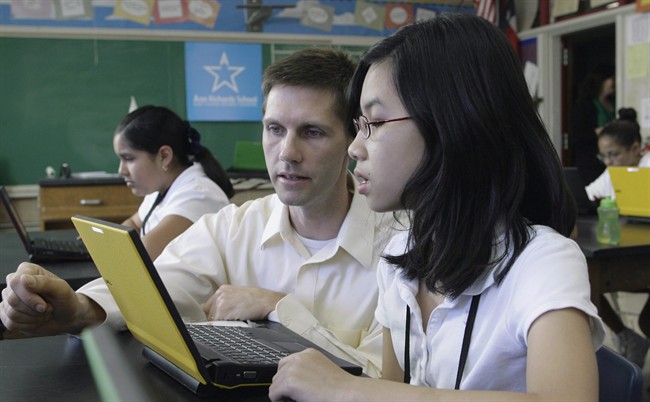
Laptops, netbooks and smartphones are staples for post-secondary students, so it’s no surprise university educators are embracing the technology wave and encouraging the use of gadgets in class.
Using tech gadgets in class has become so popular, it’s become its own movement.
BYOT, an acronym for bring your own technology, is a result of the widespread amount of technology often used by university students.
“Consumer technologies are getting both ubiquitous and cheap and better,” says David Vogt, director of learning projects at the University of British Columbia.
Tech expert Keith McWhirter from Queen’s University in Kingston, Ont., says there’s a variety of portable devices he sees on campus, including the ultrabook, a smaller version of a laptop but with the same capabilities as a full-size one.
Instead of stashing devices away during lectures, professors say using any of these tools can actually enhance the learning experience while keeping students engaged.
“They (students) live in a digital generation of instant gratification,” says Tim Richardson, a professor at Seneca College and the University of Toronto. “They expect education to be a product delivered in the same way.”
One way his students use their portable devices in class is to watch videos he is referencing or research an answer to a question posed in class.
Richardson takes it a step further by putting his lectures on YouTube.
“I’ve got a website with videos on there of me saying these exact lecture points,” he says, adding they come in handy for students who juggle part-time jobs and can’t always make it to class.
Extra participation marks are handed out to students who not only comment on his videos, but make their own and post it on YouTube.
Despite these available resources, Richardson says he has a high class attendance.
“They get all this stuff online, they bring it to class,” he says, adding it keeps his students actively engaged. “I’m not up there talking about the four points of risk assessment and boring the hell out of them.”
Aside from using a laptop to take notes, Christopher Evans, a chemistry and biology professor at Ryerson University, says instructors can ask students to use their cellphones to research information or through social media to provide feedback on a discussion.
Some universities are even developing smartphone apps as a way to help keep students across the campus connected with the technology they use on a regular basis.
UBC students will be able to download the university’s new mobile app on any mobile phone and use it to see daily event schedules on campus, program information and campus maps.
The U of T mobile app was developed to include class and exam schedules to remind students where they need to be and when.
The app also has a directory that helps students find the location of departments, buildings, parking lots and food places.
But the BYOT movement does come with some challenges.
Vogt says most educators haven’t figured out how best to implement gadget use in class.
“How do we find ways to support teachers in continuously relearning their profession and following what the opportunities are at a pace which is similar to the pace that their students are embracing the world?” he questions.

Evans says while faculty members encourage the use of technology in the learning environment, some aren’t ready to adapt.
“It depends on their own experiences with those kinds of tools and also the nature of the topics they’re discussing,” he says.
By making the tools part of the teaching and learning experience, students will be more focused on class discussion rather than playing with their devices, he says.
The BYOT movement certainly won’t replace professors; it will just enhance the way they teach while keeping students more focused, says Richardson.
“It makes them part of the learning process as participants instead of spectators,” he says. “That’s what engages students.”