WEATHER ALERT

From a grassroots hashtag to a real opportunity for change

Advertisement

Advertise with us

When First Nations chiefs angry with the federal omnibus budget Bill C-45 scuffled briefly with RCMP on Parliament Hill on Tuesday, it certainly made for compelling images. It also raised some compelling questions. Are we seeing a renewed militancy in the aboriginal community? Is this a "tipping point" of sorts? What can we expect next? To me, the most interesting question is what was the catalyst for this showdown?

Read this article for free:


or

Already have an account? Log in here »

To continue reading, please subscribe:

Subscribe and receive a limited-edition Free Press branded hat or tote.

Digital Subscription

One year of digital access for only $205*

  • Enjoy unlimited reading on winnipegfreepress.com
  • Read the E-Edition, our digital replica newspaper
  • Access News Break, our award-winning app
  • Play interactive puzzles

*First annual payment billed as $205.00 + GST for one year. This annual subscription will automatically renew at $233.00 + GST every 52 weeks (10% off the regular annual price of $259.35). Offer available to new and qualified returning subscribers only. Cancel any time.

To continue reading, please subscribe:

Add Free Press access to your Brandon Sun subscription for only an additional

$1 for the first 4 weeks*

  • Enjoy unlimited reading on winnipegfreepress.com
  • Read the E-Edition, our digital replica newspaper
  • Access News Break, our award-winning app
  • Play interactive puzzles
Start now

*Your next Brandon Sun subscription payment will increase by $1.00 and you will be charged $17.95 plus GST for four weeks. After four weeks, your payment will increase to $24.95 plus GST every four weeks.

Opinion

Hey there, time traveller!
This article was published 06/12/2012 (5009 days ago), so information in it may no longer be current.

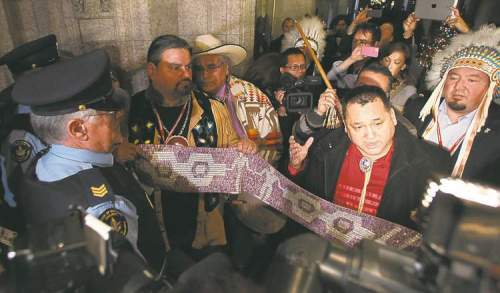
When First Nations chiefs angry with the federal omnibus budget Bill C-45 scuffled briefly with RCMP on Parliament Hill on Tuesday, it certainly made for compelling images. It also raised some compelling questions. Are we seeing a renewed militancy in the aboriginal community? Is this a “tipping point” of sorts? What can we expect next? To me, the most interesting question is what was the catalyst for this showdown?

It was actually a simple message, likely unintelligible unless you are an avid Twitter user:

“Tweeting up on Sunday, December 2, the #IdleNoMore event in Alberta. Lets get it trending! Here is the FB event…”

CP
First Nations leaders talk to the media outside the House of Commons Tuesday.
CP First Nations leaders talk to the media outside the House of Commons Tuesday.

Not necessarily “I have a dream” type material, but significant in its own right. Tanya Kappo Tanya Kappo (@Nehiyawskwew) posted that on Nov. 30 to drum up support for an event she organized called “Idle No More.” Her fellow organizers began using the “#idlenomore” hashtag (hashtags are Twitter’s way of grouping messages together by topic) and so did their followers.

Kappo told me she expected her event to be “15 people in a room listening to what I thought about the legislation.” Instead, 150 people descended on Louis Bull First Nation in Alberta to hear Kappo and her co-organizers speak against Bill C-45.

Kappo and many First Nations people object to provisions in the bill that reduce the amount of federally protected waterways and increase the minister of aboriginal affairs’ power to sell off reserve land. It is also seen as part of a broader agenda to impose legislation on aboriginal people without their consent. Some people have even begun to blame indigenous leaders for allowing this agenda to proceed.

At the Idle No More event last Sunday, Kappo says many people were upset their chiefs were not talking about the bill. “There was angst building against our leadership. People asked ‘What’s (the Assembly of First Nations) doing?’ and ‘What are the chiefs doing?'” People at the meeting kept tweeting and the hashtag took off.

It grew beyond the Alberta event. Soon all sorts of messages about indigenous issues included the hashtag. There were more messages critical of First Nations leaders. Even non-aboriginal people started using the hashtag to express their support. The hashtag went viral.

Then on Tuesday this social media talk hit the floor of an Assembly of First Nations meeting in Ottawa. Soon National Chief Shawn Atleo and others called for a march to Parliament. Fast-forward a few hours and suddenly chiefs and Mounties were shoving each other outside the House of Commons chamber.

In the aftermath, one of those leaders, Manitoba Grand Chief Derek Nepinak, appeared on CBC television and tipped his hat to the Twitterati.

“As chiefs, we always watch what our young people are doing…. They’re putting their words out on social media saying, ‘What are the chiefs going to do?’, ‘We need to stand up now.’ We are going to act and this is just the beginning of it.”

What is the lasting impact of the “#idlenomore” hashtag? Will it be as momentous as the “#jan26” hashtag that started the protests in Egypt that led to Hosni Mubarak’s removal from power? Or is it just another online fad that will come and go?

The hashtag “#Idlenomore” did not stop bill C-45. It ended up passing unamended. The true impact, however, is that it showed grassroots aboriginal people they can influence their leaders through social media. Kappo says Tuesday’s events “closed the gap” between the chiefs and their constituents, adding, “If there’s going to be real and profound change, it’s not only about the relationship with the feds, but also the relationship with ourselves.” Now she and others are planning other events to raise awareness under the Idle No More banner and the chiefs in Ottawa are discussing their next move.

This has implications far beyond the aboriginal community. From proposed changes to the Indian Act to proposed pipelines, there are many issues looming that have the potential to galvanize indigenous people into protest. If First Nations people are mobilized by any one of them, I suspect that some of the other tensions faced by our community will begin to boil over. Poverty, rundown homes, bad schools, children in care, missing and murdered women… the list goes on. In short, we could soon see a lot of conflict and acrimony.

Yet, it can be avoided. What Kappo and the others behind “#idlenomore” are asking for is simple: for the government to listen to First Nations people. Not imposed legislation. Not political rhetoric. Not games. Simply, to listen to the vision First Nations people have for our future, and work with us to make it happen. The architects of this nascent movement have already succeeded in getting aboriginal leaders to listen to that message. Perhaps others in Canada will soon pay attention.


Wab Kinew is the Director of Indigenous Inclusion at the University of Winnipeg. His hip hop has won an Aboriginal Peoples Choice Music Award. His journalism has won an Adrienne Clarkson RTNDA Award, a Gabriel Award and been nominated for a Gemini Award.

Report Error Submit a Tip

More Stories

Executive exodus continues at Shared Health with three recent departures

Chris Kitching 5 minute read Preview

Executive exodus continues at Shared Health with three recent departures

Chris Kitching 5 minute read Updated: Yesterday at 10:15 AM CDT

Manitoba’s provincial health authority is looking for its fourth chief financial officer since 2023 and additional replacements after the recent departures of three executives.

Read
Updated: Yesterday at 10:15 AM CDT

From a grassroots hashtag to a real opportunity for change

By Wab Kinew 5 minute read Preview

From a grassroots hashtag to a real opportunity for change

By Wab Kinew 5 minute read Thursday, Dec. 6, 2012

When First Nations chiefs angry with the federal omnibus budget Bill C-45 scuffled briefly with RCMP on Parliament Hill on Tuesday, it certainly made for compelling images. It also raised some compelling questions. Are we seeing a renewed militancy in the aboriginal community? Is this a "tipping point" of sorts? What can we expect next? To me, the most interesting question is what was the catalyst for this showdown?

It was actually a simple message, likely unintelligible unless you are an avid Twitter user:

"Tweeting up on Sunday, December 2, the #IdleNoMore event in Alberta. Lets get it trending! Here is the FB event..."

Not necessarily "I have a dream" type material, but significant in its own right. Tanya Kappo Tanya Kappo (@Nehiyawskwew) posted that on Nov. 30 to drum up support for an event she organized called "Idle No More." Her fellow organizers began using the "#idlenomore" hashtag (hashtags are Twitter's way of grouping messages together by topic) and so did their followers.

Read
Thursday, Dec. 6, 2012

Cool spots for more summer sweets

AV Kitching 3 minute read Preview

Cool spots for more summer sweets

AV Kitching 3 minute read 6:00 AM CDT

You scream, I scream, we all scream for ice cream. Missed seeing your favourite ice cream joint in last month’s Chill Out feature? Cheer up: we’ve compiled our reader suggestions below.

Despite the cooler weather and slight drizzle, it’s still summer and there’s time to to grab a scoop or two of your favourite flavours. So what are you waiting for?

Living up to its name Not a Waffle (2-709 Corydon Avenue) serves ice creams not in traditional waffle cones but heaped into Japanese taiyaki, a fish-shaped sturdy cake. Ice cream flavours on offer include the ever-popular ube, sakura and matcha in soft serve and for hard scoops there are vanilla, chocolate brownie, cookie dough and something called heavenly heart, which is a chocolate and almond combo. The soft serves are on until October this year so there’s still time if you’d like to give this a try.

Our readers simply adore Dug & Betty’s (309 Rue Des Meurons) for their ice cream fix. Made in small batches, popular flavours include sour cherry and chocolate, strawberry balsamic honey and black pepper and lemon meringue pie. There are seven dairy-free options, including soy chocolate caramel cookie dough and oatmeal apple caramel crunch.

Read
6:00 AM CDT

CRTC looking into high number of cellphone tornado alerts in Manitoba during June storm

Chris Kitching 4 minute read Preview

CRTC looking into high number of cellphone tornado alerts in Manitoba during June storm

Chris Kitching 4 minute read 2:36 PM CDT

Canada’s telecom regulator is investigating why some Manitobans received an “unusually high number” of tornado alerts on their cellphones when the province was hit by wild thunderstorms June 9.

The Canadian Radio-television and Telecommunications Commission has asked Pelmorex Corp., which operates the national Alert Ready system, and three wireless providers — Bell, Rogers and Telus — to answer a list of questions by Sept. 11.

“Commission staff have been informed of reports concerning tornado alerts that were issued in Winnipeg and southern Manitoba on 9 June 2026, in which members of the public reported receiving an unusually high number of wireless emergency alerts,” Simon Levasseur, the CRTC’s director of financial and multiplatform technology analysis, wrote in a letter dated Wednesday.

“Commission staff is gathering information on the event, any potential root causes that have been identified, as well as corrective actions that have or will be taken to address these causes.”

Read
2:36 PM CDT

Kinew says Manitoba stands with PM in trade war with U.S.

Melissa Martin 6 minute read Preview

Kinew says Manitoba stands with PM in trade war with U.S.

Melissa Martin 6 minute read Saturday, Aug. 22, 2026

The Manitoba government and business leaders are rallying behind Prime Minister Mark Carney’s plan to fight back, after a sudden collapse of trade talks between the U.S. and Canada sparked a new salvo of U.S. tariffs on some Canadian goods.

On Saturday, after Carney vowed to respond with retaliatory tariffs, Manitoba Premier Wab Kinew said his government stood “100 per cent” behind the prime minister’s plan to respond to what Kinew called U.S. President Donald Trump’s “unjustified and immoral” tariffs.

“History will not be kind to Donald Trump, so we should never appease him,” Kinew said. “We should fight back, which is what Canada is doing today.”

Kinew met reporters for a brief news conference at the legislature on Saturday afternoon, about an hour after finishing a call with Carney and the other premiers. There was a “really strong sense of unity” on that call, Kinew said, and emphasized that he backs the federal decision to “walk away from what would have been a bad deal.”

Read
Saturday, Aug. 22, 2026

Inflation-battered U.S. voters could prove to be key Canadian ally in fight against Trump’s trade tyranny

Dan Lett 5 minute read Preview

Inflation-battered U.S. voters could prove to be key Canadian ally in fight against Trump’s trade tyranny

Dan Lett 5 minute read 1:37 PM CDT

Is there anything or anyone that can help Canada and the United States avoid an unprecedented trade war?

Both nations stand poised on the precipice of a tariff battle that could — in the worst-case scenario — trigger an economic downturn. Both countries have a lot to lose, but neither country is showing any sign of backing down.

Canadian Prime Minister Mark Carney has, by all accounts, given negotiation a full chance to defuse the trade war. It didn’t work and it appears now that nothing — neither thoughtful negotiation or retaliatory measures — will dissuade U.S. President Donald Trump from his war of trade attrition.

Increasingly, it appears that if Trump is going to back away from punitive tariffs against Canada, it will be because of mounting pressure from within the United States and not because of tough talk and countermeasures from this side of the border.

Read
1:37 PM CDT