

‘Strong sense of unity’
Kinew says Manitoba stands with PM in trade war with U.S.

Advertisement
Read this article for free:
or
Already have an account? Log in here »
To continue reading, please subscribe:

Digital Subscription
One year of digital access for only $205*
- Enjoy unlimited reading on winnipegfreepress.com
- Read the E-Edition, our digital replica newspaper
- Access News Break, our award-winning app
- Play interactive puzzles
*First annual payment billed as $205.00 + GST for one year. This annual subscription will automatically renew at $233.00 + GST every 52 weeks (10% off the regular annual price of $259.35). Offer available to new and qualified returning subscribers only. Cancel any time.
To continue reading, please subscribe:
Add Free Press access to your Brandon Sun subscription for only an additional
$1 for the first 4 weeks*
- Enjoy unlimited reading on winnipegfreepress.com
- Read the E-Edition, our digital replica newspaper
- Access News Break, our award-winning app
- Play interactive puzzles
*Your next Brandon Sun subscription payment will increase by $1.00 and you will be charged $17.95 plus GST for four weeks. After four weeks, your payment will increase to $24.95 plus GST every four weeks.
Read unlimited articles for free today:
or
Already have an account? Log in here »
The Manitoba government and business leaders are rallying behind Prime Minister Mark Carney’s plan to fight back, after a sudden collapse of trade talks between the U.S. and Canada sparked a new salvo of U.S. tariffs on some Canadian goods.
On Saturday, after Carney vowed to respond with retaliatory tariffs, Manitoba Premier Wab Kinew said his government stood “100 per cent” behind the prime minister’s plan to respond to what Kinew called U.S. President Donald Trump’s “unjustified and immoral” tariffs.
“History will not be kind to Donald Trump, so we should never appease him,” Kinew said. “We should fight back, which is what Canada is doing today.”
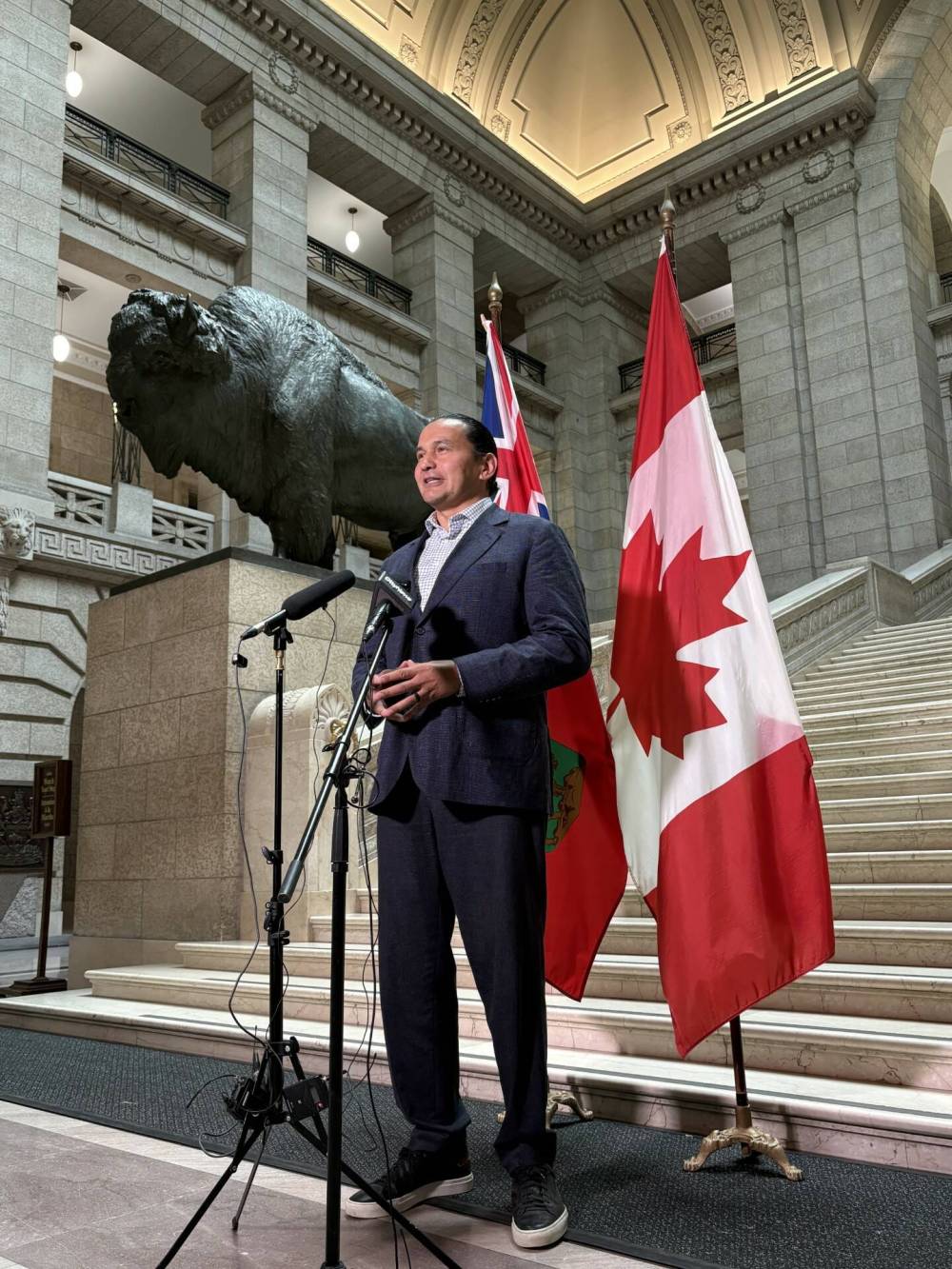
Kinew met reporters for a brief news conference at the legislature on Saturday afternoon, about an hour after finishing a call with Carney and the other premiers. There was a “really strong sense of unity” on that call, Kinew said, and emphasized that he backs the federal decision to “walk away from what would have been a bad deal.”
Now, the province’s attention must turn to helping local businesses brace for impact. Like all provinces, Manitoba relies heavily on the U.S. as its primary international market, with up to 75 per cent of its exports heading south of the border.
About four per cent of those exports will be affected by the new wave of 50 per cent U.S. tariffs, which will be levied on a range of products including honey, dairy, alcohol, and a long list of consumer products. Energy and critical minerals are notably excluded from the list.
Carney has said the feds will do “whatever it takes” for “as long as it takes” to support industries hit by the trade war.
Kinew said he expects to hear from the federal government on Tuesday about its plans to support impacted industries, with the province to unveil details that day as well. Though specifics have not yet been announced, Kinew said he expects it could include something such as tax deferrals to help businesses keep more cash on hand.
In the meantime, Kinew said, American booze won’t be going back on the shelves in Manitoba anytime soon. The province also plans to further cut back deals with suppliers south of the border. Since last year, Kinew said, the province has already reduced the amount it spends with U.S. companies by more than 80 per cent.
On that end, the province has been sitting on “a number of tenders” from U.S. companies, Kinew said. In recent days, as the contentious trade talks between the countries progressed, his government was willing to reduce its preference against using U.S. companies, pending a satisfactory deal.
“Since Donald Trump has attacked our country today, we’re going to keep tendering, and keep saying we’re going to prefer Canadian business to American business,” the premier said.
Kinew also encouraged Canadians to respond by buying from Canadian businesses, and supporting Canadian workers.
The premier’s message of unity was echoed by Winnipeg Chamber of Commerce CEO Loren Remillard.
“If anyone didn’t appreciate just the nature of how our relationship with the United States has changed, today was a good reminder of that,” Remillard said, speaking over the phone on Saturday. “We’re disappointed, but at the same time we are firmly in the Team Canada approach, and rallying to the prime minister’s call.
“Now is not the time for division or parochial concerns. We need to make sure we are speaking a unified message.”
On a hopeful note, Remillard pointed to the fact that, after over a year of uncertainty, tariffs, and trade tension, Canada’s economy has proven to be more resilient than some observers predicted. Yet to endure this next round — and the risk the United States retaliates to the retaliation — the feds will need to step up, he said.
“Now is not the time for division or parochial concerns. We need to make sure we are speaking a unified message”
— Winnipeg Chamber of Commerce CEO Loren Remillard
“We know there will be pain for businesses, for workers, and for our community,” Remillard said. “These are early days. Ultimately, what business is looking for is as those impacts begin to be felt, we need to make sure the federal government stands ready with various programs that are going to help weather the storm.”
Another thing Canada can do, Remillard said, is ease barriers to interprovincial trade.
“We can control so much within our own backyard,” Remillard said. “Canada could be a single-market economy of 41 million people, with a 2.5 trillion dollar economy… so let’s double down on those efforts. Now is not the time to justify why a provincial barrier exists. Now we need to get rid of whatever remains, and stand one Canada for 41 million people.”
Kinew also affirmed Manitoba’s support for cutting back red tape on trade between provinces.

“I think you’re going to see some of the other provinces lean more into that, which is great,” Kinew said. “Manitoba will be ready to meet them to increase the amount that we trade with one another.”
Canada’s retaliatory tariffs on some U.S. goods, including dairy, steel, appliances, and more, are set to take effect Sept. 8. That offers a window for U.S. and Canadian negotiators to resume talks and possibly avert further escalation in the trade war. Yet the premier did not indicate he was holding out hope for such progress.
“I’m sure there is a desire to get back to the table, but we should recognize that the Trump administration and the president are deeply flawed,” Kinew said. “He’s got two more years left in office. We should be prepared to duke it out for two years, and then, hopefully, sanity will return to America.”
“He wants to take away manufacturing jobs from our country, and we won’t let him,” Kinew said. “We’re going to continue to stand up for our country… because we know that the red maple leaf is stronger than that guy with the red hat down south.”
melissa.martin@freepress.mb.ca
Melissa Martin
Reporter-at-large
Melissa Martin reports and opines for the Winnipeg Free Press.
Every piece of reporting Melissa produces is reviewed by an editing team before it is posted online or published in print — part of the Free Press‘s tradition, since 1872, of producing reliable independent journalism. Read more about Free Press’s history and mandate, and learn how our newsroom operates.
Our newsroom depends on a growing audience of readers to power our journalism. If you are not a paid reader, please consider becoming a subscriber.
Our newsroom depends on its audience of readers to power our journalism. Thank you for your support.
Melissa Martin
Reporter-at-large
Melissa Martin reports and opines for the Winnipeg Free Press.
Every piece of reporting Melissa produces is reviewed by an editing team before it is posted online or published in print — part of the Free Press‘s tradition, since 1872, of producing reliable independent journalism. Read more about Free Press’s history and mandate, and learn how our newsroom operates.
Our newsroom depends on a growing audience of readers to power our journalism. If you are not a paid reader, please consider becoming a subscriber.
Our newsroom depends on its audience of readers to power our journalism. Thank you for your support.
Related Articles
Ottawa to announce details of retaliatory tariffs on U.S. Tuesday









Advertisement Advertise With Us
Advertisement Advertise With Us