Food for the soul
Church provides low-gluten wafers for communion

Advertisement
Read this article for free:
or
Already have an account? Log in here »
To continue reading, please subscribe:

Digital Subscription
One year of digital access for only $205*
- Enjoy unlimited reading on winnipegfreepress.com
- Read the E-Edition, our digital replica newspaper
- Access News Break, our award-winning app
- Play interactive puzzles
*First annual payment billed as $205.00 + GST for one year. This annual subscription will automatically renew at $233.00 + GST every 52 weeks (10% off the regular annual price of $259.35). Offer available to new and qualified returning subscribers only. Cancel any time.
To continue reading, please subscribe:
Add Free Press access to your Brandon Sun subscription for only an additional
$1 for the first 4 weeks*
- Enjoy unlimited reading on winnipegfreepress.com
- Read the E-Edition, our digital replica newspaper
- Access News Break, our award-winning app
- Play interactive puzzles
*Your next Brandon Sun subscription payment will increase by $1.00 and you will be charged $17.95 plus GST for four weeks. After four weeks, your payment will increase to $24.95 plus GST every four weeks.
Read unlimited articles for free today:
or
Already have an account? Log in here »
Hey there, time traveller!
This article was published 04/05/2013 (4894 days ago), so information in it may no longer be current.
These days Fran Van Walleghem can take communion in her southwest Winnipeg parish and feel confident it will feed her spirit without hurting her body.
“It’s very special to go to mass and know that you’re going to be OK,” says the Roman Catholic woman of the low-gluten option now available.
“I’m very happy this step has been taken in the church.”
Van Walleghem has celiac disease, a digestive condition affecting one in 133 people. It is triggered by the consumption of gluten, a protein found in grains such as wheat, rye and barley.
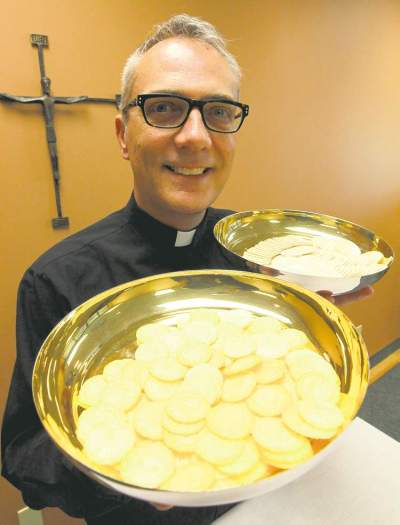
Regular communion hosts also contain gluten, but recently the Archdiocese of Winnipeg adopted a protocol for serving low-gluten communion hosts to people who have celiac disease or a wheat allergy.
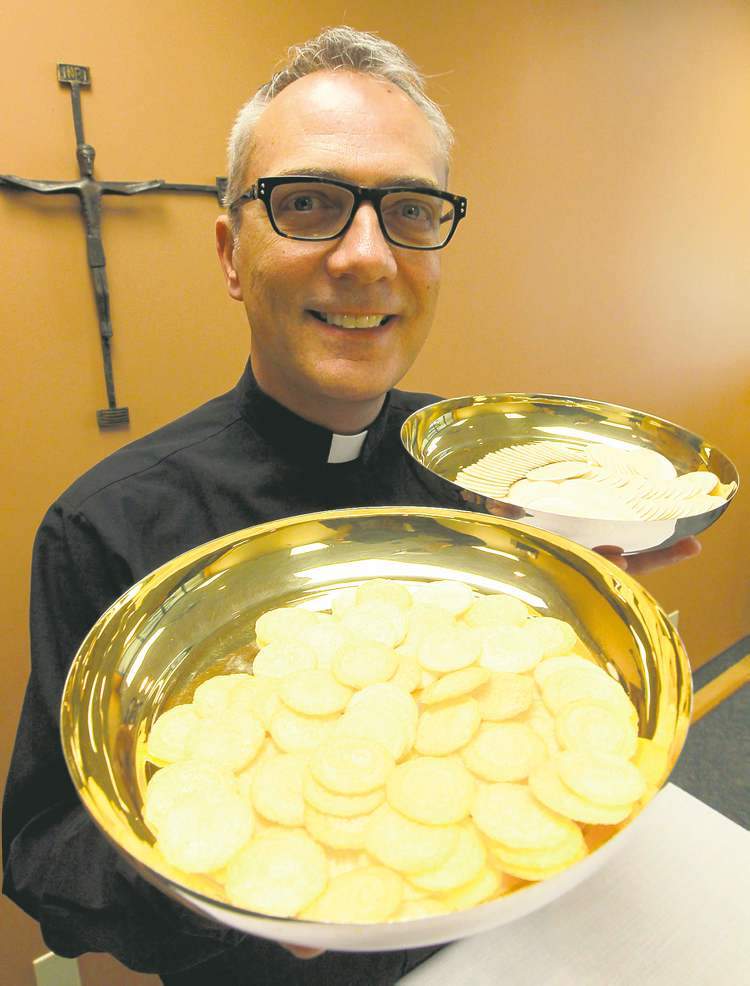
These low-gluten wafers contain only 0.01 per cent wheat, just enough to satisfy the Catholic tradition that the bread or wafer be made from wheat, but low enough so people with gluten intolerance can consume it, says Rev. Darrin Gurr of St. Gianna Beretta Molla Roman Catholic Church, where Van Welleghem attends.
“The issue for us is the element of validity,” says Gurr, who researched the issue for the archdiocese.
“For bread to be worthy to be used as the host, it has to have some element of wheat.”
Produced by the Sisters of St. Benedict in Clyde, Miss., the low-gluten hosts are slightly smaller and crisper than the regular hosts. Each parish supplies a small container, or pyx, of the low-gluten hosts to people requesting them. Before mass, these pyxes are collected and blessed along with the regular communion hosts, and kept closed during the mass.
“For those who identify themselves as gluten intolerant, they will receive a packet of low-gluten hosts and a little container (for them) and when they come for communion, they put it in the communion bowl,” says Gurr.
This solution works well for Van Walleghem, who avoided taking communion before because she didn’t want to consume wheat products.
“You don’t eat gluten at home and you don’t eat gluten at church,” she says.
That’s why Monique Clement has not participated in communion for 11 years in her parish in the Archdiocese of St. Boniface, which does not have a protocol for low-gluten wafers. Even if the archdiocese did, she is not convinced that only a miniscule amount is safe for her and others who suffer from celiac disease.
“Every little bit of gluten you ingest may be damaging your intestines,” says Clement, president of the Manitoba chapter of the Canadian Celiac Association.
“To me, it’s not OK.”
The Ukrainian Catholic Archeparchy of Winnipeg also does not have a protocol on low-gluten wafers.
Clement says she would like the Catholic Church to change its position on including wheat in communion wafers and offer gluten-free ones instead.
“I think they need to modernize a little more and part of that to me is to tolerate allergies,” she says.
Taking communion in some form is central to Catholic theology and worship, says Gurr.
“In the Catholic Church, receiving the body and blood of Jesus (through the wafer and the wine), receiving the Eucharist is the heart of the Catholic tradition and Catholic theology,” he says.
Across the Christian denominations, how communion is served depends on theological interpretation of the elements of bread and wine.
“The whole gluten-free issue is a wider health issue,” says Rev. Jennifer Marlor of Gloria Dei Lutheran Church, whose congregation has several people with celiac disease.
“If people are not able to be included in that aspect, they are excluded, and it was not Christ’s intent that people be excluded.”

In her Charleswood-area congregation, gluten-free hosts are placed in a paper muffin liner in the communion basket and are handed out as requested.
Anglicans accommodate gluten-free requests as needed, but unlike Catholics, do not require that communion hosts have some wheat in them, says Bishop Donald Phillips of the Diocese of Rupert’s Land.
“Anglicans don’t require wheat flour. It’s not the official doctrine of the church,” he says.
“We’re probably stricter than some about the wine. We do use wine, not grape juice.”
brenda@suderman.com
The Free Press is committed to covering faith in Manitoba through our Religion in the News project. This reporting continues because readers like you step forward to fund it.
Donate now to support our reporting on religion.
Your donation is eligible for a charitable tax receipt.
BECOME A FAITH JOURNALISM SUPPORTER
Brenda Suderman has been a columnist in the Saturday paper since 2000, first writing about family entertainment, and about faith and religion since 2006.
Our newsroom depends on a growing audience of readers to power our journalism. If you are not a paid reader, please consider becoming a subscriber.
Our newsroom depends on its audience of readers to power our journalism. Thank you for your support.
The Free Press is committed to covering faith in Manitoba through our Religion in the News project. This reporting continues because readers like you step forward to fund it.
Donate now to support our reporting on religion.
Your donation is eligible for a charitable tax receipt.
BECOME A FAITH JOURNALISM SUPPORTER
Brenda Suderman has been a columnist in the Saturday paper since 2000, first writing about family entertainment, and about faith and religion since 2006.
Our newsroom depends on a growing audience of readers to power our journalism. If you are not a paid reader, please consider becoming a subscriber.
Our newsroom depends on its audience of readers to power our journalism. Thank you for your support.
Advertisement Advertise With Us
Advertisement Advertise With Us
History
Updated on Tuesday, May 14, 2013 5:21 PM CDT: Corrected statistics and spelling.
The Free Press acknowledges the financial support it receives from members of the city’s faith community, which makes our coverage of religion possible.