

The wheels on the bus burned down, down, down…

Advertisement
Read this article for free:
or
Already have an account? Log in here »
To continue reading, please subscribe:

Digital Subscription
One year of digital access for only $205*
- Enjoy unlimited reading on winnipegfreepress.com
- Read the E-Edition, our digital replica newspaper
- Access News Break, our award-winning app
- Play interactive puzzles
*First annual payment billed as $205.00 + GST for one year. This annual subscription will automatically renew at $233.00 + GST every 52 weeks (10% off the regular annual price of $259.35). Offer available to new and qualified returning subscribers only. Cancel any time.
To continue reading, please subscribe:
Add Free Press access to your Brandon Sun subscription for only an additional
$1 for the first 4 weeks*
- Enjoy unlimited reading on winnipegfreepress.com
- Read the E-Edition, our digital replica newspaper
- Access News Break, our award-winning app
- Play interactive puzzles
*Your next Brandon Sun subscription payment will increase by $1.00 and you will be charged $17.95 plus GST for four weeks. After four weeks, your payment will increase to $24.95 plus GST every four weeks.
Read unlimited articles for free today:
or
Already have an account? Log in here »
Up on the high ground, a year after the big forest fire in Newfoundland’s Conception Bay North, and the bare rock is startling.
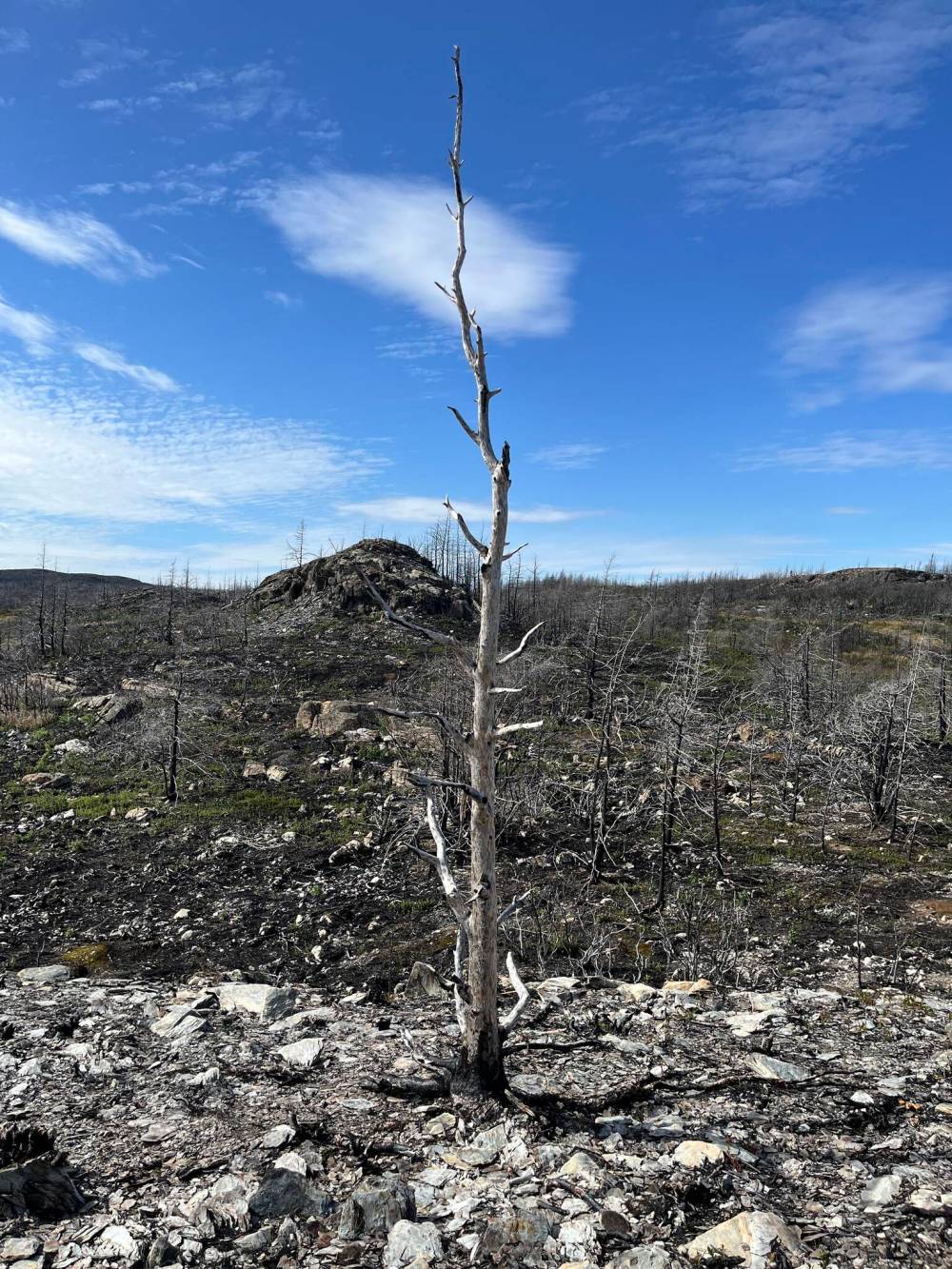
It’s ghostly. The little birds flit and chirp from the naked silver bare-wood branches, and a solitary northern flicker makes its call from — somewhere. But mostly, it’s still, and silent. With the underbrush gone, you can see how little animal life is here right now.
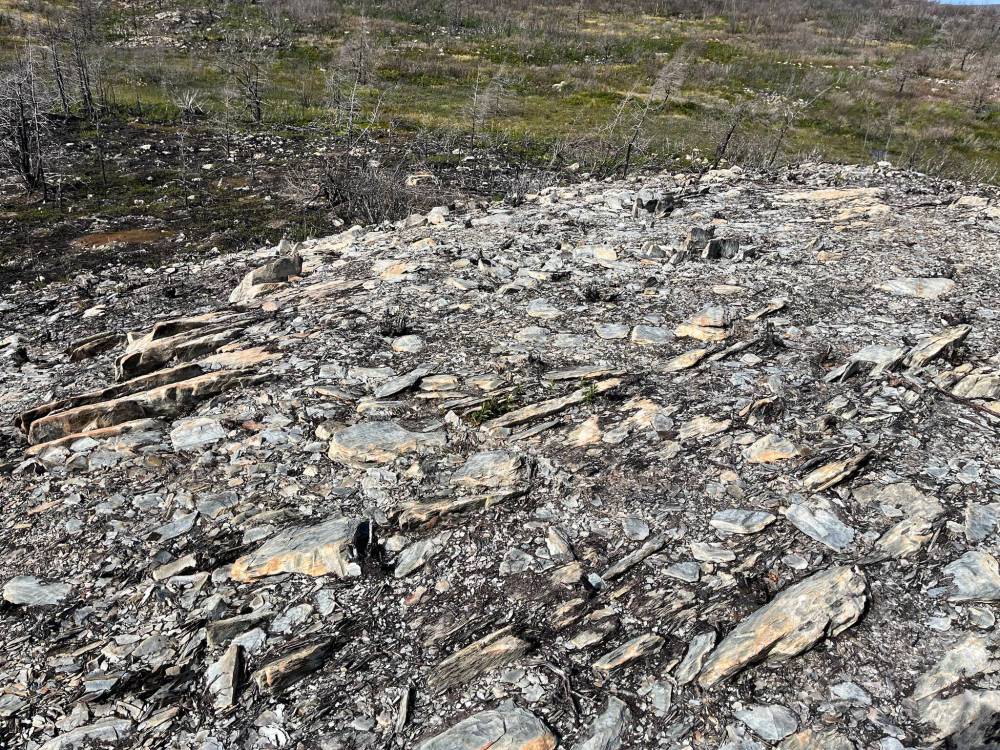
But the most astounding thing is underfoot. On the high rock behind Adam’s Cove and away from the sea, not only are the trees and low brush gone, but much of the soil has burned away as well.
Russell Wangersky/Free Press
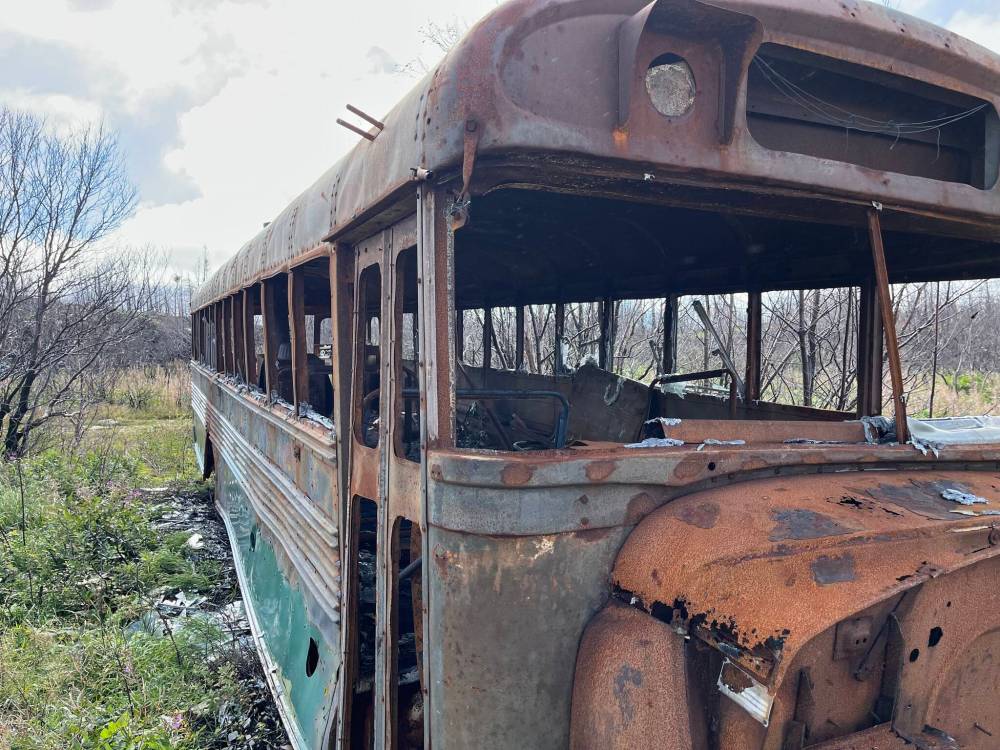
The burned bus on the Island Pond trail near Adam’s Cove, NL.
It burned very, very hot.
The solid rock of the hill is split into long shards from the heat, and crunches under your feet like you are walking across a great grey bed of saltine crackers. It’s hard not to believe that your footsteps are the first that have been here since the fire, because the thin biscuits of rock would have already been crushed if someone else had made the hike.
The whole sense of place is distorted: hills that hid behind the scrim of the windblown spruces are out in the open and prominent now, and the corners of the trail just aren’t full corners anymore. Where the trees used to hide what lay ahead around bends, their current absence makes the bends almost disappear as well — so that, instead of winding, the ATV trail to Island Pond seems to lie laid out like a piece of near-straight butcher’s string.
Tiny button-headed orange mushrooms are coming up — coming up everywhere — and you can’t help but feel all of this is a set progression, a lock-step natural trip from burn to recovery, but one that simply ignores you as it moves ahead. Fireweed gone to seed and fresh new raspberry canes, mosses forming up in their measured spreading regiments, the alders taking easy advantage.
But more than anything else right now, it is an apocalyptic trip of burn scars, a trip I know leads to just one place. I’m alone on this uphill walk, the fine rain sheeting down, the sky grey.
Heading for the bus.
It is a bus that appears often in the regular rotation of my nightmares.
Why?
I probably found the bus a decade ago, walking towards Island Pond. There it was, just parked up on the side of the trail: a full-size school bus minus the engine up front, slapdash painted green to help it blend into its surroundings. (Good luck with that camouflage — you can see it from space on satellite images on Google Maps.)
But the first time I saw it, it brought me to a halt. How did it get there? I couldn’t see how, up a rocky trail the width of a bog bike. What towed it? And then: was anyone there? I couldn’t tell. No smoke from the chimney — yes, it was a bus with a chimney — but no sound.
So you wait and see, on alert, scanning the surroundings. (It’s that alert, I’m certain, that worms things deep into you, that bookmarks fears and brings them creeping back in around your edges.)
Russell Wangersky/Free Press
A single burned tree in burned wasteland above Adam’s Cove, NL.
Eventually, I made my way to the side to look in through bus windows as high as I am tall: no one. I made my way inside through the bi-folds at the front, and there it was: a yellow-almond propane stove, a wood stove with a black metal chimney, two chairs and a card table.
Two camp beds with pillows, sheets and blankets, both beds with the covers thrown back in that triangle that says people got up in a hurry. Got up in a hurry and may be close by. And may be returning.
I’m not good alone. I’m never good alone. Alone in the deep of the night, awakened by nightmares of fires and car accidents I’ve responded to, is the worst. It’s like, left unattended, my head is assembling things out of the most frightening kind of building blocks it can gather up. Try this. Deal with that.
I’ve put those thrown-abroad beds into books I’ve written: the way they looked like someone had just left but was coming back any moment to catch you in the trespassing act, the way the frozen motion of the covers looked both immediate and permanent. The way there was always no sound — or, if there was sound, it only made things worse, the whisper of wind through the tree tips, hissing. You know the kind of place: the kind of place that makes your blood and breathing seem to stop, despite your brain arguing that this is all stupid.
I came back to that bus many times: nothing ever changed. The sheets and blankets, particularly, were always the same. The waiting, a constant. The fear, redux.
This time, though, it was different. Fire has eaten the bus.
The window glass has drooled everywhere inside and outside the bus like taffy. The aluminum front on the cookstove has melted and run down, so the oven door can no longer open. The sheets and blankets and mouldering mattresses have burned away, leaving rusting bedframes behind. The floors are charred and treacherous, so you have to watch your footing. The woodstove is covered with a skein of fresh bright rust. Outside, the tires are gone, leaving only the steel wheels and the tangled ply of their steel belts behind.
The steering wheel fallen, bent, into the springs where the driver’s seat had been.
I stopped: I listened. That much hadn’t changed.
The apprehension was as strong as it had ever been.
The forest fire is making other things happen.
Russell Wangersky/Free Press
Last year’s Conception Bay North forest fires were so hot that soil burned and rock cliffs split apart.
A two-foot-long scythe blade surfaced out of the fan of roots of a fallen spruce on our property, making me wonder if someone had been punished for misplacing it. Long, straight stone walls have appeared in a blueberry meadow we have walked by for years, with no sign about what the walls were built for, or when or by whom. There are coyote tracks and scat, moose prints in the silty soft of the fans of big-puddle runoff. Things are happening.
Along the trail back from the bus, red-rust splashes against the grey and black and white show you where other small getaways have been built, and have been relentlessly pulled back into nature.

So I sit here tonight, in the rainy, windy dark, and I think: when it comes to the bus, am I finally free of at least this one? (Sometimes the dreams stop: I never know when or why. I haven’t had the candle-wax-hands-on-fire dream for years now.)
Has the story of the bus come to an end, or has it just found a new and different beginning?
I don’t know.
But I might tonight or tomorrow.
Russell Wangersky is the Comment Editor at the Free Press. He can be reached at russell.wangersky@freepress.mb.ca.
Russell Wangersky
Perspectives editor
Russell Wangersky is Perspectives Editor for the Winnipeg Free Press, and also writes editorials and columns. He worked at newspapers in Newfoundland and Labrador, Ontario and Saskatchewan before joining the Free Press in 2023. A seven-time National Newspaper Award finalist for opinion writing, he’s also penned eight books. Read more about Russell.
Russell oversees the team that publishes editorials, opinions and analysis — part of the Free Press‘s tradition, since 1872, of producing reliable independent journalism. Read more about Free Press’s history and mandate, and learn how our newsroom operates.
Our newsroom depends on a growing audience of readers to power our journalism. If you are not a paid reader, please consider becoming a subscriber.
Our newsroom depends on its audience of readers to power our journalism. Thank you for your support.
Russell Wangersky
Perspectives editor
Russell Wangersky is Perspectives Editor for the Winnipeg Free Press, and also writes editorials and columns. He worked at newspapers in Newfoundland and Labrador, Ontario and Saskatchewan before joining the Free Press in 2023. A seven-time National Newspaper Award finalist for opinion writing, he’s also penned eight books. Read more about Russell.
Russell oversees the team that publishes editorials, opinions and analysis — part of the Free Press‘s tradition, since 1872, of producing reliable independent journalism. Read more about Free Press’s history and mandate, and learn how our newsroom operates.
Our newsroom depends on a growing audience of readers to power our journalism. If you are not a paid reader, please consider becoming a subscriber.
Our newsroom depends on its audience of readers to power our journalism. Thank you for your support.
Advertisement Advertise With Us
Advertisement Advertise With Us