

Hidden no more
It's time Canada commemorates Ukrainian internment in labour camps
Advertisement
Read this article for free:
or
Already have an account? Log in here »
To continue reading, please subscribe:
Monthly Digital Subscription
$1 per week for 24 weeks*
- Enjoy unlimited reading on winnipegfreepress.com
- Read the E-Edition, our digital replica newspaper
- Access News Break, our award-winning app
- Play interactive puzzles
*Billed as $4.00 plus GST every four weeks. After 24 weeks, price increases to the regular rate of $19.95 plus GST every four weeks. Offer available to new and qualified returning subscribers only. Cancel any time.
Monthly Digital Subscription
$4.99/week*
- Enjoy unlimited reading on winnipegfreepress.com
- Read the E-Edition, our digital replica newspaper
- Access News Break, our award-winning app
- Play interactive puzzles
*Billed as $19.95 plus GST every four weeks. Cancel any time.
To continue reading, please subscribe:
Add Free Press access to your Brandon Sun subscription for only an additional
$1 for the first 4 weeks*
*Your next subscription payment will increase by $1.00 and you will be charged $16.99 plus GST for four weeks. After four weeks, your payment will increase to $23.99 plus GST every four weeks.
Read unlimited articles for free today:
or
Already have an account? Log in here »
Hey there, time traveller!
This article was published 19/06/2013 (4702 days ago), so information in it may no longer be current.
Mary Manko was born in Montreal. Along with the other members of the city’s Ukrainian community, her family was rounded up and transported, during the First World War, to the Spirit Lake internment camp in Quebec’s remote Abitibi region.
Yet Mary Manko rarely dwelt on her family’s suffering. Instead, she wondered whether Japanese, Italian and German Canadians would have been mistreated during the Second World War, or some Quebecois in 1970, if people had only remembered Canada’s first national internment operations. They didn’t. So wrongs done once were done again, then again.
Despite indifference, ignorance, even hostility, the Ukrainian Canadian Civil Liberties Association installed commemorative plaques and statues at most of Canada’s 24 internment sites, while calling on Ottawa for acknowledgment and redress.
We never asked for an apology or compensation. Manko believed today’s Canadians shouldn’t pay for past wrongs. To put it another way: What your grandfathers did to our grandfathers is not something you should apologize for, nor something we should gain from. UCCLA’s campaign evolved as Mary wanted — it was about memory, not money.
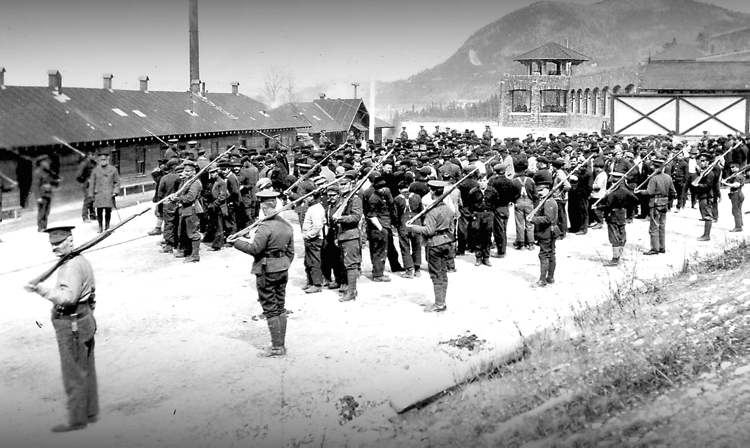
“Enemy aliens” were held in Banff from mid-July 1915 to mid-July 1917 at Castle Mountain and also at Cave and Basin, where a permanent exhibit opens Thursday, Canada’s first official commemoration.
The unpleasant story of forced labourers exploited in Western Canada’s national parks will be hidden no more. Photographs of civilians behind barbed wire should mute the mutterings of those who still deny these men were kept under duress.
Why did it take nearly 100 years for this story to be told? The destruction of most records from the Office of Internment Operations didn’t help. And mainstream historians were generally content noting “Germans, Austrians and Turks” were rounded up during the Great War, never wondering who they really were and whether imprisonment was justified. Parks Canada’s website still doesn’t admit most were Ukrainian. Until recently, nothing was taught about this in any school. Don’t be surprised if this is the first time you’re hearing about the internment operations of 1914-1920.
But why did Banff’s residents forget? Were they ashamed for never protesting as innocent men were herded into Canadian concentration camps, compelled to do heavy labour for the profit of their jailers? Or was it because the internees were not their social or racial equals? A hint of such prejudice extruded into the Crag and Canyon, Banff’s newspaper, on Nov. 18, 1916: “…the majority of our citizens are of the opinion that the scenic outlook is not vastly improved by the presence of the slouching, bovine-faced foreigners.”
Apprehension cowed entire communities. Sir Hugh Macdonald, son of Canada’s first prime minister, advised the justice minister in July 1919: “Fear is the only agency that can be successfully employed to keep them within the law and I have no doubt that if the Dominion government persists in the course that it is now adopting, the foreign element here will soon be as gentle and as easily controlled as a lot of sheep.” It worked.
Nick Lypka, a Castle Mountain prisoner, admitted as much, but only decades later. He remained afraid “because they could arrest me again.”

It was a former Manitoba MP, Dauphin’s Inky Mark, a Chinese-Canadian from a family of head-tax payers, whose Bill C-331 — Internment of Persons of Ukrainian Origin Recognition Act — led to the formation of the Canadian First World War Internment Recognition Fund in 2008. Additional monies were granted for a Cave and Basin internment museum, obliging Parks Canada bureaucrats to recall a story they worked harder to erase than to remember.
c_
That tale should be told at Cave and Basin. It won’t be. Parks Canada is about tourism, not truth.
There was a receiving station for “enemy aliens” in Winnipeg, yet Canada’s first national internment operations will barely be mentioned in the Canadian Museum for Human Rights. Why not? That’s another yarn, one yet to be told. It will be.
Lubomyr Luciuk is a professor of political geography at the Royal Military College of Canada.