

Victims to be honoured 43 years after crash
Advertisement
Read this article for free:
or
Already have an account? Log in here »
To continue reading, please subscribe:

Digital Subscription
One year of digital access for only $205*
- Enjoy unlimited reading on winnipegfreepress.com
- Read the E-Edition, our digital replica newspaper
- Access News Break, our award-winning app
- Play interactive puzzles
*First annual payment billed as $205.00 + GST for one year. This annual subscription will automatically renew at $233.00 + GST every 52 weeks (10% off the regular annual price of $259.35). Offer available to new and qualified returning subscribers only. Cancel any time.
To continue reading, please subscribe:
Add Free Press access to your Brandon Sun subscription for only an additional
$1 for the first 4 weeks*
- Enjoy unlimited reading on winnipegfreepress.com
- Read the E-Edition, our digital replica newspaper
- Access News Break, our award-winning app
- Play interactive puzzles
*Your next Brandon Sun subscription payment will increase by $1.00 and you will be charged $17.95 plus GST for four weeks. After four weeks, your payment will increase to $24.95 plus GST every four weeks.
Read unlimited articles for free today:
or
Already have an account? Log in here »
Hey there, time traveller!
This article was published 05/07/2013 (4755 days ago), so information in it may no longer be current.
TORONTO — A memorial garden dedication takes place Sunday at the site of one of Canada’s worst aviation disasters, a former farm field that for decades continued to yield bits of human remains and wreckage.
For some, such as Lynne Genova, who was in bed a few kilometres from where Air Canada Flight 621 slammed into the ground, the permanent memorial with its 109 stones has finally brought her a sense of peace.
“It haunted me because I thought that houses would be built on it and nobody would know,” Genova says. “I’m at peace now because I know it’s marked appropriately and respectfully.”
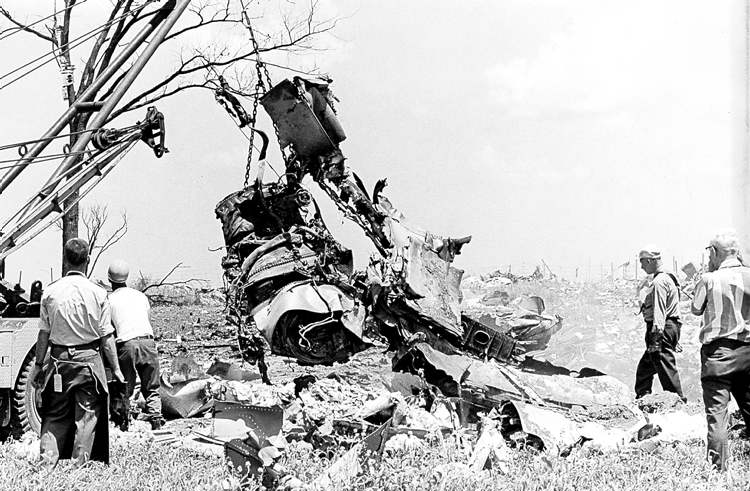
It was around 8 a.m. on Sunday, July 5, 1970, when the DC-8 en route from Montreal to Los Angeles prepared to make a routine stop at Toronto’s international airport, northwest of the city.
Just as it came in to land, co-pilot Donald Rowland mistakenly deployed the ground spoilers, which are only to be used after landing to brake the aircraft. The plane dropped.
“Sorry. Oh. Sorry, Pete,” Rowland, 39, was recorded as saying.
The captain, Peter Hamilton, 49, applied full power, but the plane bounced hard on the runway, breaking off one of the engines. Unaware of the extent of the damage, Hamilton managed to get the “California Galaxy” airborne again so he could attempt another landing.
“Oh, we’ll go around. I think we’re all right,” Hamilton said.
As the plane climbed, leaking fuel ignited. A series of explosions destroyed the right wing. The DC-8, trailing fire and smoke, nose-dived into the field from about 1,000 metres up about 10 kilometres from the airport.
“Oh, gosh!” were Rowland’s last recorded words. All 100 passengers and nine crew were killed.
Among the passengers were Canadians — including a mom and her two girls — American vacationers, and others from overseas.
Genova, who was then 13, remembers hearing explosions and the “horrific bang” as the plane hit the ground. She remembers her mom screaming for her to get out of bed. She remembers the smell of fuel. And she remembers the radio broadcast announcing the death toll.
“There was nothing to do. I felt hopeless and helpless that day.”
It took until 2000 before Genova finally went to the site, and another five years before newspaper stories about its neglect prompted her and others to begin agitating for the memorial site.
In 2008, as farmers sold their land and the surrounding area developed rapidly into what is now Brampton, the idea of constructing a permanent memorial finally took shape.
The site, formally designated as a cemetery, has plaques with the names of each of the victims. The 109 stones are grouped randomly. It’s peaceful.
“This garden, to me, is appropriate where it is,” Genova says.
“We finally encompassed our history.”
— The Canadian Press
History
Updated on Friday, July 5, 2013 8:16 AM CDT: Adds sidebar