New smartphone app helps parents walk kids through first birds-and-bees conversation

Advertisement
Read this article for free:
or
Already have an account? Log in here »
To continue reading, please subscribe:

Digital Subscription
One year of digital access for only $205*
- Enjoy unlimited reading on winnipegfreepress.com
- Read the E-Edition, our digital replica newspaper
- Access News Break, our award-winning app
- Play interactive puzzles
*First annual payment billed as $205.00 + GST for one year. This annual subscription will automatically renew at $233.00 + GST every 52 weeks (10% off the regular annual price of $259.35). Offer available to new and qualified returning subscribers only. Cancel any time.
To continue reading, please subscribe:
Add Free Press access to your Brandon Sun subscription for only an additional
$1 for the first 4 weeks*
- Enjoy unlimited reading on winnipegfreepress.com
- Read the E-Edition, our digital replica newspaper
- Access News Break, our award-winning app
- Play interactive puzzles
*Your next Brandon Sun subscription payment will increase by $1.00 and you will be charged $17.95 plus GST for four weeks. After four weeks, your payment will increase to $24.95 plus GST every four weeks.
Read unlimited articles for free today:
or
Already have an account? Log in here »
Hey there, time traveller!
This article was published 10/09/2013 (4720 days ago), so information in it may no longer be current.
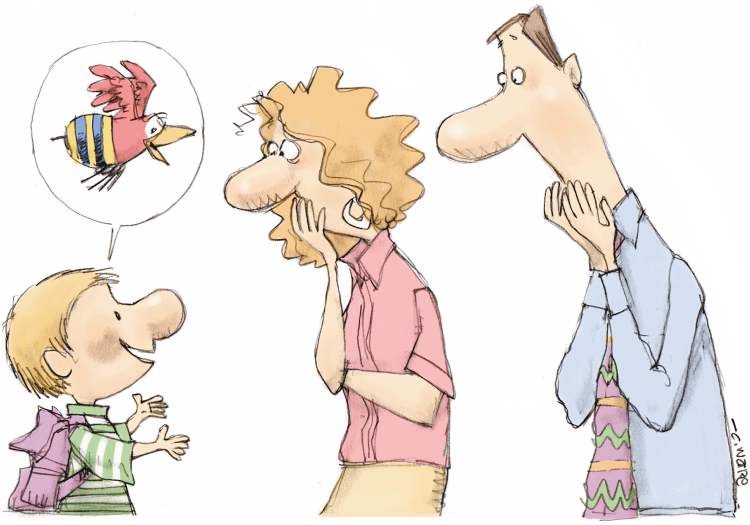
For some parents, having “the talk” can be uncomfortable — particularly with the curious preschool set.
That’s why Dr. Jillian Roberts, a Victoria-based child psychologist, created The Facts of Life, a smartphone and tablet app that helps parents answer the inevitable question, “Where do babies come from?” The app, which sells for $1.99 on iTunes, is geared toward children aged four to six and introduces sex in a G-rated way.
Through her practice, Roberts, 41, noticed that an increasing number of kids were coming to her with questions about inappropriate images they’d stumbled upon on the Internet.
“I’d have to debrief with them about what they had seen and what it meant,” she says. She realized that, in a tech-saturated era of tablets and smartphones, the age-old (well, decades-old) advice of keeping the family computer in the kitchen was becoming rather antiquated.
So, she began encouraging parents to have the birds-and-bees talk earlier.
“You need to give (kids) a framework so they’re not embarrassed about what they see, so they can come tell you about what they saw or heard at school,” she says. “We need to jump in the game and take back the conversation. Parents would ask me, ‘How early?’ and I’d say, ‘As early as you can.'”
Roberts began thinking about what that introductory conversation would be like — and how she would have gone about it if she had a do-over. The mother of three didn’t have an easy time when it came to talking sex with her eldest daughter, who’s now 12.
“It was not comfortable for me — and I’m a child psychologist,” she says with a laugh.
“I was reading Today’s Parent or Parenting and I read something that said, ‘If you haven’t had the talk by age nine, you’re too late,'” she recalls. “I remember being really nervous about that. I sat her down and I really quickly said it.”
Roberts says that, while helpful, the books she picked up to support her discussion were either too graphic or too overwhelming with the amount of information they provided.
The Facts of Life app is neither, she says. Rather than shunning technology, Roberts decided to embrace it, teaming up with students from the Centre of Digital Media in Vancouver to design a resource that is “wholesome and beautiful.”
The app asks a series of basic questions, such as “Where do babies come from?” The answers are intentionally vague: “A baby comes from a woman’s body.” A child can continue the program by clicking ‘Tell me more.’ Conversely, he or she can also select ‘Enough.’
“At every step they can decide if they want to learn more or if it’s enough for one day,” Roberts says. As for the vague answers, “we just give them what they need to know.”
The app uses storybook imagery and illustrations to avoid getting “too technical or medical,” although words such as vagina are used. For example, to answer the question of how a baby gets inside a woman, the app explains that a mom and dad’s bodies fit together like a puzzle. The accompanying image is of a man and woman holding interlocking pieces. And when they fit together in a “special embrace,” a seed is planted in the mother’s womb.
“The understanding of where they come from should be beautiful, not disgusting, painful or violent,” Roberts says. “This is meant to be a starting point.”

What it’s not meant to be is a substitute for a real interaction between parent and child, Roberts stresses. The Facts of Life is meant to be done with a parent, which is why there’s no voiceover.
Dr. Jennifer Theule, a Winnipeg clinical psychologist and an assistant professor of clinical and school psychology at the University of Manitoba, says the The Facts of Life app is useful to parents who could learn simple ways to explain these introductory topics to preschoolers, but wonders about its effectiveness for older kids.
“Older children need more sophisticated information. I think the app avoided the difficult topics kids really want to know about — sexual intercourse, puberty, etc.”

Theule is also concerned that, by using the app, parents are actually communicating their discomfort to their children. “What I’d like to see is parents who are open and answer these questions as they arise at a level their child understands.
“Ideally, ‘the talk’ isn’t a talk, it’s a huge series of conversations you have over the course of your child’s life,” she adds. “This app fits into the model of one talk, but a child needs this info again and again at different levels over an extended period.”
And there’s an app for that too — or, at least, there will be. Roberts has a series of apps in the works for older kids, including puberty for girls, puberty for boys and adolescent sexuality. For parents who are having trouble striking up that open dialogue, The Facts of Life and other apps like it could prove to be an invaluable aid.
“Strengthening that relationship is going to keep children safe,” Roberts says. “That’s my hope.”
jen.zoratti@freepress.mb.ca
Jen Zoratti is a columnist and feature writer working in the Arts & Life department, as well as the author of the weekly newsletter NEXT. A National Newspaper Award finalist for arts and entertainment writing, Jen is a graduate of the Creative Communications program at RRC Polytech and was a music writer before joining the Free Press in 2013. Read more about Jen.
Every piece of reporting Jen produces is reviewed by an editing team before it is posted online or published in print – part of the Free Press‘s tradition, since 1872, of producing reliable independent journalism. Read more about Free Press’s history and mandate, and learn how our newsroom operates.
Our newsroom depends on a growing audience of readers to power our journalism. If you are not a paid reader, please consider becoming a subscriber.
Our newsroom depends on its audience of readers to power our journalism. Thank you for your support.
Jen Zoratti is a columnist and feature writer working in the Arts & Life department, as well as the author of the weekly newsletter NEXT. A National Newspaper Award finalist for arts and entertainment writing, Jen is a graduate of the Creative Communications program at RRC Polytech and was a music writer before joining the Free Press in 2013. Read more about Jen.
Every piece of reporting Jen produces is reviewed by an editing team before it is posted online or published in print – part of the Free Press‘s tradition, since 1872, of producing reliable independent journalism. Read more about Free Press’s history and mandate, and learn how our newsroom operates.
Our newsroom depends on a growing audience of readers to power our journalism. If you are not a paid reader, please consider becoming a subscriber.
Our newsroom depends on its audience of readers to power our journalism. Thank you for your support.
Advertisement Advertise With Us
Advertisement Advertise With Us
History
Updated on Tuesday, September 10, 2013 7:08 AM CDT: Replaces image