

John Dafoe: an indelible mark
Advertisement
Read this article for free:
or
Already have an account? Log in here »
To continue reading, please subscribe:
Digital Subscription
One year of digital access for only $1.44 a week*
- Enjoy unlimited reading on winnipegfreepress.com
- Read the E-Edition, our digital replica newspaper
- Access News Break, our award-winning app
- Play interactive puzzles
*Billed as $5.77 plus GST every four weeks. After 52 weeks, price increases to the regular rate of $19.95 plus GST every four weeks. Offer available to new and qualified returning subscribers only. Cancel any time.
To continue reading, please subscribe:
Add Free Press access to your Brandon Sun subscription for only an additional
$1 for the first 4 weeks*
- Enjoy unlimited reading on winnipegfreepress.com
- Read the E-Edition, our digital replica newspaper
- Access News Break, our award-winning app
- Play interactive puzzles
*Your next Brandon Sun subscription payment will increase by $1.00 and you will be charged $17.95 plus GST for four weeks. After four weeks, your payment will increase to $24.95 plus GST every four weeks.
Read unlimited articles for free today:
or
Already have an account? Log in here »
Hey there, time traveller!
This article was published 20/02/2014 (4497 days ago), so information in it may no longer be current.
John Dafoe returned to the Free Press as editorial page editor while then prime minister Joe Clark and his Conservative party were campaigning for re-election. Shortly before the Feb. 18, 1980, election, John wrote an editorial endorsing the Conservatives, calling for re-election of Clark’s short-lived government — and astonishing readers who knew the Free Press had been loyal to the Liberal party through thick and thin for most of the 20th century.
The public brought Pierre Trudeau’s Liberals back to power in spite of the Free Press support of Clark. But readers of the Free Press and watchers of its editorial page knew from then on a new hand was on the tiller. John and his editorial page group would not be predictable. He would teach his colleagues to delight in surprise. Don’t look at a story to find confirmation of what you already believed. Look for the surprise, enjoy the surprise and share the surprise with the readers.
John was my boss on the editorial page of the Montreal Star in the 1970s until the Star was closed by its owners in the fall of 1979, following a labour dispute. We were both born and nurtured in Winnipeg, and we both wound up back here — and that was no coincidence. We were both enmeshed in a web of Winnipeg connections that reached across the decades and across the country.
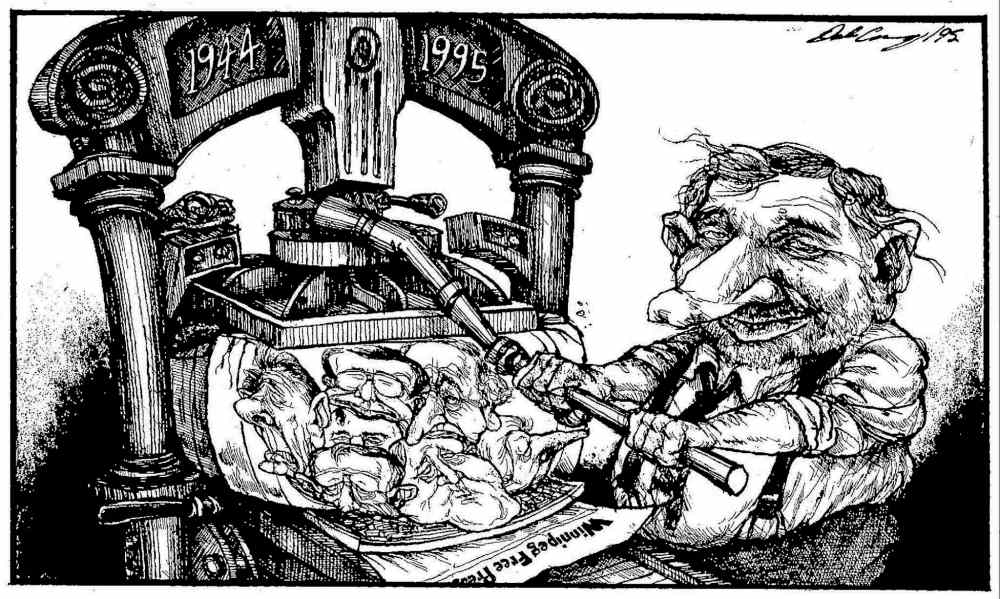
My grandfather, Harold Moore, wrote editorials for John’s grandfather, John W. Dafoe, in the 1930s and 1940s. Another member of that earlier Dafoe group was Frank Walker, who as editor-in-chief of the Montreal Star, hired both me and John in the 1970s and put us together on his editorial page. George Ferguson, another alumnus of the earlier Dafoe group, had brought Frank into the Montreal Star organization. After the sinking of the Star, Frank saw to it John took over the Free Press editorial page. John brought me to join him and so the grandsons picked up in 1980 where the grandfathers had left off in 1944. He remained my boss until he retired in 1995.
But John never aimed to look at the world through his grandfather’s glasses. He was keenly aware of the Dafoe family tradition and proud to be a Dafoe. But as the Joe Clark endorsement showed, he made his own choices among the elements of the Dafoe legacy.
Like his grandfather, he gave his writers wide freedom. He did not enjoy reading articles produced to support the official opinion of an organization. He wanted writers to write with conviction, even if he did not share those convictions. As editorial page editor, he bore formal responsibility for every word that appeared in the unsigned, formal editorials — the leaders, we called them — but he published plenty of leaders he did not entirely agree with (though he deleted the worst hyperbole) just because a well-stated argument is interesting to read while a parroting of someone else’s opinion is predictable and boring. He also fiercely defended what we wrote, even when we had given him thin ice to skate on.

Unlike his grandfather, John kept his distance from the public authorities. The elder Dafoe served the Robert Borden government on the Canadian delegation to the 1919 Paris peace conference. He served the Mackenzie King government on the Rowell-Sirois economic policy commission. The younger Dafoe could happily share a dinner or spend an evening with his many friends and former classmates in government, but he intended to comment on government policy, not make it.
As a boss, he was more like an elder brother or a coach, making us better writers by keeping the readers in mind. “Tell me where you’re going,” was his simple advice for fixing an editorial that finished with a conclusion only tenuously related to the first paragraph. “I don’t think you really mean that,” was his gentle way of underlining a wild overstatement. “The only things you need to look up are the things you know for sure,” he would say after some simple factual error had appeared in the paper.
He was profoundly loyal to his wife, Arline, nursing her through her last bout with cancer even as Parkinson’s disease was slowly eroding his strength and mobility. As the disease advanced, his world shrank. He found his joy where he could. If he ever felt angry or frustrated, he kept it to himself.
Terence Moore was the Winnipeg Free Press comment editor from 1999 to 2005.