

The battle for Portage and Main
Advertisement
Read this article for free:
or
Already have an account? Log in here »
To continue reading, please subscribe:

Digital Subscription
One year of digital access for only $205*
- Enjoy unlimited reading on winnipegfreepress.com
- Read the E-Edition, our digital replica newspaper
- Access News Break, our award-winning app
- Play interactive puzzles
*First annual payment billed as $205.00 + GST for one year. This annual subscription will automatically renew at $233.00 + GST every 52 weeks (10% off the regular annual price of $259.35). Offer available to new and qualified returning subscribers only. Cancel any time.
To continue reading, please subscribe:
Add Free Press access to your Brandon Sun subscription for only an additional
$1 for the first 4 weeks*
- Enjoy unlimited reading on winnipegfreepress.com
- Read the E-Edition, our digital replica newspaper
- Access News Break, our award-winning app
- Play interactive puzzles
*Your next Brandon Sun subscription payment will increase by $1.00 and you will be charged $17.95 plus GST for four weeks. After four weeks, your payment will increase to $24.95 plus GST every four weeks.
Read unlimited articles for free today:
or
Already have an account? Log in here »
Hey there, time traveller!
This article was published 15/03/2014 (4537 days ago), so information in it may no longer be current.
The fine for illegally walking across Portage and Main after the barriers went up in 1979 was set at $12.25, but with the exception of a few protesters who hopped over the concrete dividers to mark their right to cross the famous intersection, the closure wasn’t a huge controversy.
There’s no record of anyone being tagged for jaywalking.
In fact, the redirection of pedestrian traffic into an underground concourse of shops and stores seemed to be widely popular at the time.
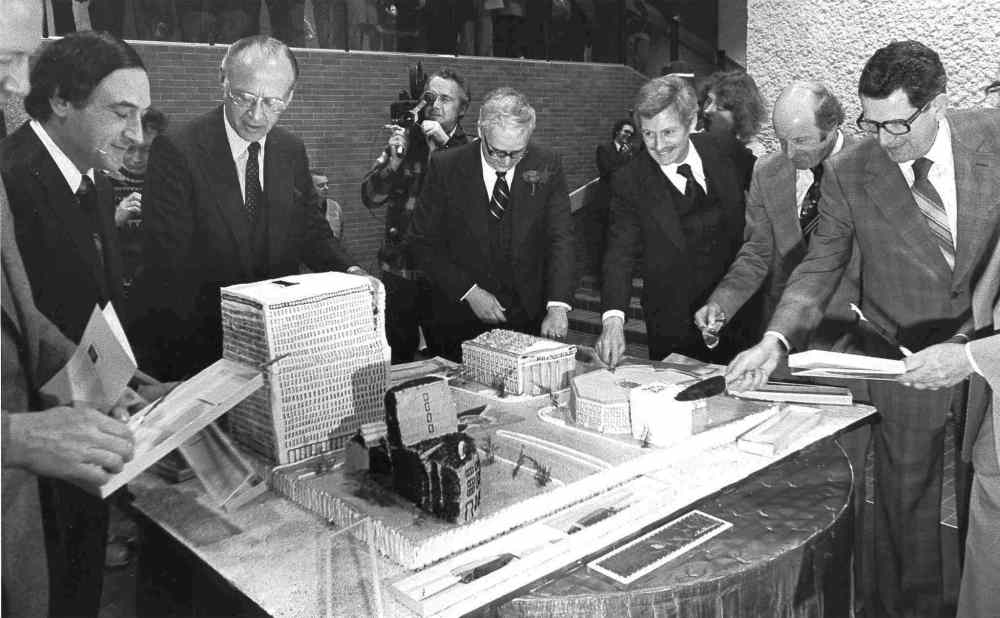
Civic leaders said it would eventually become a tourist destination, as if underground shopping was an exciting new opportunity.
A bank executive said “it reflects the pioneering spirit of the city,” while others envisioned it as the beginning of a weather-protected walkway that would connect Portage and Main with the legislative building, according to contemporary accounts in the Free Press archives.
The big news about the project on opening day, however, was the fact it had gone $820,000 over budget for the concourse portion alone, which cost about $7.5 million.
The overrun had been kept secret by civic administrators, who only revealed it a few hours after the ribbon was cut. The information had even been withheld from civic politicians, who were surprised, but not terribly upset by the news.
Former premier Gary Filmon, a councillor at the time, defended the administration’s management of the information, saying it was their right to decide how and when to release it.
He said he presumed they held it back in order to present a single, final figure and to avoid intermittent criticism from the media.
Another councillor wondered how much more money the city had hidden in its treasury, while former councillor John Angus said it was “mind-boggling” the way administrators were always able to find extra money council did not know existed.
Left-wing councillor Joe Zuken, an opponent of the project, was furious, but the overrun issue quickly blew over. It was, however, an example of the kind of abuse that would eventually lead to an administrative overhaul at city hall, which is obviously a work in progress.
In the weeks and months that followed, however, persistent criticism from Zuken and protesters such as Nick Ternette and Evelyn Shapiro, as well as the disabled community whose needs had not been properly anticipated, pressured the city to answer questions about why the intersection needed to be closed and how it could be reopened again.
The Right to Walk on Portage and Main Committee was formed, although it does not appear to have represented more than 150 people. The committee said pedestrians should have just as much rights as motorists to use the intersection.
Filmon, who was chairman of the city’s works and operations committee, took the lead in defending the closure. The underground crossing, he said, was intended to improve traffic flow and protect pedestrians.
Other councillors said the city would have “a lot of explaining to do” if a child got killed crossing the intersection.
The opposition didn’t buy it. Zuken said the city had been manipulated by the business community, whose only interest was channelling shoppers to their underground stores. It was also revealed the seven corporations that controlled the intersection had only contributed $1.45 million of the total cost, a fact that further agitated the opposition.
Within two months of the closure, the corporations said they would be happy to renegotiate the deal if the city requested it.
They also said the whole project was the city’s idea, not theirs. The city’s traffic department, they said, had promoted the idea as a way to increase automobile flow through the congested downtown.
“We were asked to sign the agreement and we did,” a Royal Bank official said, pleading innocence and ignorance.
And so it has gone ever since.

Mayor Sam Katz and Coun. Justin Swandel say the city’s hands are tied, even though previous reports have said the business interests on three of the four corners have no problem removing the barricades. It’s not clear where the fourth corner stands.
It’s also not clear a complete opening of the intersection would even be embraced by pedestrians or that it would create the vibrancy some people claim.
But after 35 years of malarkey and baloney from civic officials, the least they can do is open a dialogue with the businesses that would be affected and draw up a few options.
It’s time for a few straight answers.
dave.obrien@freepress.mb.ca
Related Articles
Steeves vows to keep Portage and Main closed to pedestrians
Advertisement Advertise With Us
Advertisement Advertise With Us