
Exhibit gives sacred pipes new breath

Advertisement

Advertise with us

Before aboriginal treaty pipes could be placed on public display, the Manitoba Museum hosted a daylong feast to invite the sacred artifacts to speak for First Nations people.

Read this article for free:


or

Already have an account? Log in here »

To continue reading, please subscribe:

Subscribe and receive a limited-edition Free Press branded hat or tote.

Digital Subscription

One year of digital access for only $205*

  • Enjoy unlimited reading on winnipegfreepress.com
  • Read the E-Edition, our digital replica newspaper
  • Access News Break, our award-winning app
  • Play interactive puzzles

*First annual payment billed as $205.00 + GST for one year. This annual subscription will automatically renew at $233.00 + GST every 52 weeks (10% off the regular annual price of $259.35). Offer available to new and qualified returning subscribers only. Cancel any time.

To continue reading, please subscribe:

Add Free Press access to your Brandon Sun subscription for only an additional

$1 for the first 4 weeks*

  • Enjoy unlimited reading on winnipegfreepress.com
  • Read the E-Edition, our digital replica newspaper
  • Access News Break, our award-winning app
  • Play interactive puzzles
Start now

*Your next Brandon Sun subscription payment will increase by $1.00 and you will be charged $17.95 plus GST for four weeks. After four weeks, your payment will increase to $24.95 plus GST every four weeks.

Hey there, time traveller!
This article was published 17/05/2014 (4533 days ago), so information in it may no longer be current.

Before aboriginal treaty pipes could be placed on public display, the Manitoba Museum hosted a daylong feast to invite the sacred artifacts to speak for First Nations people.

“Pipes are considered animate, a kind of person, by Anishinaabe people,” says Maureen Matthews, the museum’s curator of ethnology and of its latest exhibition, We Are All Treaty People. “They are addressed like another person and are sometimes called grandfather.”

Matthews, who conceived the exhibit that opened earlier this month, had to convince reluctant elders to show revered and rarely seen pipes, beaded pipe bags, headdresses and other ceremonial objects collected in the museum’s sacred storage area. They are only moved with permission of the elders.
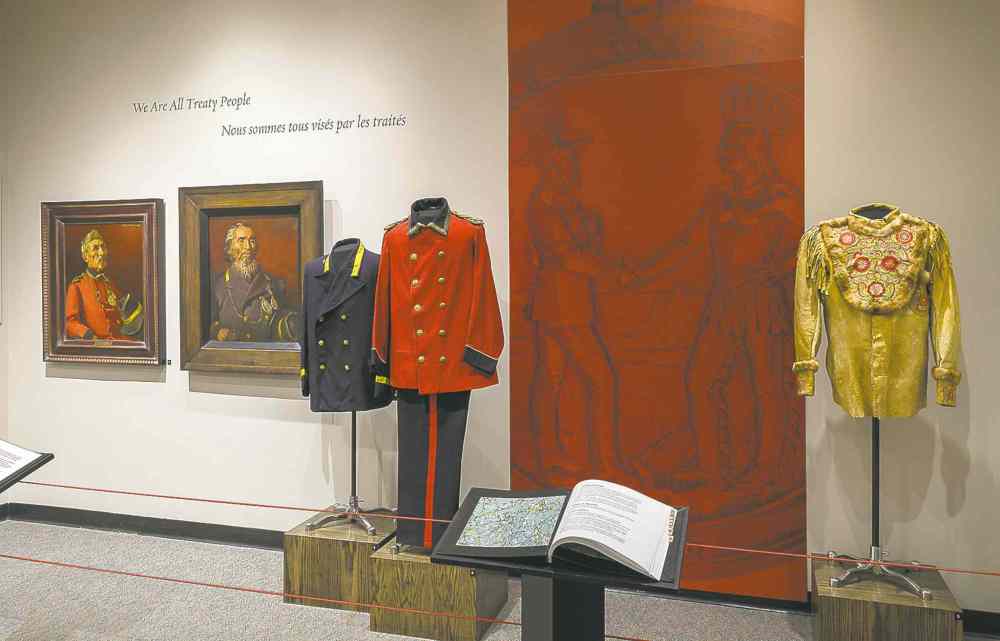
From left, portraits of Chief William Berens and Chief Jacob Berens by Marion Nelson Hooker; coat worn by William Berens, given to him by the government; coat given to Jacob Berens on the occasion of signing Treaty No. 5 in 1875; embroidered moose-hide jacket made by Nancy Berens.

“People are not easy to trust in these situations; some of the objects have been lost to theft in the past,” says Jamie Wilson, commissioner of the Treaty Relations Commission of Manitoba. “But the elders came to the conclusion that if they wanted their children to see these things they would have to allow them to go on public display.”

We Are All Treaty People, presented in the museum’s Discovery Room, features five authentic treaty medals, an original chief’s coat, an 1875 parchment commission for Treaty No. 4, a historical portrait of chiefs and the ceremonial pipes.

The oldest medal is from 1812 and was given by Lord Selkirk to Chief Peguis. The treaty medals or documents representing the Crown’s contractual obligations have been partnered with pipes and pipe bags that symbolize the First Nations’ commitment to that treaty.

First Nations’ leaders agreed to 11 numbered treaties between 1871 and 1921. Canada gained access to their homelands in return for promises to provide for the well-being of aboriginal people.

Treaties are a growing and contentious issue in the city and province as First Nations push to establish an urban reserve and develop surplus military land on what was Kapyong Barracks as an economic development zone. Talks are also ongoing about education on reserves and resource development. There are 22 land claims outstanding.

“There are unfairnesses that we have yet to resolve,” says Matthews. “So many people in Manitoba think the treaty process ended with its signing. Really, the treaty process begins with its signing. It’s the development over the last 100 years that has really shaped our province.

“We all benefit from treaties, not just native people. We wouldn’t have a right to stand here if we didn’t have treaties.”

Matthews couldn’t see how the exhibit would demonstrate what treaties mean to aboriginal people without bringing into the public the spiritual artifacts. The pipes were part of a sacred ritual that connected physical and spiritual worlds. They helped with consultations with the Creator during negotiations and then were smoked to seal the covenant or treaty.

She strictly followed the protocol for handling the material, including conversing with some objects.

“I do it because I understand that they liked to be talked to,” says Matthews, who hopes there will be a permanent treaty display after We Are All Treaty People closes in October. “I’m happy to do it. It’s not a game or insincere in any way.”

A few days before opening, Matthews, at the direction of Elders Council of the Association of Manitoba Chiefs, held a feast at the shuttered museum that included a water ceremony, inviting the return of the spirits of the pipes.
supplied photo
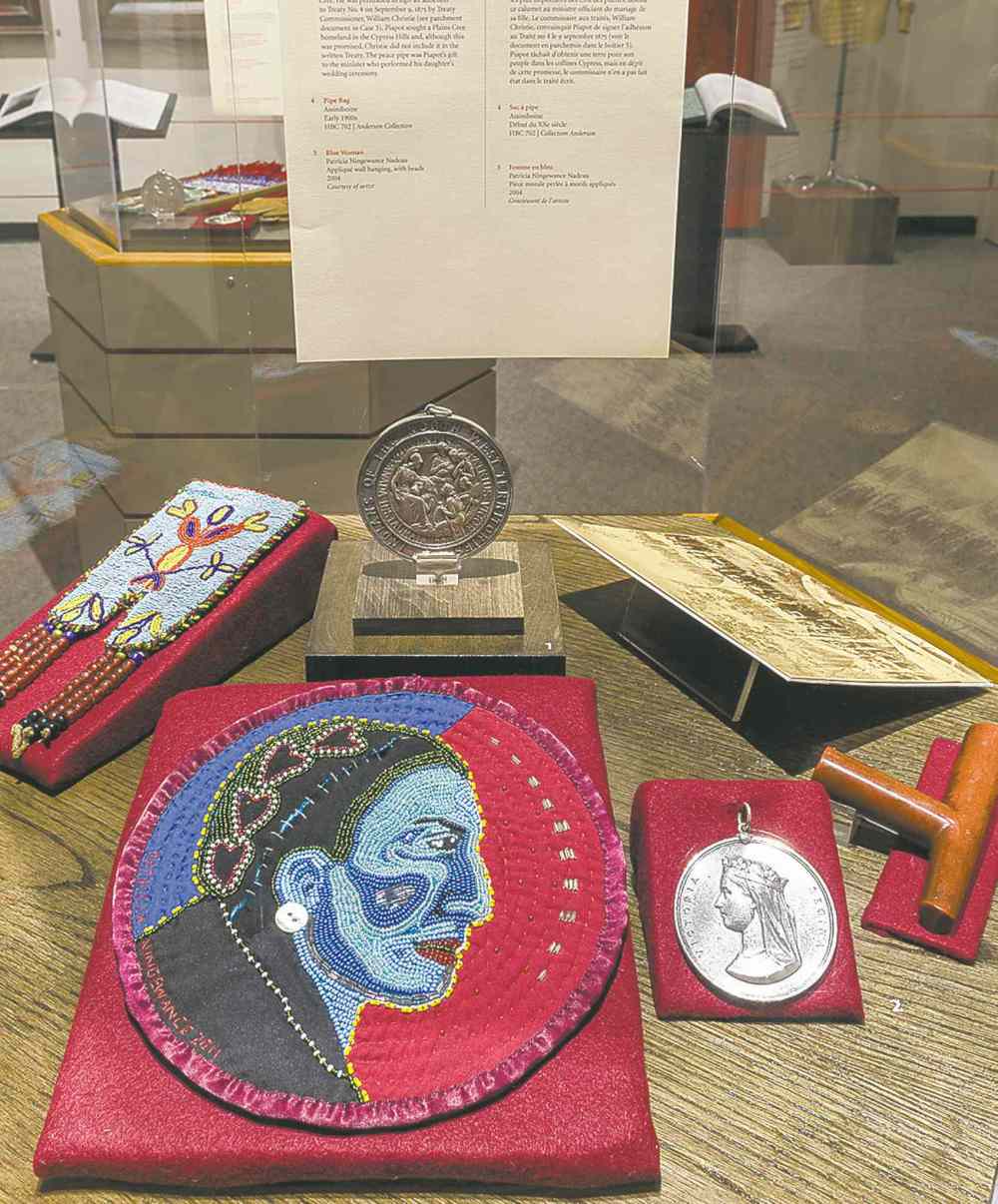
The Blue Woman, beadwork by Patricia Ningewance Nadeau; treaty No. 3 medal.
supplied photo The Blue Woman, beadwork by Patricia Ningewance Nadeau; treaty No. 3 medal.

“The elders welcomed back the pipes,” says Wilson, whose commission was a partner with the museum in the exhibit. “They brought old pipes to join the modern pipes. In our culture, pipes are comparable to human remains and the respect that goes with that. You carry them like they were a baby.

“You could feel the energy in the room. It was electric and pretty amazing. We were inviting them to speak again and giving them voice.”

What the pipes are saying is that the treaties represent a marriage of two peoples and that the relationship is both historical and contemporary.

“They say that the treaties last as long as the sun shines and water flows,” Wilson says. “If you want to understand where we are in Canada today you have to understand treaties. If you want to understand treaties you have to understand the spiritual component.”

That We are All Treaty People survived so many cultural obstacles is a reassuring sign for future negotiations.

“The process of getting the artifacts displayed was a real demonstration of how First Nations and other Canadians should work,” Wilson said.

kevin.prokosh@freepress.mb.ca

History

Updated on Tuesday, May 20, 2014 11:26 AM CDT: Removes gibberish deck

Report Error Submit a Tip

More Stories

Herd ushers in new era of men’s hoops with roster of newcomers

Joshua Frey-Sam 7 minute read Preview

Herd ushers in new era of men’s hoops with roster of newcomers

Joshua Frey-Sam 7 minute read 7:16 PM CDT

The stage is new. The role, however, is a familiar one to Taven Vigilance.

For the first time since his days as a highly touted high school recruit at Oak Park, Vigilance will be asked to help drive the Manitoba Bisons offence this season.

An elevated role for the 6-7 guard, entering his third year comes as the Bisons turn the page to a new era of the men’s basketball program, having lost all five of its starters from a season ago.

Vigilance spent this summer honing his craft, knowing this opportunity was coming. He focused on his ability to dribble off a screen, in particular, which is a common demand of Bison ball-handlers who need to understand how to decisively read defenders off the pick.

Read
7:16 PM CDT

Tenants battling landlords find help in short supply from province

Scott Billeck 14 minute read Preview

Tenants battling landlords find help in short supply from province

Scott Billeck 14 minute read 6:00 AM CDT

For nearly three years, Quincy Houdayer and Avery Helm repeatedly pressed their landlord to address plumbing failures, water damage and other maintenance problems at their West Broadway apartment, with records showing some issues persisted until the couple turned to the Residential Tenancies Branch.

Emails and text messages between the tenants, Clearwater Management and the RTB reviewed by the Free Press document recurring leaks and flooding, periods without heat or hot water, concerns about mould and basement conditions and repeated followups from the couple seeking repairs.

“Most of the experiences we’ve had with them can be boiled down to, like, they either are very dismissive about it, they act like it’s not their problem… or they will just fully, blatantly ignore you,” Helm said, adding that the only way to get Clearwater to respond was to threaten going to the RTB, a provincial government agency.

RTB data obtained by the Free Press also shows 13 orders involving the three-building complex at 193-197 Furby St. in 2026 alone. All but one favoured the tenant, while the remaining order ruled in favour of both the tenant and landlord on different items.

Read
6:00 AM CDT

20th annual VIBE awards put spotlight on giving back

Aaron Epp 4 minute read Preview

20th annual VIBE awards put spotlight on giving back

Aaron Epp 4 minute read Updated: 7:50 PM CDT

As a student at the University of Manitoba, Terry Brown never thought that one day he might be the leader of an award-winning company.

“I was just trying to find my own way,” he said.

More than two decades later, the company Brown co-founded, Okimaw Community & HR Solutions, will be honoured next month in Winnipeg at the 20th annual Visionary Indigenous Business Excellence Awards.

The awards are presented by Indigenous Business Education Partners, which offers tutoring, mentoring and financial aid and more to Indigenous students pursuing a degree at the U of M’s Asper School of Business.

Read
Updated: 7:50 PM CDT

Fire destroys St. Boniface housing unit

By Matthew Frank 3 minute read Preview

Fire destroys St. Boniface housing unit

By Matthew Frank 3 minute read Updated: 4:48 PM CDT

A six-unit housing development in St. Boniface was levelled by fire Tuesday.

The Winnipeg Fire Paramedic Service was notified at 4:50 a.m. that the site on the 800 block of Archibald Street, near Elizabeth Road, was on fire, a city spokesperson said in an email. No injuries were reported.

Firefighters had the blaze under control by about 6:15 a.m. after using an aerial ladder to tackle the flames from above and protect nearby homes, the spokesperson said.

At the site, no signs were present to identify the construction company or developer. The fences of neighbouring homes were burned and rooftop shingles were singed. Ash and fire-retardant foam littered the lawns.

Read
Updated: 4:48 PM CDT

Police, street groups looking to extend co-ordinated outreach-first approach to drug-use, trafficking crackdown

Chris Kitching 6 minute read Preview

Police, street groups looking to extend co-ordinated outreach-first approach to drug-use, trafficking crackdown

Chris Kitching 6 minute read Updated: 5:36 PM CDT

Winnipeg police and street outreach groups are discussing how to extend an initiative that tries to link people with addictions and homelessness services, while targeting open drug use and dealing.

Read
Updated: 5:36 PM CDT

Ontario to move northwest regions to permanent daylight time

Liam Casey, The Canadian Press 3 minute read Preview

Ontario to move northwest regions to permanent daylight time

Liam Casey, The Canadian Press 3 minute read Updated: 11:29 AM CDT

TORONTO - Ontario is set to move parts of the province's northwest region to permanent daylight time in order to align with Manitoba, Indigenous Affairs Minister Greg Rickford told The Canadian Press.

Rickford said there is overwhelming consensus among municipalities, First Nations and businesses to make the time change permanent.

The province intends to make a regulatory change in the Time Act on Nov. 1 to allow regions west of the 90th meridian to align with Manitoba, he said.

Manitoba Premier Wab Kinew announced last month the province would stop twice-annual clock changes and stay on daylight time year-round in the central time zone, leaving it one hour ahead of the other Prairie provinces rather than aligned with them.

Read
Updated: 11:29 AM CDT



