

Ontario to move northwest regions to permanent daylight time
Advertisement
Read this article for free:
or
Already have an account? Log in here »
To continue reading, please subscribe:

Digital Subscription
One year of digital access for only $205*
- Enjoy unlimited reading on winnipegfreepress.com
- Read the E-Edition, our digital replica newspaper
- Access News Break, our award-winning app
- Play interactive puzzles
*First annual payment billed as $205.00 + GST for one year. This annual subscription will automatically renew at $233.00 + GST every 52 weeks (10% off the regular annual price of $259.35). Offer available to new and qualified returning subscribers only. Cancel any time.
To continue reading, please subscribe:
Add Free Press access to your Brandon Sun subscription for only an additional
$1 for the first 4 weeks*
- Enjoy unlimited reading on winnipegfreepress.com
- Read the E-Edition, our digital replica newspaper
- Access News Break, our award-winning app
- Play interactive puzzles
*Your next Brandon Sun subscription payment will increase by $1.00 and you will be charged $17.95 plus GST for four weeks. After four weeks, your payment will increase to $24.95 plus GST every four weeks.
Read unlimited articles for free today:
or
Already have an account? Log in here »
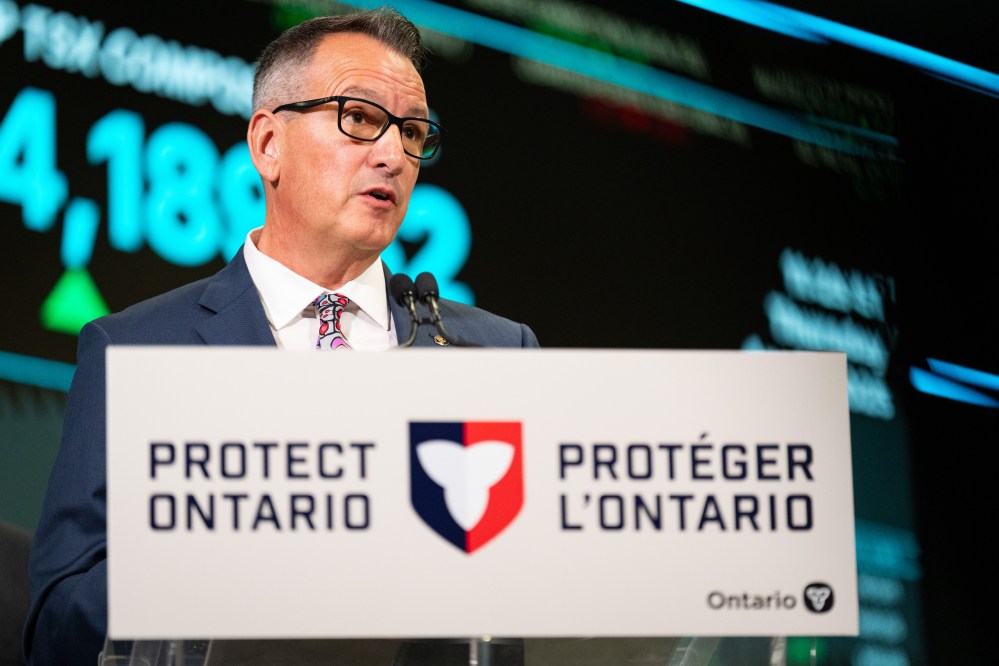
TORONTO – Ontario is set to move parts of the province’s northwest region to permanent daylight time in order to align with Manitoba, Indigenous Affairs Minister Greg Rickford told The Canadian Press.
Rickford said there is overwhelming consensus among municipalities, First Nations and businesses to make the time change permanent.
The province intends to make a regulatory change in the Time Act on Nov. 1 to allow regions west of the 90th meridian to align with Manitoba, he said.
Manitoba Premier Wab Kinew announced last month the province would stop twice-annual clock changes and stay on daylight time year-round in the central time zone, leaving it one hour ahead of the other Prairie provinces rather than aligned with them.
“That put northwestern Ontario, who sits in the central standard time zone, in a bit of a spot, to say the least,” Rickford said.
The province had three options, he said.
One, the northwestern region could shift to eastern time to align with the rest of the province. Two, they could continue on with time changes, but then they’d be out of step with the rest of Ontario and Manitoba.
“The other option … we took by unanimous consensus, was to not change our clocks and go to what I’m calling Wab Kinew time,” Rickford said.
Much of the province’s northwest jumped into action after Kinew’s announcement to figure out a way forward. Rickford said the province reached out to municipalities, businesses and First Nations to get their thoughts.
“What ended up coming back was overwhelmingly unanimous, 90 to 94 per cent from every survey,” he said.
New Democrat Sol Mamakwa, who represents the riding of Kiiwetinoong that is home to the majority of Ontario’s remote, fly-in First Nations, also helped figure out a way forward.

“After having brought the voices of our communities across the northwest to the table, we are happy the advocacy to observe daylight savings will be implemented permanently,” Mamakwa said in a statement.
“We are proud of our collaborative efforts to deliver what works for the North. We thank everyone who reached out and shared their thoughts on this important decision.”
British Columbia said in March that it was moving to permanent Pacific daylight time.
Alberta also switched to permanent daylight time this year in what it calls Alberta time, which means it now has the same time as Saskatchewan year round.
This report by The Canadian Press was first published Oct. 13, 2026.
Related Articles
Manitoba premier says time changes are officially over with proclamation signing




Advertisement Advertise With Us
Advertisement Advertise With Us